Traveling by train in France can be significantly cheaper than flying—but only when a direct rail link is available. This is the conclusion of a new study published by French consumer advocacy group UFC-Que Choisir, which compared the lowest available prices on 48 of the country’s busiest domestic air routes.
According to the report, train fares are on average 40% cheaper than airfares when a direct rail connection is available.
However, when travelers must make one or more transfers, train prices actually rise—becoming 10% more expensive than flying. The lack of seamless rail options across French regions leads to a near doubling of average fares: €113 for non-direct routes, compared to €64 for direct ones.
One striking example is the rail route between Nantes and Marseille, where the cancellation of a direct rail service in 2020 coincided with an 11% increase in air traffic. The route now sees more than 400,000 air passengers annually, making it France’s leading domestic air corridor.
France-Europe rail fare on average 2.5 times more expensive than an air fare
The disparity is even more pronounced on international routes. A forthcoming report by Greenpeace, covering 21 popular France-Europe travel corridors, found that rail tickets are on average 2.5 times more expensive than air when weighted by passenger volumes. For example, on the Paris–Rome route, airfares average €70, while the equivalent rail fare can reach €210.
Greenpeace also found extreme pricing gaps on some days: a €15 flight from Marseille to London, while the cheapest train ticket was €188.
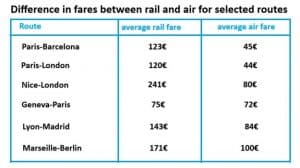
Environmental think tank Carbone 4 analyzed costs for the Paris–Barcelona route and attributed the imbalance to two main structural issues:
-
Tax breaks for airlines, including exemptions from kerosene tax and 0% VAT on international flights, which effectively subsidize air travel by €30–€40 per passenger.
-
High rail tolls, which account for over half of SNCF’s operating costs on certain cross-border lines.
The Climate Action Network is now calling for a rollback of aviation tax exemptions (excluding overseas territories) and a redirection of funds toward rail improvements. Their proposal would finance three key initiatives:
-
A subsidized annual round-trip train ticket at €29 per person, updating the 1936 “vacation ticket” introduced by France’s first socialist government called “Front Populaire”.
-
A revival of night train services, focusing on under-served regional and international routes (e.g. Marseille–Nantes, Paris–Barcelona).
-
Reduced rail tolls for TGV services, particularly on international and cross-regional lines.
As the climate crisis intensifies and public scrutiny of carbon-intensive travel grows, campaigners argue that pricing structures must better reflect environmental impacts—and that rail must be made both affordable and accessible across France and Europe.