Berlin’s long-awaited plan to bring the landmark International Congress Center (ICC) back to life has reached a decisive stage, with the operators behind Leipzig’s renowned Spinnerei arts complex emerging as the leading candidate to take over and manage the vast venue.
According to German media reports, the consortium linked to the Leipzig Spinnerei creative hub is now the sole remaining bidder in Berlin’s competition to redevelop and operate the ICC, one of Europe’s largest and most recognizable congress centers.
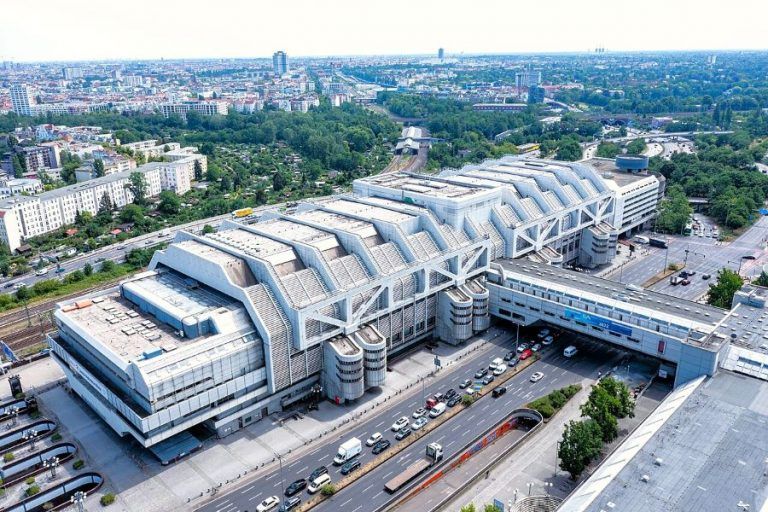
The futuristic ICC, often referred to as Berlin’s “spaceship,” opened in 1979 and was once among Europe’s premier conference venues – welcoming among others the travel show ITB Berlin. Its space-style interior design with its neon lights, its silver-clad external walls evoking robots gave the center its iconic identity. The structure is a listed monument since 2019.
 The 49h ICC was an event which opened the vacant structure during the Open Monument Day 2025 (Photo: https://convention.visitberlin.de/en/newsroom/blog/49h-icc)
However, it has stood largely vacant since 2014 after being closed due to asbestos contamination and the need for extensive modernization. Since then, the building has only been used occasionally for cultural events and exhibitions. Twelve years of abandonment have also left their mark on the exterior of the ICC with numerous traces of rust and graffiti.
Berlin launched an international competition in late 2024 to find an investor and operator capable of transforming the 313-meter-long landmark into a sustainable destination for culture, innovation, technology and events. The city plans to retain ownership of the site while granting a 99-year leasehold agreement to the selected operator.
More than a convention center
The proposed vision for the ICC goes far beyond simply reopening a convention center. Berlin officials want the building reinvented as a globally significant hub for arts, culture, creative industries, innovation and technology, while also hosting congresses and major events. The redevelopment package includes adjacent land parcels and parking structures that could be used to support the project financially.
The involvement of the Leipzig Spinnerei operators has generated particular interest. The Spinnerei, a former cotton mill in Leipzig transformed into one of Europe’s leading contemporary art and creative districts, is widely regarded as a model for successful industrial regeneration and cultural placemaking. Observers see parallels between that transformation and Berlin’s ambitions for the ICC.
A final recommendation on the ICC operator is expected to be presented by Berlin authorities this week, following a lengthy evaluation process. If approved, the project could mark the beginning of one of Germany’s most ambitious cultural and tourism redevelopment schemes, restoring a globally recognized architectural icon while creating a major new attraction for visitors and residents alike.