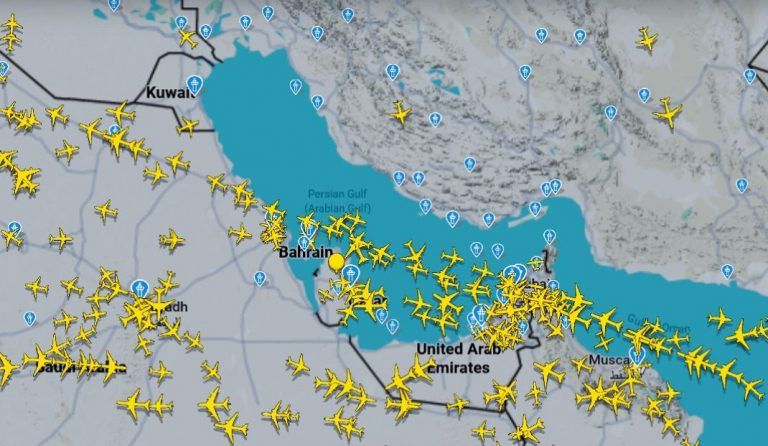
London Heathrow Airport continued to record growth in March despite the Gulf War. In parallel, the airport’s management is supporting airlines and passengers as they adjust to widespread airspace closures across the Middle East, which have triggered a 10% surge in transfer traffic through the hub.
While Heathrow has temporarily absorbed displaced demand, overall growth continues to lag behind EU competitors due to full runway slot capacity, limiting expansion opportunities.
The airport recorded year-on-year passenger growth in March, handling 6.6 million travelers (+6.9%) as demand shifted across its long-haul network. However, the outlook for the coming months remains uncertain amid the ongoing regional conflict, according to management.
Passengers trafic collapsed to the Middle East in March
By market, growth was led by Asia/Pacific and Africa. Asia/Pacific traffic jumped 31.1% to 1.1 million passengers in March, with year-to-date volumes reaching 3.0 million (+12.3%). Africa also saw strong growth, up 23.3% to 323,000 passengers, and 923,000 for the first quarter (+10.4%).
European traffic remained robust, with EU routes accounting for 2.23 million passengers (+11.6%) in March and 5.9 million (+5.4%) year-to-date. Non-EU Europe added 483,000 passengers (+11.5%) in March and 1.38 million (+5.8%) for the quarter.
North America handled 1.6 million passengers (+6.8%) in March, totaling 4.2 million (+3.2%) year-to-date, while Latin America posted more modest growth at 199,000 passengers (+3.8%), though remained down 1.5% for the quarter.
Middle East traffic was hardest hit, plunging 51.1% in March to 294,000 passengers, with year-to-date volumes down 12.7% to 1.8 million.
Domestic UK traffic reached 390,000 passengers (+4.3%) in March and 1.08 million (+2.1%) for the first three months of the year.
Overall, Heathrow handled 18.9 million passengers in Q1 2026 (+3.7%), while rolling 12-month traffic reached 85.1 million (+1.9%).
No impact on jet fuel supply… so far
Despite wider disruption, knock-on effects on global supply chains—including fuel—have not impacted Heathrow’s operations. The airport said it will continue to monitor developments closely while working with government and airline partners to safeguard passenger journeys.
The airport also marked a major milestone on March 25, celebrating 80 years since its first commercial flight, when Starlight departed for Buenos Aires. Since then, Heathrow has handled more than 2.9 billion passengers and supported nearly £300 billion in UK trade last year alone.
Heathrow CEO Thomas Woldbye said: “We’re doing everything we can to support airlines and passengers as travel trends shift during the Middle East crisis. While Heathrow’s long-haul network absorbed demand in March, the outlook for the next few months remains uncertain. I’m proud of what colleagues have achieved to quickly adapt and continue delivering great service during challenging times.”