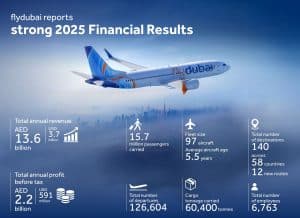
flydubai delivered another strong financial performance for its financial year ending December 31, 2025. The carrier reported a pre-tax profit of US$ 591 million while total revenue reached US$ 3.7 billion, up 6% compared to 2024. Profit after tax stood at US$ 531 million, reflecting the strength of its strategic network expansion, continued investment in innovation, enhancements to its customer experience, and a sustained commitment to serving underserved markets.
Commenting on the airline’s financial results, Sheikh Ahmed bin Saeed Al Maktoum, Chairman of flydubai, said: “flydubai’s achievements align closely with Dubai’s broader economic vision, where aviation remains a cornerstone of Dubai’s growth strategy. Reporting its fifth consecutive year of strong profitability is a clear testament to flydubai’s disciplined strategy and operational resilience.
The carrier successfully leveraged Dubai’s position as a leading global aviation hub, enabling it to capture strong, sustained passenger demand. By connecting the city to more than 100 underserved markets, flydubai has helped attract more visitors and reinforce Dubai as a gateway for trade, tourism, and opportunity,” he added.
15.7 million passengers to 140 destinations
The airline carried a record 15.7 million passengers in 2025, driven by sustained demand for both business and leisure travel across its network. Business Class demand was particularly strong, with uptake increasing by 19% compared with 2024.
Increased frequencies and the expansion of its network across key markets further supported passenger growth, with the Middle East recording a 17% increase, followed by Africa at 12% and Europe at 12%. flydubai enhancing operational efficiency remained a strategic priority, with on-time departure performance across the network improving by 6% compared with 2024.
While flydubai connects 140 airports in 58 countries to Dubai, the airline continued to ramp up operations to meet increasing travel demand to and from the United Arab Emirates.
Last year, the carrier operated 126,604 flights, the second-highest number of flights serving the country. It also added 9 new destinations to its network. They included Al Alamein (Egypt); Antalya (Türkiye); Bushehr and Qeshm (Iran); Iași (Romania); Nairobi (Kenya); Peshawar (Pakistan); Riga (Latvia); and Vilnius (Lithuania). The carrier also resumed operations to three destinations: Chișinău (Moldova), Damascus (Syria), and Tabriz (Iran).
The strategic partnership between Emirates and flydubai enabled more than 2.5 million passengers to enjoy seamless connectivity across a joint network of 243 destinations in 103 countries via Dubai’s global aviation hub in 2025. The carrier also signed 11 new interline agreements, expanding its portfolio to 42 interline partners.
Improved customers’ experience
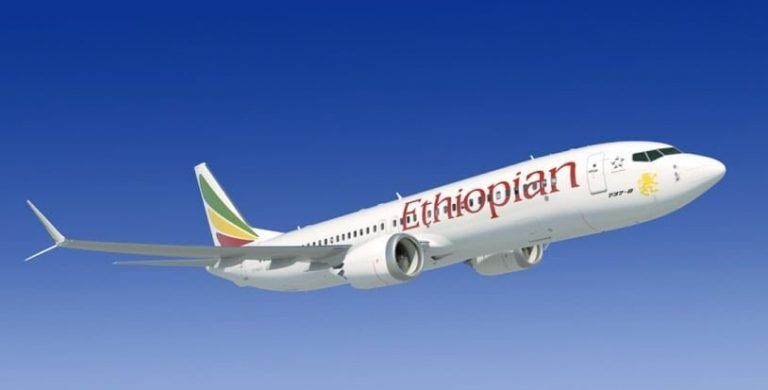
flydubai took delivery of 12 Boeing 737 MAX 8 aircraft, expanding its fleet to 97 aircraft with an average age of 5.5 years. The Boeing 737 MAX remains central to flydubai’s operational efficiency strategy, delivering 14% greater fuel efficiency than its predecessor.
The airline also finalized its retrofit program, retrofitting eight Next-Generation Boeing 737-800 aircraft and bringing the total number of retrofitted aircraft in the fleet to 25. This is part of the carrier’s ongoing efforts to enhance product consistency and deliver a more cohesive travel experience for passengers in both Business and Economy Class.
In November 2025, the carrier enhanced its Economy Class offering across all flights, introducing meals and inflight entertainment for all Economy Class fares. This milestone marks a significant evolution of the airline’s business model, underscoring its commitment to putting customers first and responding to dynamic market needs.
flydubai also signed an agreement to introduce complimentary high-speed Starlink inflight connectivity across its fleet from 2026, further elevating the onboard experience.
Outlook for 2026
Ghaith Al Ghaith, Chief Executive Officer at flydubai, commenting on the outlook for 2026, said: “As we look ahead to 2026, demand for travel remains healthy despite ongoing challenges. The fundamentals of our business are strong, and we are well positioned to meet this sustained appetite for both leisure and business travel across our network.
Our focus remains firmly on laying the foundations for future growth. We are prioritizing investment in AI-driven technologies, enhancing our processes through greater digitization, and continuing to develop our people, while keeping our customers at the center of everything we do.
We expect to take delivery of 12 aircraft in 2026, subject to manufacturer schedules. Seven of these will be Boeing 737 MAX 9 aircraft, increasing our Business Class capacity, and five will be Boeing 737 MAX 8 aircraft. We will also add frequencies across selected routes and continue to evaluate new growth opportunities, including the launch of Bangkok later this year, which will mark an important gateway into Southeast Asia.”