For over 25 years, Bavaria’s most iconic royal castles—Neuschwanstein, Herrenchiemsee, Linderhof, and the lesser-known Königshaus am Schachen—have long dreamed of their inscription on UNESCO’s World Heritage List. Since July 15, it has turned into a reality.
Bavaria’s Minister of Tourism, Michaela Kaniber, praised the decision by UNESCO to designate the Bavarian royal castles as World Heritage Sites. “What a historic moment! UNESCO decision that Neuschwanstein, Herrenchiemsee, Linderhof, and the Royal Lodge at Schachen are now part of the World Heritage of Humanityfills us in Bavaria with deep joy, immense pride – and a clear awareness of our responsibility,” she declared.
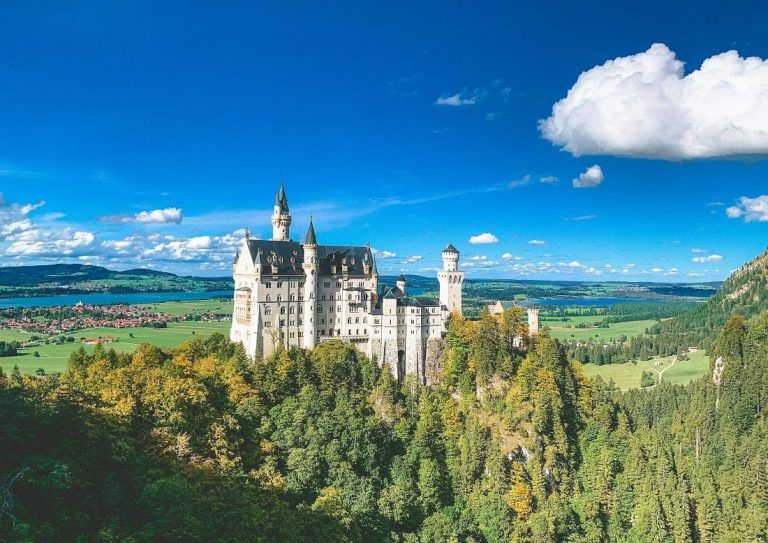
While many saw the move as long overdue, it also felt like a formality: these palaces have long held legendary status in the public imagination. Neuschwanstein – world-famous, widely photographed, and admired countless times – is far more than just a Bavarian castle. It epitomizes on a global scale romantic Germany. It inspired Walt Disney’s fairy-tale castle and has found its way into the dreams of millions of children and adults around the world.
Built by King Ludwig II, the so-called “Fairy Tale King”, Neuschwanstein Castle draws around 1.5 million summer visitors annually. Herrenchiemsee is a faithful copy of Versailles castle in France. However, in contrary to its model, the castle’s setting is the Bavarian Alps and the beautiful Chiem Lake. The castle attracts an estimated 400,000 visitors per year.
Designed as a private refuge, not a public museum, Ludwig II had indeed no intention of sharing his dreamed properties. In fact, he even ordered his castles to be destroyed after his death. Fortunately, nobody fulfilled his plea…
Balancing fame and sustainability
UNESCO official recognition will further strengthen their international appeal – and that presents a wonderful opportunity for tourism in Bavaria and all of Germany.
Minister Kaniber noted the millions of annual visitors and emphasized that the designation enhances Bavaria’s international tourism appeal. She however stressed the responsibility to protect these cultural landmarks through sustainable tourism and thoughtful preservation for future generations.
This popularity comes at a cost. Over the past three decades, Bavaria has invested millions to maintain the sites. The State spent €43 million into Neuschwanstein. While in Linderhof, it provided nearly €59 million to restore the artificial Venus Grotto. The castle is also a technological wonder. It has 19th-century high-tech wonders like electricity, flushing toilets, and even early telephone systems.

Neuschwanstein total number of visitors already capped
With the new UNESCO status comes not just prestige, but the need for sustainable tourism management. Yet for the overcrowded Neuschwanstein, further optimization may be near impossible. The castle already runs up to 120 timed tours a day, guiding as many as 8,000 visitors with military-style precision.
Visitor numbers were however capped during recent restoration work. Post-renovation, the castle will now allow only 45 visitors per group on a permanent basis to mitigate the impact of heavy foot traffic on the structure. Authorities are likely to introduce similar measures in Herrenchiemsee and Linderhof. In a bid to preserve those architectural marvels.