
“Glowcations”, “romantasy”, “destined-ations”: how Booking.com see travel trends in 2026

Booking.com’s latest Travel Predictions report paints a clear picture of where global travel is heading in 2026: firmly toward the individual.
In its tenth edition, based on a survey of nearly 30,000 travelers across 33 countries, the study shows travelers moving away from standardized experiences and embracing trips that reflect their personalities, values, curiosities, and life moments. Travel, the report suggests, is becoming less about ticking off destinations and more about self-expression.
At the heart of the findings is the rise of ultra-personalized journeys, enabled by technology and driven by a growing desire to travel “as yourself, for yourself.” Travelers are increasingly willing to experiment, whether that means stepping into fantasy worlds inspired by books and films, testing personal relationships under pressure, or designing trips around skin care routines, astrology, or nostalgia.
Individuality shapes 2026 trends
One of the standout trends is the emergence of “romantasy retreats,” where popular fantasy genres inspire immersive travel experiences. Enchanted castles, medieval banquets, role-playing weekends, and destinations tied to fictional worlds are gaining traction, with more than seven in ten travelers expressing interest. Technology, particularly AI, is expected to play a key role in matching travelers with storybook settings and cinematic locations that bring imagination to life.
Technology also underpins the rise of “humanoid homes,” futuristic vacation rentals enhanced by robotics. From cleaning bots to robotic chefs and smart sustainability systems, travelers are increasingly open to tech-driven comfort and novelty. For many, the appeal lies not just in convenience, but in the experience of staying somewhere that feels cutting-edge and memorable.
Relationships, too, are being redefined through travel. The report highlights a trend dubbed the “turbulence test,” where trips are used to evaluate compatibility with partners, friends, or colleagues – an idea which finds its roots in reality shows. Remote destinations, role-reversal itineraries, and constraint-based travel are becoming ways to assess adaptability and teamwork. This is particularly true among Gen Z travelers, who are the most willing to experiment with unconventional travel dynamics.
Souvenirs are also evolving. Instead of mass-produced trinkets, travelers are gravitating toward “shelf-ie souvenirs”: design-led kitchenware and edible items that double as décor and cultural storytelling. These items allow travelers to relive destinations at home, blending aesthetics, sustainability, and craftsmanship.
The classic road trip is undergoing a transformation as well. In 2026, shared journeys, carpooling, and AI-assisted routing are reshaping road travel into a more social, flexible experience. Younger travelers are especially open to using technology to find companions, map scenic routes, and explore off-the-beaten-path destinations, turning the road itself into a space for connection.
Spirituality is also influencing travel choices more openly. In 2026, the stars won’t just inform horoscopes and star signs, they will also shape travel plans. Booking.com calls this trend “Destined-ations”, travel written in the stars. Astrology, moon phases, and mystical beliefs are guiding when and where people travel. Many willing to adjust plans based on horoscopes or spiritual advice. For younger generations in particular, travel is increasingly tied to personal alignment and self-discovery.
Wellness travel is on the rise with “glow-cations,” trips centered on skin health and recovery. These experiences blend high-tech diagnostics, personalized treatments, sleep optimization, and traditional rituals, reflecting a broader shift toward hyper-customized wellness. Nearly 80% of travelers are open to booking a dedicated glow-cation featuring multiple skin-specific treatments.
At the opposite end of the spectrum, many travelers are seeking quiet. “Hushed hobbies” such as birdwatching, fishing, foraging, and insect spotting are gaining popularity as travelers look for calm, nature-based experiences that counter over-stimulation. Even here, technology plays a subtle supporting role, helping identify species or plan seasonal activities.
Nostalgia-driven travel, labeled “PastPorts,” rounds out the trends. Advances in AI and mapping are enabling travelers to retrace personal memories, recreate old photographs, and explore ancestral roots, turning emotional connections into destinations.
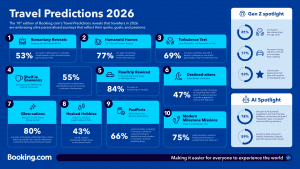
Finally, the report underscores a shift in why people travel at all. Modern milestone trips are no longer tied solely to traditional life events. Instead, travelers are celebrating personal achievements, transitions, and even small wins, using travel as a reward and affirmation of identity.
Taken together, Booking.com’s 2026 Travel Predictions suggest a future where travel is less about following trends and more about creating meaning—deeply personal, unapologetically individual, and shaped by both technology and emotion.


newadmin






















Vegas’s Billion-Dollar Secrets – What They Don’t Want Tourists to Know

Visit Florida’s New CEO Bryan Griffin Shares His Vision for State Tourism with Graham

Chicago’s Tourism Renaissance: Graham Interviews Kristin Reynolds of Choose Chicago

Graham Talks with Cassandra McCauley of MMGY NextFactor About the Latest Industry Research

Destination International’s Andreas Weissenborn: Research, Advocacy, and Destination Impact

Graham and Don Welsh Discuss the Success of Destinations International’s Annual Conference

Graham and CEO Andre Kiwitz on Ventura Travel’s UK Move and Recruitment for the Role

Brett Laiken and Graham Discuss Florida’s Tourism Momentum and Global Appeal

Graham and Elliot Ferguson on Positioning DC as a Cultural and Inclusive Global Destination

Graham Talks to Fraser Last About His England-to-Ireland Trek for Mental Health Awareness

Kathy Nelson Tells Graham About the Honour of Hosting the World Cup and Kansas City’s Future

Graham McKenzie on Sir Richie Richardson’s Dual Passion for Golf and His Homeland, Antigua







 ADS PRO
Phocuswright reveals the world's largest travel markets in volume in 2025
Higher departure tax and visa cost, e-arrival card: Japan unleashes the fiscal weapon against tourists
Singapore to forbid entry to undesirable travelers with new no-boarding directive
Cyclone in Sri Lanka had limited effect on tourism in contrary to media reports
Euromonitor International unveils world’s top 100 city destinations for 2025