
New destination may rival Dubai
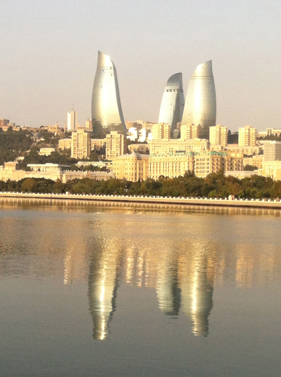
Oil rich Caspian Sea destination goes for tourism growth but why?
This Silk Road destination has pretty much everything including a massive harvest of fruit and veg and wine, bags of culinary style and cultural heritage, a lovely sea in which the world’s most valuable fish swim PLUS the world’s first major oil economy that stretches back to the 19th century and forward to the 22nd – but does it really need tourism?
From a cultural point of view, it’s not for nothing that the country is branded as "Land of Fire" – the Zoroastrians travelled to Azerbaijan somewhere in the first millennium BC and created their fire temples all over. Even after Soviet depredations – you can still see some with flames fuelled by gas now, rather than natural gas straight from below.

SEE VIDEO INTERVIEW IN FIRE TEMPLE
And Azerbaijan was so taken with the religion that the major Zoroastrian Persian festival – Nowruz is still celebrated as the Azeri National Day. Azerbaijan actually means "Protector of Fire"
So, stand by for major pilgrimages of other fire-worshippers from all over the world. And you’d be surprised just how widespread this religion’s diaspora is since they left Persia 1,000 years or so ago.
Famous Parsees included Freddy Mercury, Zubin Mehta, Rohinton Mistry and the massively wealthy and talented Tata family.
And, apart from the Zoroastrians and the Silk Road travelers bringing ideas and cultures to this intriguing land, Azerbaijan is also famous for its exquisite hand-woven carpets. Here, too, carpets are a lifestyle, lifelong issue – the Azeris say you are born on a carpet, you receive your guests on a carpet and you are buried in one too. Interestingly, it’s now possible to get an export licence for a fabulous new carpet but for an old one? That’s another matter!
From a cultural and historical aspect Azerbaijan’s oil wealth is a fascinating issue too. Although there is evidence of oil being used as far back as the 3rd century – it really came into its own in the latter stages of the industrial revolution.
The massive amounts of easily accessible oil and the ready markets of countries gearing up for industrial capacity and the Great War – made dozens of Baku billionaire oil barons and a really wealthy, architecturally stunning capital city of Baku. Interestingly three of the first prospectors to get rich were Alfred, Ludvig and Robert Nobel who used the wealth created to begin their munitions business – the funding source of the global prize.
By 1901 Azerbaijan produced more than half of the world’s oil.
The country’s other main claims to fame are its food, hospitality and long living villagers.

After the ‘Flavours of the Silk Road’ food event, venturing off to a village full of centenarians, we stopped in a village hostelry and were confronted with a massive heaving table. It was laden with dozens of dishes including perfectly cooked local lamb created in a number of ways barbequed, roast, with dried fruits. and with pomegranate sauce; Caspian salmon; a massive platter of the Azerbaijani version of the Silk Road staple – saffron-scented Plov; delicious chicken kebabs and beef shashliks; a variety of different prime vegetables and peppers and spicy condiments including saffron and sumac.
Naturally local fruits and nuts and dates and figs, local wines and cherry and raspberry juices completed the spread.
After this feast, there was a feast for the eyes and senses, at a riverbank teahouse in a glade of pomegranates; we enjoyed local black tea with a range of local jams and sweet delicacies.

Future centenarians in Lankaran
And at the village famous for its centenarians just outside of Lankaran (twinned with Monterey CA by the way) – the happiness of the old people and their hospitality was touching. More good food – home made butter and bread, yoghurt and cheese. Clearly the secret of longevity is not being abstemious!
Back in Baku – the rich Caspian-side capital of the country, wealth is palpable. The old walled city is beautifully kept – not a bit of litter anywhere, but outside in Baku’s 19th, 20th and 21st century boulevards the throbbing heart of a wealthy modern metropolis beats to the tune of hordes of SUVs.
The skyline and the corniche is astounding, modern architecture at its blatant best – buildings with night-time light shows, staggering skyscrapers and towers – all the way to the sea port and the Crystal Hall created in just eight months.
As far as tourism is concerned, the country has set its sights on Dubai and already there are over 3500 five star rooms with all the top brands in Baku and building has started on the local version of the Palm – the Khazar islands are set to provide residences for a million people, and even a Formula 1 racetrack.
But Azerbaijan has one trump card – its gloriously fertile land. Here you can experience 9 of the world’s 11 climates – producing a fabulous harvest of food and wine and oil. And it’s already set to produce much more, its oil production is still increasing.
With all this wealth, does it really need tourists too?
A clue to the answer is perhaps Baku’s International Jazz Festival. It’s a little known fact that Azeris are absolutely ‘sent’ by jazz – they have been big aficionados since the 1920’s with, even, their own style (a blend of Jazz and Azeri music). And, even when jazz went underground in the Soviet era, Azeris supported it.
But for great jazz, you need a great party, and for a great party you need great guests – could this be the real reason for Azerbaijan’s tourism drive?
Valere Tjolle
CLICK HERE FOR SUSTAINABLE TOURISM SPECIAL OFFERS


Valere



















Vegas’s Billion-Dollar Secrets – What They Don’t Want Tourists to Know

Visit Florida’s New CEO Bryan Griffin Shares His Vision for State Tourism with Graham

Chicago’s Tourism Renaissance: Graham Interviews Kristin Reynolds of Choose Chicago

Graham Talks with Cassandra McCauley of MMGY NextFactor About the Latest Industry Research

Destination International’s Andreas Weissenborn: Research, Advocacy, and Destination Impact

Graham and Don Welsh Discuss the Success of Destinations International’s Annual Conference

Graham and CEO Andre Kiwitz on Ventura Travel’s UK Move and Recruitment for the Role

Brett Laiken and Graham Discuss Florida’s Tourism Momentum and Global Appeal

Graham and Elliot Ferguson on Positioning DC as a Cultural and Inclusive Global Destination

Graham Talks to Fraser Last About His England-to-Ireland Trek for Mental Health Awareness

Kathy Nelson Tells Graham About the Honour of Hosting the World Cup and Kansas City’s Future

Graham McKenzie on Sir Richie Richardson’s Dual Passion for Golf and His Homeland, Antigua







 ADS PRO
Global tourism exceeds 1.5 billion travelers announces UN-Tourism
Qatar Airways offers reduced timetable to over 60 destinations
WTTC global tourism reached record economic impact of 11 trillion in 2025
Hands In, UATP join forces for airline multi-card payments
Overseas travelers to the United States declined by 2.5% in 2025