
Colombia spells hope for coral reefs but danger too
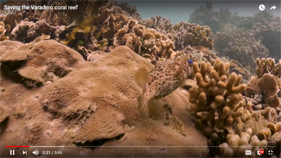
SEE THE GLORIOUS VIDEO OF THIS REEF
Enigmatic Varadero reef has survived the odds but a quarter of it may be destroyed by shipping
Just off the shore of the city of Cartagena, home of one of Colombia’s biggest ports, lies a coral reef that campaigners are furiously battling to protect.
The Varadero reef, located in Cartagena Bay, has survived against the odds to thrive in a highly polluted environment. The Caribbean Sea bay, a major waterway for shipping vessels and cruise ships, is contaminated by industrial and sewage waste.
Shipping businesses are planning to expand the canal’s Bocachica Channel and build another passageway straight through the reef, meaning a quarter of it will be destroyed and the remainder threatened.
According to marine biologists, the reef should not be alive, and yet it has flourished, providing a home to a large number of coral, fish and urchin species.
A report, written in 2017 by scientists, said the reef was "improbable and imperiled".
Despite the close proximity of the reef to Cartagena’s one million-odd inhabitants, it remained concealed for so long due to the perception that the environment was too hostile for any reef to survive. Ninety percent of other reefs in the area are dead.
"Current plans to dredge part of Varadero … could hinder researchers’ ability to gain insight into the factors that have allowed corals to thrive under such unusual conditions," the report added.
With further study, scientists hope the enigmatic reef could provide clues to recovering the world’s bleached and dying corals.
In the past four decades, Caribbean reefs have seen their coral cover decrease from an average of 50% to 10%, but the report notes the Varadero reef has "high coral cover" of 45.1%.
"This reef is in an area in which the environmental conditions are, in theory, not the best for coral reefs: there is high sedimentation, and high sea surface temperatures," Valeria Pizarro, who discovered the reef in 2013 and co-authored the report, explains.
"The first time I dove at Varadero I was expecting to see few corals in a highly degraded reef," she recalls. "The surface is usually brown due to sediments, so I never expected to see a reef down there." The biologist recalled feeling "shocked" at the beauty of the reef.
"I didn’t understand how this reef hadn’t been discovered before. I couldn’t help but immediately think of the consequences a shipping channel would have."
Ms Pizarro hopes studying this reef can shed light how the coral has adapted to survive under these conditions.
Valere Tjolle


Valere




















Vegas’s Billion-Dollar Secrets – What They Don’t Want Tourists to Know

Visit Florida’s New CEO Bryan Griffin Shares His Vision for State Tourism with Graham

Chicago’s Tourism Renaissance: Graham Interviews Kristin Reynolds of Choose Chicago

Graham Talks with Cassandra McCauley of MMGY NextFactor About the Latest Industry Research

Destination International’s Andreas Weissenborn: Research, Advocacy, and Destination Impact

Graham and Don Welsh Discuss the Success of Destinations International’s Annual Conference

Graham and CEO Andre Kiwitz on Ventura Travel’s UK Move and Recruitment for the Role

Brett Laiken and Graham Discuss Florida’s Tourism Momentum and Global Appeal

Graham and Elliot Ferguson on Positioning DC as a Cultural and Inclusive Global Destination

Graham Talks to Fraser Last About His England-to-Ireland Trek for Mental Health Awareness

Kathy Nelson Tells Graham About the Honour of Hosting the World Cup and Kansas City’s Future

Graham McKenzie on Sir Richie Richardson’s Dual Passion for Golf and His Homeland, Antigua







 ADS PRO
Global tourism exceeds 1.5 billion travelers announces UN-Tourism
Qatar Airways offers reduced timetable to over 60 destinations
WTTC global tourism reached record economic impact of 11 trillion in 2025
Hands In, UATP join forces for airline multi-card payments
Overseas travelers to the United States declined by 2.5% in 2025