
Europe’s multi-billion-dollar megaprojects bogged down by 17-year average delays
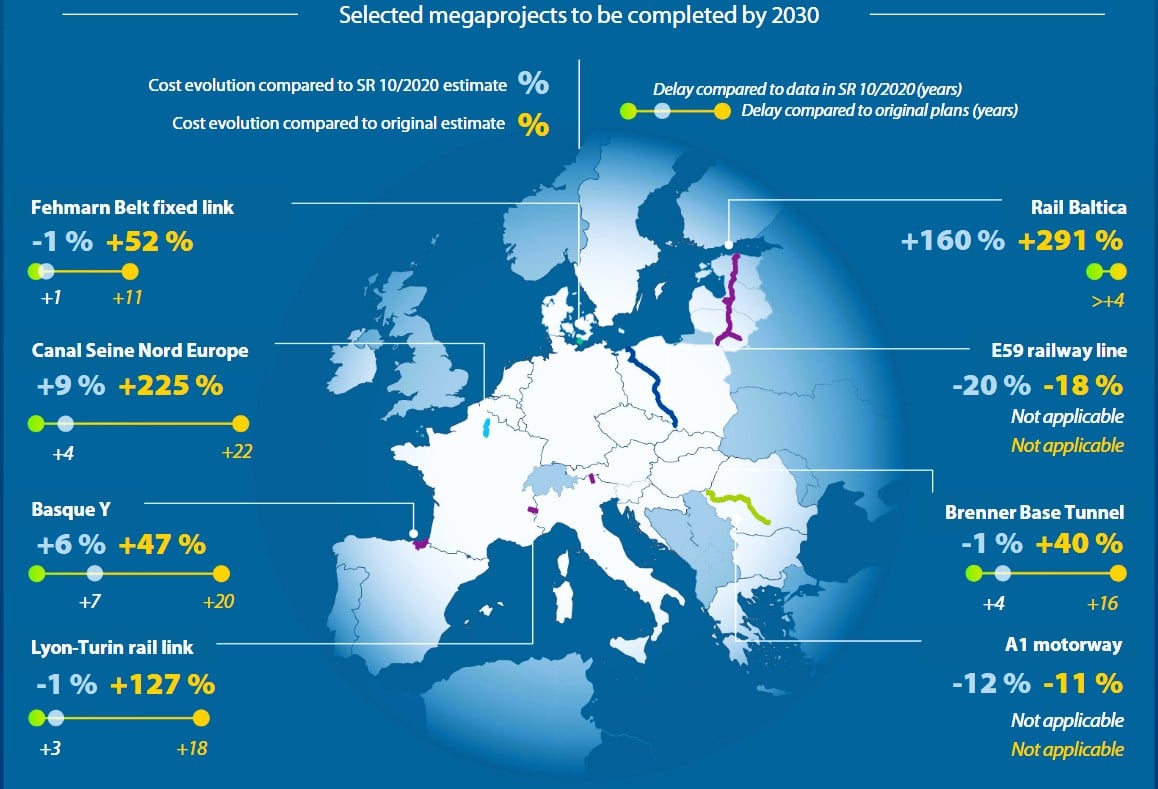
In the context of unforeseen multiple crises, the construction of Europe’s flagship transport infrastructure has been affected by rising costs and further delays in delivery.
This is the main conclusion of a new report by the European Court of Auditors (ECA), which updates the observations and findings of a similar audit carried out in 2020. As a result, EU auditors have revised their assessment of the 2030 target for completing the core Trans-European Transport Network (TEN-T), shifting from “unlikely to be met” five years ago to a clear “will not be met” today.
Given the importance of core cross-border transport corridors for European citizens and businesses, the European Union auditors have updated the key data and findings from their 2020 special report. The outlook in 2025 is worse than in 2020 and falls far short of what was initially envisioned. Since 2020, these megaprojects have faced additional challenges stemming from the COVID-19 pandemic and Russia’s war of aggression against Ukraine. New regulatory requirements and unexpected technical issues have also emerged.
“EU transport flagship infrastructure is supposed to reshape Europe, bringing people closer together and facilitating economic activity,” said Annemie Turtelboom, the ECA Member who led the update. “But three decades after most of these projects were designed, we are still far from cutting the ribbon and far from achieving the intended improvements in passenger and freight flows across Europe.”
Many megaprojects have been plagued by cost overruns. In 2020, EU auditors reported that the eight projects examined had experienced an overall real cost increase (net of inflation) of 47% compared with original estimates.
Today, that figure is almost double, at +82%. This increase has been driven by budget overruns in two projects: Rail Baltica, whose costs have surged by 160% over the past six years to nearly four times the original estimate, and the Lyon-Turin rail link, which has seen a 23% increase over the same period. It is more than double the initial projection. Although the pace of cost growth has slowed to +9% over the last six years, total construction costs for the Seine-Nord Europe Canal have tripled since the project began.
The eight megaprojects have collectively received an additional €7.9 billion in EU grants since the 2020 analysis, bringing total EU funding disbursed to €15.3 billion.
From 11 to 17 years delay on average
Regarding implementation schedules, EU auditors noted in their 2020 report an average delay of 11 years compared with original plans.
The 2025 update shows that the situation has worsened further. For the five megaprojects for which data is available, the average delay has now increased to 17 years. The Basque Y rail line, originally scheduled to be operational by 2010 and revised to 2023 in the 2020 plan, is now expected to be completed no earlier than 2030, with project promoters considering 2035 more realistic. The Lyon-Turin rail link is now projected to open in 2033, rather than 2015 as originally planned or 2030 under the 2020 schedule. The Brenner Base Tunnel is now expected to open in 2032 at the earliest, instead of 2016 or 2028 as previously anticipated. The Seine-Nord Europe Canal was initially set to begin operations in 2010; 2032 is now considered more likely. The conclusion is unequivocal: the 2030 target for completing the EU TEN-T core network will be missed.
Auditors expect the recent revision of the TEN-T Regulation to strengthen the European Commission’s role and authority in overseeing network completion. However, they stress that this will primarily affect future megaprojects. They also note that the impact of these changes will ultimately depend on whether the legal provisions are effectively implemented and respected by EU member states.
Special Report 02/2026, “EU transport infrastructure—Further delays and some cost increases, but a reinforced governance framework is in place for the future (an update of ECA Special Report 10/2020)”, is available on the ECA website, along with a one-page overview of key facts and findings.
The eight transport megaprojects comprise four rail projects (Rail Baltica, Lyon-Turin, Brenner Base Tunnel, Basque Y); one inland waterway (Seine-Scheldt); one highway (Romania’s A1), and two multi-modal connections (the Fehmarn Belt road-rail link and the E59 rail link to ports in Poland). These megaprojects directly involve 13 EU countries: Belgium, Denmark, Germany, Estonia, Spain, France, Italy, Latvia, Lithuania, Austria, Poland, Romania, and Finland.
Related News Stories: Egypt tourism Ethiopia's Grand Renaissance Dam to become also a new tourist ... Thailand's flagship high-speed airport rail project on the brink of ...


newadmin




















Vegas’s Billion-Dollar Secrets – What They Don’t Want Tourists to Know

Visit Florida’s New CEO Bryan Griffin Shares His Vision for State Tourism with Graham

Chicago’s Tourism Renaissance: Graham Interviews Kristin Reynolds of Choose Chicago

Graham Talks with Cassandra McCauley of MMGY NextFactor About the Latest Industry Research

Destination International’s Andreas Weissenborn: Research, Advocacy, and Destination Impact

Graham and Don Welsh Discuss the Success of Destinations International’s Annual Conference

Graham and CEO Andre Kiwitz on Ventura Travel’s UK Move and Recruitment for the Role

Brett Laiken and Graham Discuss Florida’s Tourism Momentum and Global Appeal

Graham and Elliot Ferguson on Positioning DC as a Cultural and Inclusive Global Destination

Graham Talks to Fraser Last About His England-to-Ireland Trek for Mental Health Awareness

Kathy Nelson Tells Graham About the Honour of Hosting the World Cup and Kansas City’s Future

Graham McKenzie on Sir Richie Richardson’s Dual Passion for Golf and His Homeland, Antigua







 ADS PRO
Higher departure tax and visa cost, e-arrival card: Japan unleashes the fiscal weapon against tourists
Singapore to forbid entry to undesirable travelers with new no-boarding directive
Euromonitor International unveils world’s top 100 city destinations for 2025
U.S.A. and Israel attacks on Iran impact air movements in the Gulf (Update 1.00pm CET)
Global tourism exceeds 1.5 billion travelers announces UN-Tourism