
FAO report: Global deforestation slows, although forests remain under pressure
While sustainability and environment issues are of utmost importance for people living on earth -and consequently for the travel industry- the Food and Agriculture Organization of the United Nations (FAO) released at the end of last year its Global Forest Resources Assessment 2025 (FRA 2025).
Released every five years, the 2025 edition of the report was published during the Global Forest Observations Initiative (GFOI) Plenary in Bali, Indonesia at the end of October 2025.
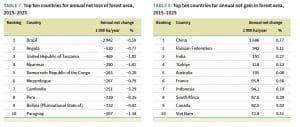
FRA 2025 covers 236 countries and areas. The assessment is the result of a country-driven process, with officially nominated national correspondents from 197 countries and areas contributing data, supported by more than 700 experts worldwide. It then shows among others the 10 top countries in terms of forest gains and losses.
Deforestation slowdown
Good news are that deforestation has slowed in all of the world’s regions in the last decade, according to the FAO. The 2025 edition of FRA contains the most up-to-date data on the world’s forests and how they are changing.
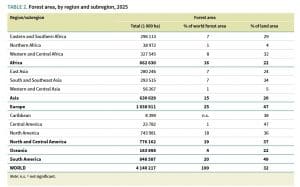
It reveals that the world has 4.14 billion hectares (ha) of forest, or 32 percent of total land area. Promisingly, the rate of deforestation is declining, although still high at nearly 10.9 million ha per year in 2015–2025. The pledges of 91 countries and areas reported to FRA 2025 to restore up to 190 million hectares of degraded forest in the next few decades are a great step in the right direction.
In addition to slowing deforestation rates, FRA 2025enf highlights further positive news for the world’s forests, which includes more than half of forests now covered by long-term management plans, and one fifth of forests now being within legally established protected areas.
Forests are important for food security, local livelihoods and the provision of renewable biomaterials and energy. They are habitat for a large proportion of the world’s biodiversity, help regulate the global carbon and hydrologic cycles, and can reduce the risks and impacts of drought, desertification, soil erosion, landslides and floods.
FAO Director-General QU Dongyu, writing in the Foreword to FRA 2025, stated: “FRAs are the most comprehensive and transparent global evaluations of forest resources and their condition, management and uses, covering all the thematic elements of sustainable forest management. The data they produce serve multiple purposes, from informing the global community of the status of forests and their changes, to supporting decisions, policies and investments related to forests and the ecosystem services they provide.”
Key findings
- Forest extent: Forests cover 4.14 billion hectares, or 32 percent of the global land area, equivalent to 0.5 hectares per person. Nearly half of the world’s forests are located in the tropics.
- Net loss declining: The annual rate of net forest loss fell from 10.7 million hectares in the 1990s to 4.12 million hectares in 2015–2025.
- Deforestation and expansion: Deforestation slowed to 10.9 million hectares per year in 2015–2025, down from 17.6 million in 1990–2000. The rate of forest expansion also decreased, from 9.88 million hectares annually in 2000–2015 to 6.78 million in 2015–2025.
- Naturally regenerating forests: These account for 92 percent of total forest area (3.83 billion hectares). While they declined by 324 million hectares between 1990 and 2025, the rate of net loss slowed significantly. The most significant declines (within the last decade) took place in Africa and South America, while Europe registered an increase in naturally regenerating forests.
- Primary forests: Primary forests cover at least 1.18 billion hectares – about one-third of reported forest area. Losses continue, but the rate has halved compared with the early 2000s.
- Planted forests: Planted forests account for about 8 percent of total forest area, covering an estimated 312 million hectares. Their area has increased in all regions since 1990, but globally at a slower rate in the most recent decade.
- Biomass and carbon: The world’s forest growing stock is estimated at 630 billion cubic metres. Forest carbon stocks have increased, reaching 714 gigatonnes.
- Protected areas: About 20 percent of forests (813 million hectares) are in legally established protected areas, an increase of 251 million hectares since 1990.
- Management plans: More than half of forests worldwide (2.13 billion hectares, or 55 percent of total area) are under management plans, up 365 million hectares since 1990.
- Disturbances: Fire affects an average of 261 million hectares of land annually, nearly half of which is forested. In 2020, insects, diseases and severe weather damaged about 41 million hectares of forests, mainly in temperate and boreal regions.
- Ownership: Seventy-one percent of the world’s forests are publicly owned, 24 percent are privately owned, with the remainder under other or unknown ownership.
- Management objectives: Around 1.20 billion hectares (29 percent of forests) are managed primarily for production, and 616 million hectares for multiple use. Additional areas are designated for biodiversity conservation (482 million hectares), soil and water protection (386 million hectares), and social services (221 million hectares).
New features in FRA 2025
FRA 2025 offers expanded digital tools for easier access and use:
- An interactive online database with full data and metadata for 236 countries and areas.
- An application programming interface (API) enabling automated data access and integration.
- Country reports in PDF format, available in official languages of correspondence.


newadmin





















Vegas’s Billion-Dollar Secrets – What They Don’t Want Tourists to Know

Visit Florida’s New CEO Bryan Griffin Shares His Vision for State Tourism with Graham

Chicago’s Tourism Renaissance: Graham Interviews Kristin Reynolds of Choose Chicago

Graham Talks with Cassandra McCauley of MMGY NextFactor About the Latest Industry Research

Destination International’s Andreas Weissenborn: Research, Advocacy, and Destination Impact

Graham and Don Welsh Discuss the Success of Destinations International’s Annual Conference

Graham and CEO Andre Kiwitz on Ventura Travel’s UK Move and Recruitment for the Role

Brett Laiken and Graham Discuss Florida’s Tourism Momentum and Global Appeal

Graham and Elliot Ferguson on Positioning DC as a Cultural and Inclusive Global Destination

Graham Talks to Fraser Last About His England-to-Ireland Trek for Mental Health Awareness

Kathy Nelson Tells Graham About the Honour of Hosting the World Cup and Kansas City’s Future

Graham McKenzie on Sir Richie Richardson’s Dual Passion for Golf and His Homeland, Antigua







 ADS PRO
Phocuswright reveals the world's largest travel markets in volume in 2025
Higher departure tax and visa cost, e-arrival card: Japan unleashes the fiscal weapon against tourists
Singapore to forbid entry to undesirable travelers with new no-boarding directive
Cyclone in Sri Lanka had limited effect on tourism in contrary to media reports
Euromonitor International unveils world’s top 100 city destinations for 2025