
How do you find an extra few thousand billion? Simple – refocus: revalue environmental assets and rebrand economy
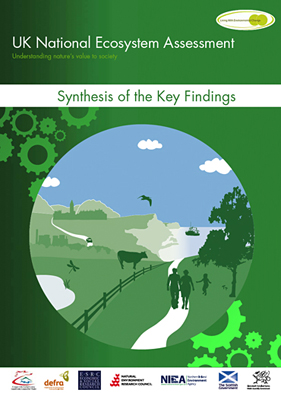
New reports revalue nature and forecast refocused UK economy with new sustainable industries: ideal setting for green tourism
The National Ecosystem Assessment, carried out by 500 experts in ecology, economics and social sciences, provides a “new way of estimating our national wealth”, said Lord Selborne, chairman of the UK government’s Living with Environmental Change partnership. “It shows how we have undervalued our natural resources.”
The Department for Environment, Food and Rural Affairs said the report “strengthens the arguments for protecting and enhancing the environment and will be used by the government to direct policy in future”.
The findings would shape the forthcoming natural environment white paper, said Caroline Spelman, the environment secretary.
The assessment examines the services provided by nature across Britain’s eight main habitats, from cities and farmland to woodland and moorland.
It finds that a fifth of these services are improving with time; they include climate regulation by woodlands and crop production on farmland.
A “nature at work” scenario, promoting biodiversity and varied landscapes, produces a loss of £510m a year in farm incomes – but an overall gain of £33bn a year through increased recreation and other green space values.
Bob Watson, Defra chief scientist, said “The higher-level stewardship scheme for farm payments under the Common Agricultural Policy is already very successful in enabling the landowner to capture some of these values,” said Prof Watson.
A second report published last week visualizes the UK’s business map redrawn by emerging industries and processes during the coming decade, offering a brighter future after a painfully slow economic recovery.
The UK, it says, can achieve a “renaissance in manufacturing” based on new technologies by 2020. It expects Glasgow to be an international force in renewable energy, one of the “supercities” to capitalise on technologies or new ways of working.
Cities include Liverpool, Newcastle, Dundee and Glasgow. Others are Bristol (new materials and advanced manufacturing), Newcastle (scientific research), Leeds (financial services), Liverpool (cultural and branding industries), London (creative industries) and Brighton (“capital of the UK’s rebellious, alternative economy”).
With the economy flat and spending cuts biting, the research, by HSBC and The Future Laboratory, indicates that developing next-generation industries has never been more important.
Digital communications biotechnology and low-carbon industries provide the best growth prospects, finds a survey of 500 entrepreneurs and small businesses.
The authors expect new industries from wave energy and solar farms to electronic paper and cybersecurity – to advance strongly. They think the high-tech trend will mean manufacturing’s return to the UK from overseas.
Lynda Gratton, professor at London Business School, said: “We will see the rise of clusters of industries that the UK excels in. The UK already has a track record in sectors such as creativity, renewable energy and medicine, so it is incredibly well-positioned…”
Jim Whyte of The Future Laboratory said Bristol would lead the rebalancing. “Bristol’s tradition of high-tech production within aerospace and information and communications technology means it is ideally placed to benefit. New world-leading research centres into materials science and pioneering research at Bristol university will only add to the city’s repertoire.”
The report sees regenerative healthcare driving half a dozen clusters including Edinburgh, York and Nottingham. Plastic electronics – printing circuits on various surfaces – is emerging in Durham, Cambridge, Swansea and London.
It sees a space cluster at the UK Space Agency in Oxfordshire and clusters of photonics – transmitting information by light – in Strathclyde, West Midlands, the Cotswolds, the Thames Valley and Southampton.
It is only a question of time before tourism will become a key element in this rebranding process
Valere Tjolle
Valere Tjolle is editor of the Sustainable Tourism Report Suite – special offers HERE


Valere
















Vegas’s Billion-Dollar Secrets – What They Don’t Want Tourists to Know

Visit Florida’s New CEO Bryan Griffin Shares His Vision for State Tourism with Graham

Chicago’s Tourism Renaissance: Graham Interviews Kristin Reynolds of Choose Chicago

Graham Talks with Cassandra McCauley of MMGY NextFactor About the Latest Industry Research

Destination International’s Andreas Weissenborn: Research, Advocacy, and Destination Impact

Graham and Don Welsh Discuss the Success of Destinations International’s Annual Conference

Graham and CEO Andre Kiwitz on Ventura Travel’s UK Move and Recruitment for the Role

Brett Laiken and Graham Discuss Florida’s Tourism Momentum and Global Appeal

Graham and Elliot Ferguson on Positioning DC as a Cultural and Inclusive Global Destination

Graham Talks to Fraser Last About His England-to-Ireland Trek for Mental Health Awareness

Kathy Nelson Tells Graham About the Honour of Hosting the World Cup and Kansas City’s Future

Graham McKenzie on Sir Richie Richardson’s Dual Passion for Golf and His Homeland, Antigua







 ADS PRO
Higher departure tax and visa cost, e-arrival card: Japan unleashes the fiscal weapon against tourists
U.S.A. and Israel attacks on Iran impact air movements in the Gulf (Update 1.00pm CET)
Global tourism exceeds 1.5 billion travelers announces UN-Tourism
WTTC global tourism reached record economic impact of 11 trillion in 2025
Marginal increase for New York City tourism in 2025