
Vienna Airport is the largest air gateway in Central Europe with a passengers traffic of over 30 million. The airport success is built on its hub function for national carrier Austrian Airlines, strong competition of point-to-point airline and the strong appeal of Vienna for travelers around the world. In an exclusive talk at ITB Berlin, Joint CEO and COO Julian Jäger spoke about Vienna Airport’s perspectives in 2026 and beyond.
Last year was a very strong year for Vienna Airport. How do you see 2026 shaping up, especially with the ongoing conflict in the Middle East?
Julian Jäger: 2025 was an excellent year for us as we had a record year with 32.6 million passengers. For 2026 we expect around 30 million passengers, so slightly lower. The main reason is a reduction in capacity from low-cost carriers, which explains roughly two million fewer passengers. Regarding the conflict in the Middle East, it’s still too early to assess the full impact. At the moment, we are losing around 5,000 passengers per day due to flight cancellations. But whether this affects our full-year forecast depends largely on how long the conflict lasts. If resolved quickly, the impact will be limited. If it continues longer, it could affect our outlook. But we do not expect anything remotely comparable to the collapse in traffic we saw during Covid.
You do not forecast travel demand to collapse?
Julian Jäger: No, not at all. Travel patterns might shift instead. If people decide not to travel to certain long-haul destinations, they may simply travel elsewhere, perhaps within Europe. In fact, during the first two months of this year we saw strong demand for North America and East Asia, and we expect that to continue.
The USA is turning not that popular in many European countries. Have you noticed any slowdown from Vienna Airport to the United States?
Julian Jäger: Not so far. There may be slightly fewer Europeans traveling to the US, but demand from the US to Europe remains strong. Our airline partners have a clearer view of the booking data, but the first weeks of this year have shown solid development and we do not expect a major impact on transatlantic traffic.
Low-cost carriers appear to be reducing capacity. Is this linked to higher taxes and operating costs?
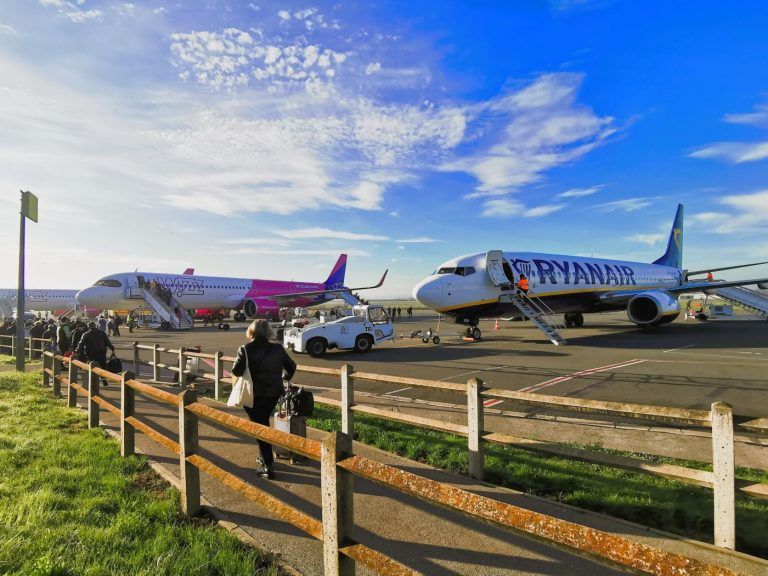
Julian Jäger: Yes, that’s a major factor. Austria has a ticket tax, and on short-haul flights it is currently the third-highest in Europe. It’s a flat €12 tax per ticket, which affects low-cost carriers more than traditional airlines. That’s one of the main reasons we’re seeing reductions this year. For example, Wizz Air is shifting some operations to Bratislava, which is very close to Vienna, and Ryanair is also reducing capacity. Airlines are putting pressure on the government to reconsider these taxes.
Are you also lobbying the government to avoid the high tax situation experienced in Germany -with all the negative consequences for airports?
Julian Jäger: Absolutely. If you look across the border to Germany, traffic is still below 2019 levels, partly due to higher costs and taxes. Vienna Airport, on the other hand, is already above pre-pandemic traffic levels. We are advocating for a reduction of the tax, but with current budget constraints at the government level, there is no guarantee of success.
Is the government not receptive to these arguments? Are you working together with Austrian tourism authorities on this issue?
Julian Jäger: It depends on whom you ask. The finance ministry may have a different view than the transport ministry. We are lobbying on multiple fronts and hope to have more clarity by the summer. We of course work with tourism authorities, because when aviation is affected, tourism is affected as well. Several regional tourism leaders have already spoken out against the tax. The State secretary responsible for tourism is supportive as well.
What about Vienna airport’s expansion plans? Are investments being slowed?
Julian Jäger: No, our long-term strategy remains unchanged. We experienced very strong growth before the pandemic and recovered quickly afterward. We see the possible decline in 2026 as temporary. Our goal is to reach around 40 million passengers within the next decade. To support that, we are expanding our infrastructure. In the second quarter of 2027 we will open a new terminal expansion adding about 70,000 square meters. This includes new waiting areas, around 10,000 square meters of retail and food & beverage space, and additional lounges.
Will the new terminal reflect Vienna’s local culture?
Julian Jäger: Absolutely. We want passengers to experience Vienna at the airport. There will be a traditional Viennese coffee house and a schnitzel restaurant, featuring well-known local names from the city’s dining scene. The expansion won’t meanwhile stop there. After completing this project we plan to extend our northern pier with additional gates.
Are you also working to improve rail connectivity to the airport?
Julian Jäger: Yes, we have a very good partnership with the Austrian Federal Railways. Connections to the city center and western Austria already work very well. However, links toward the east still need improvement. Large rail projects take time, so I expect it could take another 10 years before we have direct rail connections from Vienna Airport to Bratislava and Budapest.
Finally, are there any new airlines launching services this summer?
Julian Jäger: We are pleased to welcome several new routes. China Eastern will launch flights between Xi’an and Vienna in April, and SalamAir is planning to connect Muscat with Vienna starting in June if the situation in the Middle East is settled.
At the same time, we are continuing to invest in service quality. With our terminal expansion we aim to move toward achieving a five-star airport rating. Improving the passenger experience is key to supporting our long-term growth.