
Overseas travel intentions to Europe on the decline for summer 2025

Is Europe less attractive this summer season? Although the demand remains sustained, the European Travel Commission (ETC) latest Long-Haul Travel Barometer (LHTB 2/2025) points to a slight declined for summer 2025.
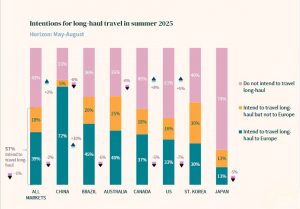
The report published by the European Travel Commission and Eurail BV highlights that only 39% of the respondents plan to visit Europe—down from 41% in 2024. While 57% of respondents across key overseas markets intend to travel internationally between May and August.
China is back to Europe
This decrease is most evident in the United States, Brazil, Canada, and Japan, where economic uncertainty and rising travel costs have impacted sentiment. In the US, just 33% of respondents intend to visit Europe, a 7% drop from last year, with affordability and political unease cited as key deterrents.
Brazilian interest has also declined by 6%, although enthusiasm remains strong among younger and higher-income travelers. In Canada, the share of those planning a European trip has fallen 5% to 37%, while Japan shows the lowest interest at 13%. The Japanese market is ageing which explains a cautious outlook from consumers. A weak Japanese Yen acts also as a deterrent factor. Meanwhile, sentiment in South Korea remains stable, with 30% considering Europe, focusing mainly on France, Spain, and Italy.
In contrast, China stands out as the only market with a major surge in travel intent. Driven by economic recovery and evolving consumer priorities, 72% of Chinese respondents now plan to visit Europe. This represents a 10% year-on-year increase.
Australia also shows a modest increase, with 40% of respondents indicating plans to travel to the region.
Europe to expensive?
The perception of Europe as an expensive destination remains the top barrier. Nearly half of those not planning to visit point to high spending, a 7% rise from 2024. Cost concerns are especially acute in the US and Brazil. Limited vacation time and a preference for domestic trips also play a role in markets like Japan and Australia. However, concerns about the Russo-Ukrainian war have notably declined, with only 4% citing it as a deterrent this year.
Travel patterns are also evolving. More travelers are opting for earlier summer departures, with interest in May and June trips rising from 24% to 34%. Budget preferences are shifting as well: fewer respondents now plan to spend over €200 per day, while 40% expect to spend between €100 and €200.
Dining remains the top spending priority (65%), followed by tourist activities and shopping, Transport budgets remain high (41%) due to the continued popularity of multi-destination itineraries.
European Travel Commission President Miguel Sanz stressed the importance of boosting Europe’s competitiveness and accessibility. He encouraged promoting off-season travel and lesser-known destinations to maintain the region’s global appeal.


TravelMole Editorial Team





















Vegas’s Billion-Dollar Secrets – What They Don’t Want Tourists to Know

Visit Florida’s New CEO Bryan Griffin Shares His Vision for State Tourism with Graham

Chicago’s Tourism Renaissance: Graham Interviews Kristin Reynolds of Choose Chicago

Graham Talks with Cassandra McCauley of MMGY NextFactor About the Latest Industry Research

Destination International’s Andreas Weissenborn: Research, Advocacy, and Destination Impact

Graham and Don Welsh Discuss the Success of Destinations International’s Annual Conference

Graham and CEO Andre Kiwitz on Ventura Travel’s UK Move and Recruitment for the Role

Brett Laiken and Graham Discuss Florida’s Tourism Momentum and Global Appeal

Graham and Elliot Ferguson on Positioning DC as a Cultural and Inclusive Global Destination

Graham Talks to Fraser Last About His England-to-Ireland Trek for Mental Health Awareness

Kathy Nelson Tells Graham About the Honour of Hosting the World Cup and Kansas City’s Future

Graham McKenzie on Sir Richie Richardson’s Dual Passion for Golf and His Homeland, Antigua







 ADS PRO
Global tourism exceeds 1.5 billion travelers announces UN-Tourism
Qatar Airways offers reduced timetable to over 60 destinations
WTTC global tourism reached record economic impact of 11 trillion in 2025
Hands In, UATP join forces for airline multi-card payments
Overseas travelers to the United States declined by 2.5% in 2025