
China reopens part of the Palace Museum inside the Forbidden City in Beijing
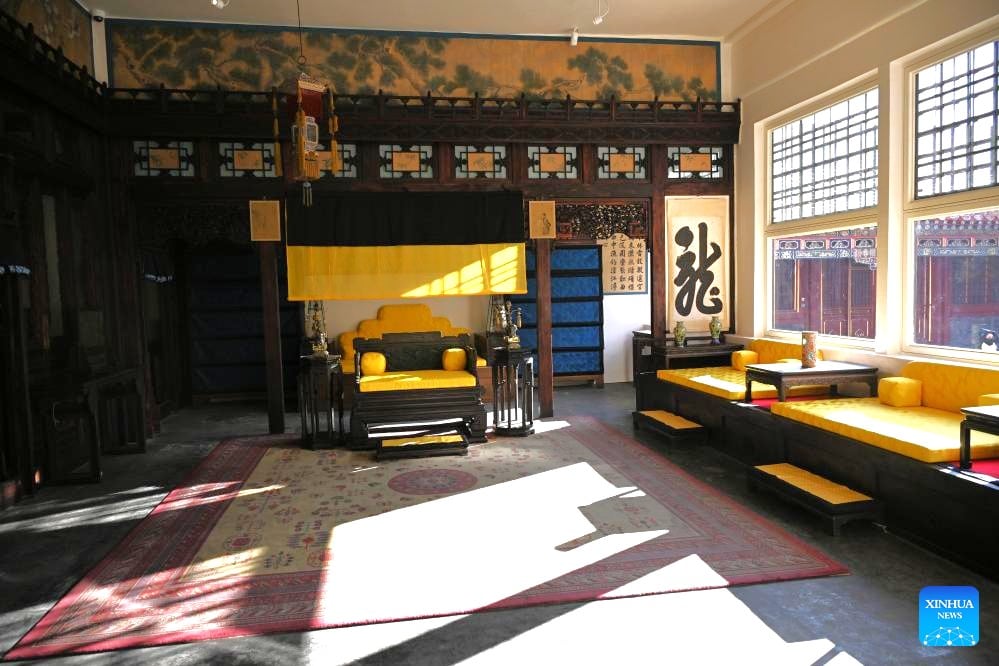
An important part of China’s Palace Museum, located within Beijing’s Forbidden City, reopened to the public on December 26, 2025 after nearly a decade of meticulous conservation and restoration.
The Hall of Mental Cultivation, first built in 1537 during the Ming Dynasty, later became the residence and administrative center for several Qing Dynasty emperors, who used the space to conduct daily state affairs. Over the past ten years, the historic hall and its collections have undergone an extensive, research-driven preservation effort aimed at maintaining their original character.
The reopened hall now displays 1,020 artifacts, according to Wen Ming, deputy director of the Palace Museum’s palace history department in an interview with China official news agency Xinhua. With the exception of light-sensitive objects such as silk textiles, calligraphy, paintings, and inscribed plaques and couplets, all items on view are original relics.
Much of the hall’s historical importance centers on the Western Warmth Chamber, where Qing emperors met officials and reviewed imperial reports. Equally compelling for visitors is a small adjoining study known as the Hall of Three Rarities, once home to three renowned calligraphy scrolls dating back about 1,600 years.
Digital exhibition to complement Palace Museum’s visit
Museum officials say the current exhibition closely follows the hall’s documented historical layout. Visitors can see Emperor Yongzheng’s calligraphy on a plaque above the central throne, restored couplets in a western room, and a recreation of the Hall of Three Rarities based on records from more than two centuries ago.
The conservation project, launched in 2015, prioritized thorough research before any physical intervention, setting a benchmark for future restoration work at the Palace Museum. “We adhere to the principles of preserving the original state and minimizing intervention,” said Zhao Peng, head of the museum’s ancient architecture department to Xinhua.
Most of the hall’s painted decorations were preserved, with only limited reinforcement and careful retouching where damage was severe.
Alongside the reopening, the museum will launch a digital exhibition allowing visitors to virtually experience traditional court ceremonies and observe how an emperor once wrote prayers for peace.
(Source: Xinhua)
Related News Stories: North Korea reopens for tour groups Cambodia-Thailand cease fire does not reopen land borders to ... Cambodia Tourism Chief on fresh promotion plans after Thailand ... What's new in Washington DC North Korea to open beach resort Laos hostel behind poisoning set to reopen Indonesia to pull the plug on Kertajati airport near Bandung What's New in Fort Myers Palawan private island resort unveils transformation Air travel to Thailand banned for Cambodians amid tensions


newadmin




















Vegas’s Billion-Dollar Secrets – What They Don’t Want Tourists to Know

Visit Florida’s New CEO Bryan Griffin Shares His Vision for State Tourism with Graham

Chicago’s Tourism Renaissance: Graham Interviews Kristin Reynolds of Choose Chicago

Graham Talks with Cassandra McCauley of MMGY NextFactor About the Latest Industry Research

Destination International’s Andreas Weissenborn: Research, Advocacy, and Destination Impact

Graham and Don Welsh Discuss the Success of Destinations International’s Annual Conference

Graham and CEO Andre Kiwitz on Ventura Travel’s UK Move and Recruitment for the Role

Brett Laiken and Graham Discuss Florida’s Tourism Momentum and Global Appeal

Graham and Elliot Ferguson on Positioning DC as a Cultural and Inclusive Global Destination

Graham Talks to Fraser Last About His England-to-Ireland Trek for Mental Health Awareness

Kathy Nelson Tells Graham About the Honour of Hosting the World Cup and Kansas City’s Future

Graham McKenzie on Sir Richie Richardson’s Dual Passion for Golf and His Homeland, Antigua







 ADS PRO
Phocuswright reveals the world's largest travel markets in volume in 2025
Higher departure tax and visa cost, e-arrival card: Japan unleashes the fiscal weapon against tourists
Singapore to forbid entry to undesirable travelers with new no-boarding directive
Euromonitor International unveils world’s top 100 city destinations for 2025
U.S.A. and Israel attacks on Iran impact air movements in the Gulf (Update 1.00pm CET)