
Siberian red gate opens up
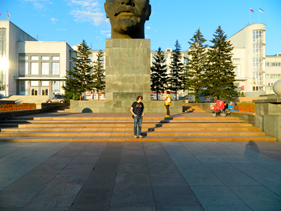
Brian with VI Lenin
Brian Kilgour talks about sustainable tourism at Russia’s eastern gate – Buryatia.
Ulan-Ude, a medium sized city with a population of about 400,000, sits nestled near the Selenga River in southern Buryatia. The name Ulan-Ude has several meanings in the Buryat language. Ulan-Ude is located at the intersection of the Ude and Selenga Rivers. Ulan means red, or beautiful (Russian speakers will note that the Russian word for red, krasny, has the same double meaning). Therefore, Ulan-Ude could mean Red Ude or Beautiful Ude. However, Ude is not just the name of a river, it is also the Buryat word for gate. Therefore, it could also mean Red Gates or Beautiful Gates. I tend to prefer the latter interpretations, especially considering the role that Ulan-Ude plays in Buryatia, Russia, and Central Eurasia. It serves as a major transportation hub, providing rail service to Beijing, Ulan-Bator, Vladivostok, and Moscow. It is where Orthodox Christianity meets Buddhism. It is where tea traveled from Asia for Europe. Ulan-Ude is truly Russia’s gate to Asia.
Ulan-Ude is also a microcosm of Buryatia. When driving to the city from the airport, Ulan-Ude looks much more like a large village than a city (people often joke that Ulan-Ude is a large village because everyone knows each other). Once one crosses the Ude River, the number of wooden houses decreases and the number of Soviet apartment blocks and modern tall buildings (skyscrapers is much too generous) increases. It contains Buddhist temples and Orthodox churches. The Ulan-Ude power plants provide much of the power used in southern Buryatia. Home to half the population of the entire Republic, it also houses the government of Buryatia, the majority of Buryatia’s cultural centers, and most of its wealth. In many ways, Ulan-Ude compresses the key characteristics of the rest of Buryatia into itself.
Ulan-Ude is one of the easiest places in Buryatia to be a sustainable tourist. The fact that it houses the Republic’s government and most of its major businesses and cultural leaders has made Ulan-Ude a major focus of government led tourism development. This focus has been dramatically increased in the last few years, with leaders concentrating resources on developing tourist infrastructure. Unfortunately, this has led to the development of a few super deluxe hotels that are controlled by corporations in Moscow, the EU, and Japan. The experienced traveler will have little trouble distinguishing between these hotels and locally owned hotels, which are more than adequate.
Dining is similar. If a place looks like it’s locally owned, i.e. it has no sign and makes no attempt to advertise itself, it is definitely locally owned. Even the majority of newer restaurants are locally owned.
Ulan-Ude is a fantastic place to become acquainted with traditional Buryat food. The most common food are meat dumplings called buuzi or pozi. These are made of beef or lamb ground up with bread, onions, and some spices. These are wrapped in dough and steamed. To eat them, one must carefully nibble a small hole into the side of the dough, suck out the scalding hot juice, and then enjoy the rest.
Many Buryat and Russians eat buzzi with soy sauce. The easiest place to find buuzi is located on Soviet Square in an alley between the philharmonic and the Progress movie theater. It is a restaurant within a yurt (Buryat teepee/tent), and I recommend it largely for the atmosphere. The best buuzi in town are at Café Shenekhen at Smolina 81 (across from the Mini Hostel). For a more sit-down feel, try Modern Nomads or Samurai, which both feature Mongolian food. Both are very close to Soviet Square.
Ulan-Ude is known for having the largest Lenin head on the planet sitting in the center of the city. But Lenin is hardly the reason to stop in Ulan-Ude. Ulan-Ude has some of the most interesting museums in the Russian Federation, particularly the Ethnographic Museum and the History Museum. The History Museum is very easy to find (it’s a 5 minute walk from Soviet Square and Lenin), much of it is in English, and the guides there enjoy practicing their English. The second floor has exhibits of Hun tools, Buryat clothing, and a Shaman’s coat. The third floor, however, is the reason to visit. Buryatia is the center of Buddhism in Russia, and Buddhist culture flourished in the 18th, 19th, and early 20th Centuries. The third floor features works by Buddhist masters that were used in temples and ceremonies before the October Revolution. The Ethnographic Museum can be tricky to reach without help. If you’re brave, go to the bus stop on Soviet Square at the philharmonic and stop a 37. When it stops, say "etnographichesky muzey" to the driver. If he nods his head, get on and make sure he stops there (it’s about a 20 minute ride). Otherwise, ask for help from the hostel or hotel you’re staying at.
The Ethnographic Museum is an outdoor museum with old Russian, Buryat, and Evenk settlements that were moved when the Irkutsk Dam raised the level of Baikal.
Ulan-Ude is also an excellent place to see traditional Buryat and Old Believer music and dance. Many of the theaters in town have frequent Buryat performances. Ask someone at your hotel if they can help you find a show to go to.
Ulan-Ude was a wonderful city to call home. It’s quiet, beautiful, and full of culture. Many travelers spend less than a day in the city as they rush to see as much of the Trans-Siberian Railroad as possible. Ulan-Ude is not just a city on the Trans-Siberian, it is a gateway where Asia has welcomed Western diplomats and merchants for centuries. And Ulan-Ude is only the beginning of the adventure that lies in Buryatia.
THIS YEAR’S SUSTAINABLE TOURISM MASTERCLASS AND OTHER OFFERS


Valere

















Vegas’s Billion-Dollar Secrets – What They Don’t Want Tourists to Know

Visit Florida’s New CEO Bryan Griffin Shares His Vision for State Tourism with Graham

Chicago’s Tourism Renaissance: Graham Interviews Kristin Reynolds of Choose Chicago

Graham Talks with Cassandra McCauley of MMGY NextFactor About the Latest Industry Research

Destination International’s Andreas Weissenborn: Research, Advocacy, and Destination Impact

Graham and Don Welsh Discuss the Success of Destinations International’s Annual Conference

Graham and CEO Andre Kiwitz on Ventura Travel’s UK Move and Recruitment for the Role

Brett Laiken and Graham Discuss Florida’s Tourism Momentum and Global Appeal

Graham and Elliot Ferguson on Positioning DC as a Cultural and Inclusive Global Destination

Graham Talks to Fraser Last About His England-to-Ireland Trek for Mental Health Awareness

Kathy Nelson Tells Graham About the Honour of Hosting the World Cup and Kansas City’s Future

Graham McKenzie on Sir Richie Richardson’s Dual Passion for Golf and His Homeland, Antigua







 ADS PRO
Higher departure tax and visa cost, e-arrival card: Japan unleashes the fiscal weapon against tourists
Singapore to forbid entry to undesirable travelers with new no-boarding directive
Euromonitor International unveils world’s top 100 city destinations for 2025
U.S.A. and Israel attacks on Iran impact air movements in the Gulf (Update 1.00pm CET)
Global tourism exceeds 1.5 billion travelers announces UN-Tourism