
TOURISM AND TRAVEL IN THE GREEN ECONOMY
Thursday, 20 Aug, 2009
0
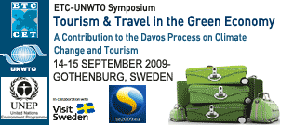
A Preview of the Gothenburg Symposium, Sweden 14th & 15th September 2009
About the Gothenburg Symposium.
The United Nations have been driving the Sustainable Development agenda ever since the Stockholm Conference on the Environment in 1972. In the last four decades, a global multi-stakeholder process has been crystallizing around more equitable, environmentally friendly, and socially beneficial sustainable business practice. Never in human history have we needed this more, with global pressures building up at every level of our economies, environments and personal lives, evidenced internationally in the difficulty of implementing the Millennium Development Goals and the WSSD programme, and locally in thousands of villages, towns and cities needing to change their patterns of consumption and production to fit the new world order.
Every UN action requires a multi-stakeholder response for implementation. By following policy guidance from the UN and the European Union, the European Travel Commission (ETC) has entered this challenging process with the aim of supporting its 39 European member countries in their response to globalization, climate change and sustainable tourism development.
The Gothenburg Symposium process was initiated by the European Travel Commission in 2008, after a survey commissioned to find out the ETC membership’s interest, understanding and commitment to sustainable tourism and climate change. VisitSweden executed the survey and presented it to the ETC members in October 2008 San Marino Conference.
A process was launched from San Marino to address the needs of NTOs, leading the creation of a knowledge networking process that would inform NTOs of ongoing policy lines and best practice at the global and European levels, and look at national ways of working that promote green tourism solutions. Using its affiliation to the UNWTO and the experience of the European Environment Agency`s (EEA) DestiNet UN Type II Partnership, a structured knowledge networking process has been taking place that has drawn in UNWTO, UNEP, WTTC and the European Commission’s DG Enterprise alongside the Swedish government and other national and sectoral tourism high level stakeholders. They will present their points of view in Gothenburg on how travel and tourism fit into the green economy.
Aims of the Symposium:
The Gothenburg Symposium has a pivotal role to play as an event where tourism & travel stakeholders can learn about green economy issues and then react to them in time for Copenhagen. Outcomes of the seminar will include:
- A Symposium Statement about Copenhagen and Tourism
Participants should be able to use this conference to both learn about and contribute to the Copenhagen debate on how to deal with climate change. A draft statement will be distributed to the participants, providing a scenario of the tourism sector’s working reality in anticipation of the new Copenhagen Climate Change Agreement and the deriving commitments for countries and sectors. The Symposium’s outcomes will build on the Davos Process on climate change and tourism, led by UNWTO in partnership with several other organizations and tourism stakeholders. The messages of the Davos Declaration: Adapt, Mitigate, Improve Technology are more relevant than ever for the tourism industry. It is also expected that the Symposium conclusions will offer ideas and lines of actions on how tourism can better integrate into the green economy and benefit from stimulus packages and other global and national initiatives supporting the green economy
.
- The NTO knowledge networking process
The NTO knowledge networking process is a key outcome of the Symposium, and it is clear that the panellists will contribute greatly to an NTO’s understanding of sustainable tourism, climate change and the green economy. The compilation of the conference will be structured using the DestiNet Sustainable Tourism Portal, which will allow stakeholder access to the conference proceedings. This will constitute the basis of the Learning Area on Climate Change and Sustainable Tourism for NTOs (See the article on the NTO Climate Change and Sustainable Tourism Learning Area)
Linking Tourism and Environment Administrative Bodies to Develop the Green Economy
By using the UN`s Type II Partnership approach to the implementation of sustainable development, the EEA addressed the need to overcome the institutional governance gap that exists between the administration of the tourism sector and the administration of the environment. This gap exists at all governance levels, i.e. global, sub-global, national, regional and local. A green economy requires integrated territorial governance, so these horizontal administrative files have to be linked across department and up and down the governance chain of command. Good governance is central to the development the green economy, but administrators themselves need ever improving decision support and communications systems to do their jobs at this speed and size of global changes.
With the UNWTO joining the UNEP initiative of the Green Economy on behalf of the tourism sector, other international entities and national administrative bodies should be encouraged to develop greater coherence between economic and environmental departments. NTOs need to be supported by their national departmental counterparts who deal with the implementation of SCP in general, and in turn can support tourism sector environmental and economic initiatives where appropriate. Therefore it is recommended that the conference results reach those national level stakeholders that would be interested in developing this collaborative approach, and seeing how the post-Symposium networking processes manage to do that.
The Symposium has the following content structure, which is mirrored in the structure of this Special Edition issue:
- Towards a Green Economy – Sustainability and the Tourism Sector in the run up to the Copenhagen Agreement
Opening day ministerial-level presentations providing policy and programme information on global crisis management, climate change and sustainable tourism development
- Tourism Going Climate Neutral
Panel on the issue of what the tourism sector is doing to minimize negative impacts on the environment. It will outline the initiatives at the global and national levels, and provide a business stakeholders viewpoint on how business & industry can positively contribute to this process.
- The Travel Industry, Innovation and New Technologies –
Panel on the subject of how new technologies can be used to achieve climate neutral actions in travelling. Key industry leaders will show the response from air and rail transport links of the tourism supply chain.
- Destinations: a Sustainable Approach
Panel on how tourism destinations are managing climate change, offering a global perspective on moves to harmonize sustainable tourism criteria, a national level approach to implementing a Sustainable Consumption & Production (SCP) policy for the tourism sector, and what the accommodation sector can do to move towards climate neutral activity. The panel provides an insight into how the tourism sector fits into the wider moves towards sustainable consumption and production. It will demonstrate the important link between conservation and the development of tourism, taking a territorial approach to show how best to create regional green economies in coastal, mountain urban and protected areas.
- Towards a Green Economy – NTO Challenges and Opportunities –
This panel describes the scope and actions that an NTO can undertake in order to deal with climate change and sustainable tourism development. It will consider the requisites needed to build a model of NTO organization at the international, national and regional levels which can be used to develop the NTO contribution to a green economy using an NTO good practice model in response to policy lines. The Learning Area on Climate Change and Sustainable Tourism for NTOs will be highlighted in this section.
Symposium Hosts – Visit Sweden
VisitSweden have chosen a location that is certified by Svanenmärkt, and are doing their best to make the event climate neutral and as sustainable as possible from their part. They will present their climate-neutral operational plan they have implemented in the NTO action discussion panel.
Booking
There has been a large take up of Symposium places up to now, and you will need to book soon to guarantee a place.
For further information, please contact the Conference Secretariat – European Travel Commission [email protected] or by phone +32 2 548 90 00)
LINKS:
See ETC report – Climate Change & Sustainable Tourism – Understanding the Role of European National Tourism Organizations European Travel Commission 2009 available on:
www.unep.org/Documents.Multilingual/Default.asp


Valere













Vegas’s Billion-Dollar Secrets – What They Don’t Want Tourists to Know

Visit Florida’s New CEO Bryan Griffin Shares His Vision for State Tourism with Graham

Chicago’s Tourism Renaissance: Graham Interviews Kristin Reynolds of Choose Chicago

Graham Talks with Cassandra McCauley of MMGY NextFactor About the Latest Industry Research

Destination International’s Andreas Weissenborn: Research, Advocacy, and Destination Impact

Graham and Don Welsh Discuss the Success of Destinations International’s Annual Conference

Graham and CEO Andre Kiwitz on Ventura Travel’s UK Move and Recruitment for the Role

Brett Laiken and Graham Discuss Florida’s Tourism Momentum and Global Appeal

Graham and Elliot Ferguson on Positioning DC as a Cultural and Inclusive Global Destination

Graham Talks to Fraser Last About His England-to-Ireland Trek for Mental Health Awareness

Kathy Nelson Tells Graham About the Honour of Hosting the World Cup and Kansas City’s Future

Graham McKenzie on Sir Richie Richardson’s Dual Passion for Golf and His Homeland, Antigua







 ADS PRO
Clearing CSS/JS assets' cache... Please wait until this notice disappears...
Updating... Please wait...
Global tourism exceeds 1.5 billion travelers announces UN-Tourism
Qatar Airways offers reduced timetable to over 60 destinations
WTTC global tourism reached record economic impact of 11 trillion in 2025
Marginal increase for New York City tourism in 2025
Hands In, UATP join forces for airline multi-card payments