
Tourism Concern Releases Hard Hitting New Human Rights Report
Wednesday, 25 Nov, 2009
0
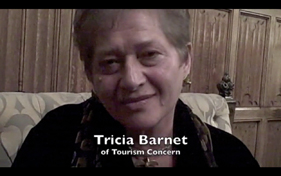
See interview with Tricia Barnet and Baroness Helena Kennedy www.travelmole.tv/watch_vdo.php
Beleaguered Tourism Concern certainly came out of its corner fighting last night when Baroness Helena Kennedy and Tricia Barnet released a hard hitting Human Rights and Tourism Report in front of a select audience at the House of Lords.
The organisation has just launched an appeal for funds to survive, and members of the travel industry are contributing small and large amounts to keep the small band of committed staff fighting to keep the industry’s conscience in business.
In ‘Putting Tourism to Rights’ Tourism Concern accuses the tourism industry of:
- · Forced evictions from homes to make way for tourism developments
- · Environmental damage and loss of access to grazing land, coastal areas and fresh water
- · Exploitation of tribal peoples as tourism attractions
- · Poor pay and working conditions
The organization challenged the UK Government, tour operators and trade associations, UNWTO, destination governments, hotels and NGOs to get their act in order over human rights abuses in the tourism industry. Tourism Concern called for the government and industry to ensure that the rights of local people in destinations are protected in line with international law.
Said Tricia Barnet “While tourism has great potential to create wealth and improve the lives local communities, our report shows that it is often developed at the expense of human rights. This is particularly true of poor people who are easy to exploit, often driving them deeper into poverty”
The report exposes the violations of human rights occurring as a direct result of tourism through an examination of key articles of the Universal Declaration of Human Rights. It challenges the UK Government and industry to recognise that human rights are a fundamental element of any sustainable approach to development – including tourism development, and calls for action to ensure their protection.
The organisation says: “A profound disconnect persists in the minds of governments, industry and international donor agencies when it comes to addressing the human rights dimensions of the global tourism industry – the largest and fastest growing services industry in the world."
“Their primary focus remains on tourism’s potential to generate economic growth, which has meant unfettering the sector from rules and regulations that might hinder its rapid expansion.”
“This is particularly true where developing countries are concerned. Plagued by high unemployment and debt, but rich in cheap labour and unspoilt landscapes, many governments see tourism as the panacea to their economic woes.
Yet while tourism may swell the national coffers, countless numbers of people – particularly those who are already vulnerable and poor – have their basic human rights violated as a direct result of tourism’s growth, exacerbating their poverty and trapping them in a cycle of deprivation.”
“Clearly, tourism has the potential to generate enormous benefits for destination countries. There is, on paper at least, an increasing recognition of the need for tourism to be developed sustainably. Tourism has also been highlighted as an important contributor to the achievement of the Millennium Development Goals in relation to poverty alleviation, environmental sustainability and gender equity. “
“However, tourism is a competitive, resource hungry industry, which is often highly exploitative. International hotel chains and operators jostle to expand and out-price each other, and cash-strapped governments compete to attract business by offering cheap land and tax free investment, often complemented by weak labour laws. This places constant pressure on those at the bottom of the tourism supply chain – the maids, porters, cooks and drivers, as well as the inhabitants of the land and ecosystems earmarked for tourism development. “
‘Putting Tourism to Rights’ urges all major tourism stakeholders to take action to ensure that the human rights of destination communities and industry employees are respected and protected in line with international human rights law. Key recommendations include:
The UK Government
- To identify a single government department to take on full responsibility for outbound tourism which explicitly recognises and seeks to address tourism’s impacts on development and human rights.
- That DFID takes on the membership of the UNWTO so that it can engage in and influence international debates around tourism, poverty alleviation, human rights and climate change.
- To hold UK businesses operating overseas to account through the implementation of corporate social responsibility regulations and reporting mechanisms; to ensure access to justice for victims of corporate abuse committed by UK businesses outside of the UK.
UK tour operators and tourism trade associations
- To respect and protect human rights as a primary responsibility.
- To take responsibility for and seek to mitigate human rights abuses that occur throughout their tourism supply chains.
- To make use of all available environmental and social impact assessments and labour audits when contracting with hotels to ensure that the working conditions and human rights of employees are protected.
UNWTO:
- To open doors to stakeholder NGOs and to recognise the legitimacy of grass-roots perspectives; to take full cognisance of the concerns expressed therein.
- To ensure that member countries are in compliance with its Global Code of Ethics; to utilise the mechanism set out in Article 10 in order to challenge practices which do not match its correct application and interpretation.
- To implement additional mechanisms to assist member countries in complying with the Global Code and to strengthen its potential to mitigate human rights abuses in tourism.
Destination governments
- To fulfil their international legal obligations to protect their citizens from human rights abuses perpetrated by third parties, including the tourism industry.
- To implement regulations and planning controls which ensure that the development of the tourism industry is sustainable.
- To ensure the right to self-determination of indigenous peoples in respect to prospective developments on their land and in their vicinity.
Hotels
- To make use of all available independent social and environmental impact assessments when contracting with developers; to ensure that there are no ongoing legal disputes over land ownership or access to key resources on any site where a hotel is to be built.
- To adopt a single, well understood code of practice that includes human rights and environmental protection measures.
UK-based NGOs
- To consider taking tourism on to their agendas as a key determining factor in development in many of the countries in which they work.
- To identify whether tourism development has played a role in relation to land issues, natural resources depletion and other human rights abuses that their beneficiaries may face. To incorporate an awareness of tourism within their long-term development work.
To Support Tourism Concern, go to www.tourismconcern.org.uk
Valere Tjolle


Valere




















Vegas’s Billion-Dollar Secrets – What They Don’t Want Tourists to Know

Visit Florida’s New CEO Bryan Griffin Shares His Vision for State Tourism with Graham

Chicago’s Tourism Renaissance: Graham Interviews Kristin Reynolds of Choose Chicago

Graham Talks with Cassandra McCauley of MMGY NextFactor About the Latest Industry Research

Destination International’s Andreas Weissenborn: Research, Advocacy, and Destination Impact

Graham and Don Welsh Discuss the Success of Destinations International’s Annual Conference

Graham and CEO Andre Kiwitz on Ventura Travel’s UK Move and Recruitment for the Role

Brett Laiken and Graham Discuss Florida’s Tourism Momentum and Global Appeal

Graham and Elliot Ferguson on Positioning DC as a Cultural and Inclusive Global Destination

Graham Talks to Fraser Last About His England-to-Ireland Trek for Mental Health Awareness

Kathy Nelson Tells Graham About the Honour of Hosting the World Cup and Kansas City’s Future

Graham McKenzie on Sir Richie Richardson’s Dual Passion for Golf and His Homeland, Antigua







 ADS PRO
Clearing CSS/JS assets' cache... Please wait until this notice disappears...
Updating... Please wait...
Higher departure tax and visa cost, e-arrival card: Japan unleashes the fiscal weapon against tourists
Singapore to forbid entry to undesirable travelers with new no-boarding directive
Euromonitor International unveils world’s top 100 city destinations for 2025
U.S.A. and Israel attacks on Iran impact air movements in the Gulf (Update 1.00pm CET)
Global tourism exceeds 1.5 billion travelers announces UN-Tourism