
TOURISM GOING CLIMATE NEUTRAL
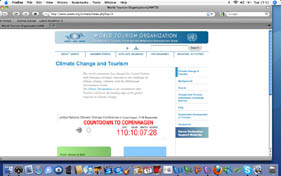
- How the tourism sector will be affected by climate change
- How the tourism sector contributes to climate change
- How to mitigate and adapt to climate change by making tourism more sustainable
- Mitigate its Greenhouse Gas GHG emissions, derived especially from transport and accommodation activities;
- Adapt tourism businesses and destinations to changing climate conditions;
- Apply existing and new technology to improve energy efficiency; and
- Secure financial resources to help poor regions and countries.
Q "Geoffrey, the European Travel Commission and UNWTO Symposium on Tourism & Travel in the Green Economy, to take place in Gothenburg and sponsored by VisitSweden on September 14-15th, what is it about?"
A "This event is an important element of the Davos Declaration Process and the Copenhagen Seal the Deal Imperative – it’s even more
important as a small step in the strategic global transformation to a Green Economy"
Q "Please expand on that."
A "From the UN system to the OECD to the G20 – including pivotally China, India, Brazil and South Africa there is recognition of the imperative of – long term shift from fossil fuel to low cabon renewable energy – resource and biodiversity conservation – green consumption, production and accounting – inclusion of all countries on a fair and equitable basis, with technology, capacity building and financing support for the poorest – wide range of market and regulatory mechanisms to encourage efficiency and innovation – linkage of environment technology and information communication technology to enable and manage the shift."
Q "What is OECD?"
A "That’s the Organisation for Economic Co-operation and Development. OECD is an international organisation helping governments tackle the economic, social and governance challenges of a globalised economy…"
Q "While you used the word ‘imperative’, practically speaking, how long of a process will these ‘imperative’ issues take to address?"
A "We know this is a long term measured shift from now to 2050: we know it has to start fast with tough targets to stabilize the earths
temperature at reasonable levels: we know it will have different levels of intensity for different countries for social and developmental reasons and for trade and poverty coherence: we know if we start now the cost and the pain will be tough but bearable – and that cost and consequence will increase exponentially with every procrastination: and we know we have no
alternatives."
Q "Are there any regions or countries for which these ‘imperatives’ apply to more or less?"
A "All countries and regions are important in this evolution and some are pivotal – Europe and the US because they have such massive impacts today in carbon output and leadership potential: China, India and Brazil because of their dynamic economic emergence and their population impacts: Africa, much of South America and Island States because of their vulnerabilty and at the same time their green potential."
- Moderator: Geoffrey Lipman
- Luigi Cabrini, Director Sustainable Development, UNWTO
- The Hon. Predrag Nenezic, Minister of Tourism, Montenegro
- Fulai Sheng, Division of Technology, Industry & Economics, UNEP
- Jean-Claude Baumgarten, President WTTC


Valere




















Vegas’s Billion-Dollar Secrets – What They Don’t Want Tourists to Know

Visit Florida’s New CEO Bryan Griffin Shares His Vision for State Tourism with Graham

Chicago’s Tourism Renaissance: Graham Interviews Kristin Reynolds of Choose Chicago

Graham Talks with Cassandra McCauley of MMGY NextFactor About the Latest Industry Research

Destination International’s Andreas Weissenborn: Research, Advocacy, and Destination Impact

Graham and Don Welsh Discuss the Success of Destinations International’s Annual Conference

Graham and CEO Andre Kiwitz on Ventura Travel’s UK Move and Recruitment for the Role

Brett Laiken and Graham Discuss Florida’s Tourism Momentum and Global Appeal

Graham and Elliot Ferguson on Positioning DC as a Cultural and Inclusive Global Destination

Graham Talks to Fraser Last About His England-to-Ireland Trek for Mental Health Awareness

Kathy Nelson Tells Graham About the Honour of Hosting the World Cup and Kansas City’s Future

Graham McKenzie on Sir Richie Richardson’s Dual Passion for Golf and His Homeland, Antigua







 ADS PRO
Global tourism exceeds 1.5 billion travelers announces UN-Tourism
Qatar Airways offers reduced timetable to over 60 destinations
WTTC global tourism reached record economic impact of 11 trillion in 2025
Marginal increase for New York City tourism in 2025
Hands In, UATP join forces for airline multi-card payments