
Phocuswright research shows that over 60% of travel companies accelerate AI adoption
At ITB Berlin 2026, the conversation around artificial intelligence will be intense and unavoidable. And with good reason, According to Phocuswright’s latest study Budgets, Barriers and the Race to Agentic AI, travel companies are not only adopting AI, they are beginning to operationalize it in ways that will define competitive positioning for years to come. After a year of rapid exploration, 2026 is indeed shaping up as the year agentic AI moves into the core of travel operations. Unlike earlier AI tools focused on content creation, agentic AI is designed to execute real-world tasks across systems and workflows. Agentic AI refers to systems that autonomously perform complex tasks using real-time data, integrations and defined objectives, going well beyond simple text or image generation.
61% of travel business already engage with agentic AI
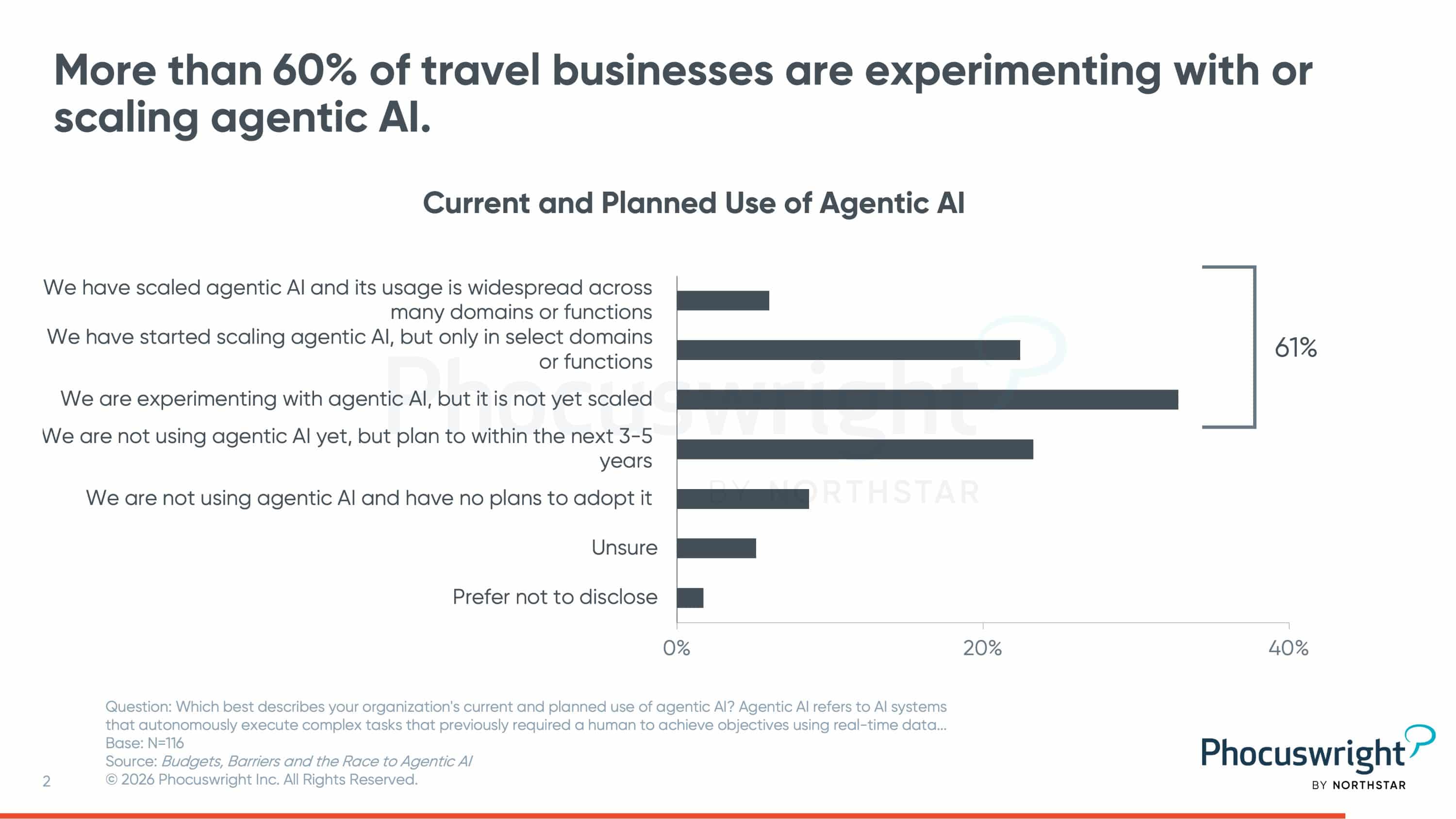
According to Phocuswright, 61% of travel businesses are either experimenting with or scaling agentic AI today. This signals a clear shift in mindset. AI is increasingly viewed as a structural capability rather than a side project.
Phocuswright’s research shows that agentic AI adoption is no longer theoretical:
⦁ 6% of travel companies are already scaling agentic AI across multiple domains and functions.
⦁ 22% have begun scaling in select area.
⦁ Some 35% are actively experimenting with agentic AI but has not yet scaled.
⦁ Close to 10% additional travel companies plan to adopt agentic AI within the next three to five years.
Technology budgets lined up with AI ambitions
Investment trends reinforce this momentum. Phocuswright research demonstrates that :
– 62% of companies expect their technology budgets to increase in 2026.
– Growth expectations are strongest in the one to five percent, six to ten percent and greater than ten percent increase categories.
– Very few companies anticipate budget reductions.
While AI does not yet dominate technology budgets, leaders are clearly being given room to invest. Many are choosing to direct that capital toward generative and agentic AI initiatives.
Looking beyond headline adoption numbers, executive sentiment reveals where the market is headed.
– AI has risen to the top of the technology agenda
Generative AI is now the number one technology investment priority over the next 12 to 18 months for many travel companies. It has moved firmly into board-level planning discussions.
– Most AI spending still funds experimentation
Although adoption is widespread, most deployments remain tactical. Few companies have fully redesigned workflows or systems around AI. Instead, AI is being layered onto existing infrastructure.
– Budgets are rising, but not yet rewired for AI
Overall technology budgets are increasing, but only a small share of companies currently allocate more than 20% of that spend to gen AI. This suggests AI investment is accelerating but has not yet reached core-infrastructure status.
– Impact is clear, preparedness is uneven
A strong majority of executives say gen AI has already delivered positive business impact. At the same time, many do not feel fully prepared to scale. The biggest obstacles are integration complexity, talent gaps and data security concerns, not lack of interest or funding.
Travel companies present at ITB Berlin can expect that the next phase of competition in travel will be shaped by the companies able to move from pilots to production. Scaling agentic AI requires infrastructure, governance, data readiness and organizational change with interoperability being critical. Companies that also invest in skills, operating models and execution discipline will move faster and capture disproportionate advantage, stresses Phocuwright report.
For leaders attending ITB Berlin, the message is clear. The question is no longer whether to invest in AI. It is how quickly organizations can turn that investment into durable advantage.
Related News Stories: Phocuswright: Global travel growth shifts toward emerging markets ... Africa's luxury tourism brings little to local communities - TravelMole News Archive - Page 4317 of 9696 - TravelMole United adds new features to mobile app - TravelMole Amari Bangkok crowned as Thailand's Best MICE and Best City ... Burkina Faso removes visa obligations for African travelers UNESCO recognizes Italy's culinary traditions as World Heritage Breaking Archives - Page 152 of 1606 - TravelMole Stolen loyalty accounts thrive on the dark web according to study Five dead in New York tour bus crash - TravelMole


newadmin



















Vegas’s Billion-Dollar Secrets – What They Don’t Want Tourists to Know

Visit Florida’s New CEO Bryan Griffin Shares His Vision for State Tourism with Graham

Chicago’s Tourism Renaissance: Graham Interviews Kristin Reynolds of Choose Chicago

Graham Talks with Cassandra McCauley of MMGY NextFactor About the Latest Industry Research

Destination International’s Andreas Weissenborn: Research, Advocacy, and Destination Impact

Graham and Don Welsh Discuss the Success of Destinations International’s Annual Conference

Graham and CEO Andre Kiwitz on Ventura Travel’s UK Move and Recruitment for the Role

Brett Laiken and Graham Discuss Florida’s Tourism Momentum and Global Appeal

Graham and Elliot Ferguson on Positioning DC as a Cultural and Inclusive Global Destination

Graham Talks to Fraser Last About His England-to-Ireland Trek for Mental Health Awareness

Kathy Nelson Tells Graham About the Honour of Hosting the World Cup and Kansas City’s Future

Graham McKenzie on Sir Richie Richardson’s Dual Passion for Golf and His Homeland, Antigua







 ADS PRO
Higher departure tax and visa cost, e-arrival card: Japan unleashes the fiscal weapon against tourists
U.S.A. and Israel attacks on Iran impact air movements in the Gulf (Update 1.00pm CET)
Global tourism exceeds 1.5 billion travelers announces UN-Tourism
WTTC global tourism reached record economic impact of 11 trillion in 2025
Marginal increase for New York City tourism in 2025