
Are electric planes on the cards – Oslo says yes
Norway, the largest oil and gas producer in western Europe, is a pioneer in electric transport
"Many people say that we must get rid of air transport because we will never be able to deal with emissions and noise, but this is an outdated approach," said Norwegian Transport Minister Ketil Solvik-Olsen, who recently hosted an aviation conference in Oslo.
The nation aims for all new vehicle registrations to be zero emission by 2025 and launched a first electric ferry in early 2015.
"In my mind, there is no doubt: by 2040 Norway will be operating totally electric," said Dag Falk-Petersen, head of the country’s public airport operator, Avinor.
The airline industry aims to cut its CO2 emissions in half by 2050 from 2005 levels.
While the international umbrella group Climate Action Network (CAN) says these goals are unrealistic, some airlines are beginning to look at electric-powered aircraft as an answer.
The small regional carrier Wideroe Airlines, operating in Norway’s far north, plans to renew its fleet of twin-engine Bombardier Dash 8 planes with electric-powered aircraft by 2030.
"Aircraft producers see that they have to do it because otherwise there will be a new Tesla taking their positions," said Falk-Petersen.
Apparently both of the major manufacturers of large passenger aircraft, Airbus and Boeing, are exploring the viability of electric planes.
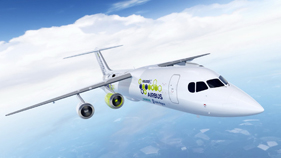
Airbus aims to develop a hybrid model called E-Fan X, and has teamed up with British engine maker Rolls Royce and German industrial group Siemens. The first flight is planned for 2020. See: http://www.airbus.com/newsroom/press-releases/en/2017/11/airbus–rolls-royce–and-siemens-team-up-for-electric-future-par.html
Zunum Aero , a start-up partly financed by US aeronautics group Boeing, meanwhile plans to bring a 12-seat hybrid plane to the market by 2022.
"The price that we’re targeting is very much in line with the current aircraft but the operation cost is just a fraction, it’s literally 60 to 70 percent lower than an equivalent aircraft in operation right now," said the startup’s founder Matt Knapp.
The expected lower operating costs of electric planes, both due to cheap electricity and simpler motors, means that the highly competitive airline industry could end up adopting them quickly.
Combined with the fact that electric planes don’t need such long runways, they could be used at some smaller airports close to city centres.
Avinor said switching to electric would also help airlines avoid any climate change related penalties that regulators could impose, such as higher taxes and flying restrictions.
Valere Tjolle


Valere





















Vegas’s Billion-Dollar Secrets – What They Don’t Want Tourists to Know

Visit Florida’s New CEO Bryan Griffin Shares His Vision for State Tourism with Graham

Chicago’s Tourism Renaissance: Graham Interviews Kristin Reynolds of Choose Chicago

Graham Talks with Cassandra McCauley of MMGY NextFactor About the Latest Industry Research

Destination International’s Andreas Weissenborn: Research, Advocacy, and Destination Impact

Graham and Don Welsh Discuss the Success of Destinations International’s Annual Conference

Graham and CEO Andre Kiwitz on Ventura Travel’s UK Move and Recruitment for the Role

Brett Laiken and Graham Discuss Florida’s Tourism Momentum and Global Appeal

Graham and Elliot Ferguson on Positioning DC as a Cultural and Inclusive Global Destination

Graham Talks to Fraser Last About His England-to-Ireland Trek for Mental Health Awareness

Kathy Nelson Tells Graham About the Honour of Hosting the World Cup and Kansas City’s Future

Graham McKenzie on Sir Richie Richardson’s Dual Passion for Golf and His Homeland, Antigua







 ADS PRO
Global tourism exceeds 1.5 billion travelers announces UN-Tourism
Qatar Airways offers reduced timetable to over 60 destinations
WTTC global tourism reached record economic impact of 11 trillion in 2025
Hands In, UATP join forces for airline multi-card payments
Overseas travelers to the United States declined by 2.5% in 2025