
Brexit will ‘lead to loss of 2.3 million visitors to UK’
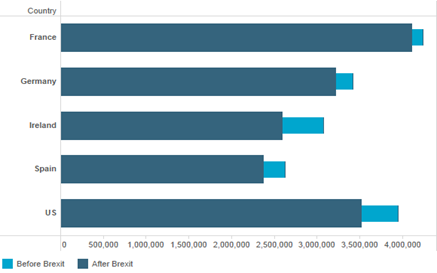
Market researcher Euromonitor is predicting 2.3 million fewer visitors to the UK over the five years up to 2020 following the UK’s vote to leave the European Union.
It said that as the UK had entered a ‘period of uncertainty with many unknowns’, it forecast a 2% drop in GDP over the next five years, with the biggest impact felt next year.
The GDP would not return to the baseline until 2023, said Euromonitor.
Head of travel research Caroline Bremner said: "Destination branding and consumer desire to travel would be hit hard by the uncertainty Brexit would entail in the short to mid-term.
"EU source markets, such as Ireland, Germany and Spain along with the US would experience the sharpest forecast change in volume. However, a pound slump after Brexit would help to entice visitors to the UK."
The UK is high up on the scale of popular destinations, ranked sixth globally in 2015, with an impressive 35.4 million international trips, worth £28 billion to the UK economy, said Euromonitor.
It has a high dependency on Western and Eastern Europe for its international tourists, with both regions accounting for 73% of all inbound tourism in 2015.
France is the UK’s biggest and robust source market, with 3.7 million visitors to the UK in 2015, and has exhibited a high level of resilience to external factors in turbulent times.
Based on previous travel behaviour during times of uncertainty and weaker economic performance at home, Germans and Americans are less likely to travel to the UK, and Euromonitor expects that each country will send half a million fewer people here between 2015 and 2020 to reach 3.3 million and 3.5 million respectively.
Following the global recession in 2008, it took eight years for UK outbound demand to recover to its original levels pre-crisis, only achieving levels of over 78 million outbound trips in 2015.
In value sales terms, the outbound market lost over £10 billion from its peak in 2008 and bottomed out in 2013 when the outbound market started to pick up again thanks to pent-up demand and a stronger economy.
"The sharp fall was not just a result of demand collapsing, but also the removal of unprofitable low-costs deals and players, with major tour operators reducing supply to maximise average transaction prices," said Euromonitor.


Linsey McNeill
Editor Linsey McNeill has been writing about travel for more than three decades. Bylines include The Times, Telegraph, Observer, Guardian and Which? plus the South China Morning Post. She also shares insider tips on thetraveljournalist.co.uk





















Vegas’s Billion-Dollar Secrets – What They Don’t Want Tourists to Know

Visit Florida’s New CEO Bryan Griffin Shares His Vision for State Tourism with Graham

Chicago’s Tourism Renaissance: Graham Interviews Kristin Reynolds of Choose Chicago

Graham Talks with Cassandra McCauley of MMGY NextFactor About the Latest Industry Research

Destination International’s Andreas Weissenborn: Research, Advocacy, and Destination Impact

Graham and Don Welsh Discuss the Success of Destinations International’s Annual Conference

Graham and CEO Andre Kiwitz on Ventura Travel’s UK Move and Recruitment for the Role

Brett Laiken and Graham Discuss Florida’s Tourism Momentum and Global Appeal

Graham and Elliot Ferguson on Positioning DC as a Cultural and Inclusive Global Destination

Graham Talks to Fraser Last About His England-to-Ireland Trek for Mental Health Awareness

Kathy Nelson Tells Graham About the Honour of Hosting the World Cup and Kansas City’s Future

Graham McKenzie on Sir Richie Richardson’s Dual Passion for Golf and His Homeland, Antigua







 ADS PRO
Global tourism exceeds 1.5 billion travelers announces UN-Tourism
Qatar Airways offers reduced timetable to over 60 destinations
WTTC global tourism reached record economic impact of 11 trillion in 2025
Marginal increase for New York City tourism in 2025
Hands In, UATP join forces for airline multi-card payments