
The voice of an expert: C9 Hotelworks Managing director Bill Barnett about Thailand tourism future
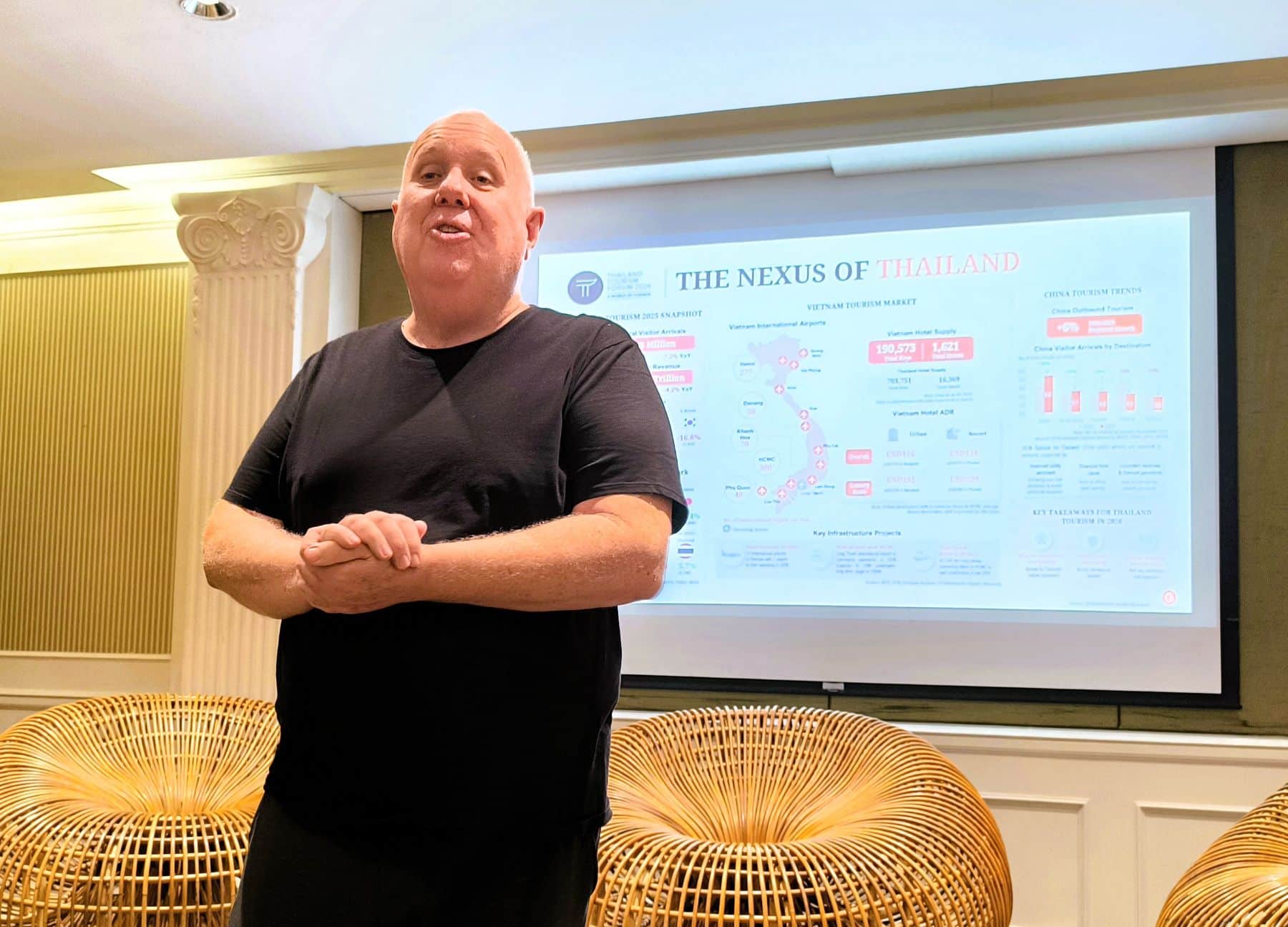
Managing Director of C9 Hotelworks, an awarded hospitality consultancy focusing on hotel, branded residential, real estate and mixed-use developments across Asia, Bill Barnett is the soul behind the Thailand Tourism Forum (TTF). The half-day conference is looking specifically at the evolution of Thailand tourism, particularly towards investors and the private sector.
” What began years ago in a single hotel meeting room has grown into Thailand’s largest hospitality event, tells Bill Barnett. Today, we welcome more than 1,100 participants, which says a lot about how important this forum has become.“
TTF is always preceded by a press conference where Barnett takes a glance and sketches the perspectives of Thailand tourism. For C9 Hotelworks managing director, 2025 and 2026 are definitely reshaping the Kingdom’s tourism evolution.
“ I think of Thailand as being at a crossroads—a real nexus point. The idea of a nexus is about change: where shifts are happening, where pressures meet opportunity. We often talk about the “new normal” or try to predict the future, but the reality is that the future is changing every single day. That’s why we keep coming back to the data—it helps ground the conversation,” said Barnett.
“In 2025, Thailand welcomed 33 million visitors. Some people call that a failure. It’s not”
“ Thailand, however, remains fixated on one number: 38 million international arrivals. The Tourism Authority of Thailand treats it as the ultimate benchmark, as if tourism success or failure can be measured by that figure alone. That doesn’t make much sense, especially when you look at how other industries evaluate performance. In 2025, Thailand welcomed close to 33 million visitors. Some people call that a failure. It’s not. Thirty-three million visitors is still an enormous number, and tourism remains a dynamic engine of the economy, contributing roughly 12% to 15% of GDP when you look at the broader picture.”
“What really matters is what’s happening beneath the surface, and that means segmentation. When we break down the numbers, we see clear shifts. China, for example, is down 33%. Everyone keeps asking when the Chinese market will come back, but the reality is that it won’t look the same as before. And that’s not unique—no market stays static. At the same time, India is emerging as a strong growth market. On the other hand, Korea is declining, influenced by economic pressures, political uncertainty, and the fact that Korean travelers are choosing alternative destinations.”
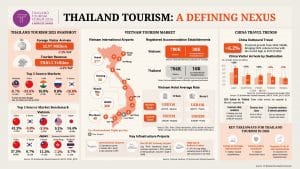
Vietnam, the new rising star
” This brings us to competition in the region. Vietnam, in particular, is a rising star. In 2025, arrivals to Vietnam grew by 41% year over year. That growth has come partly at Thailand’s expense, as Vietnam has successfully captured market share. Japan is also growing strongly in Vietnam, reinforcing the idea that travelers are shifting their preferences within Asia.”
“When we look at Japan as a destination itself, the numbers are striking. Thai outbound travel to Japan grew by 5.7%, supported by visa-free access and ease of travel. Chinese outbound travel to Japan surged as well, up 37%. But as we’ve seen, geopolitics can shift overnight and reshape travel flows instantly. That’s why resilience and diversification are essential. Thailand cannot rely on a single market or old assumptions.”
” One key lesson is the role of the private sector. Tourism growth in Thailand has always been driven by private enterprise—companies like Marriott, CPN [Ed. Central Pattana PCL], and many others. The private sector pushes forward, while the public sector struggles to keep up with infrastructure. That gap is becoming more visible when we compare Thailand with its neighbors.”
“Take Vietnam again. In terms of hotel supply, Vietnam now has roughly the same number of hotel keys as Thailand. These are comparable markets. The difference is that Vietnam is earlier in its development cycle and investing aggressively in infrastructure. International airports are expanding rapidly, often through public-private partnerships. Developers are required to contribute to infrastructure, including airports, through BOT [Ed. Build-Operate-Transfer] projects. That simply isn’t happening at the same pace in Thailand. We are still waiting for the Phuket expressway, still waiting for a new airport, still facing delays in the Eastern Economic Corridor and the high-speed rail project.”
“Infrastructure matters because if travelers can’t get there easily, they won’t stay there. And while Thailand once had a clear advantage, neighboring countries are catching up fast.“
“There’s also a perception that Vietnam is significantly cheaper than Thailand. In reality, the gap isn’t as wide as people think. Luxury hotels in Vietnam may be cheaper, but overall pricing is not dramatically different. Destinations like Phu Quoc are actively attracting travelers who might previously have chosen Thailand. Vietnam is competitive, not just on price, but on novelty and momentum. Over time, Vietnam will face the same challenge Thailand does today—how to increase profitability in a maturing market.”

“We can’t suddenly decide Thailand wants only wealthy travelers with over 700,000 hotel rooms”
“Thailand, meanwhile, is already a mature tourism destination. That brings us back to China. Chinese outbound travel volumes in 2025 are roughly back to 2019 levels—but those travelers are going elsewhere.
“The question Thailand must ask is simple but critical: what comes next? Do we keep chasing an arbitrary target of 38 million visitors, or do we rethink the product? Do we invest in secondary and tertiary destinations? Vietnam has consolidated provinces and deliberately focused on growing second- and third-tier destinations. Thailand needs to do the same. Today, we remain overly dependent on legacy destinations—Phuket, Koh Samui, Pattaya, Chiang Mai. What about everywhere else?”
“We often talk about quality versus quantity, but Thailand has more than 700,000 hotel rooms. We can’t suddenly decide we only want wealthy travelers. Budget travelers matter. Someone staying in a budget hotel today may become a higher-end traveler tomorrow. They grow, their aspirations grow, and they come back. That journey is part of what has made Thailand successful.”
“The challenge is managing massive supply while increasing value. The private sector is making progress—developments like those by lifestyle real estate group AWC and large-scale mixed-use destinations show what’s possible. But looking ahead to 2026, the private sector must also influence government thinking. Tourism is the face of Thailand. It’s the country’s most powerful brand—rooted in food, culture, hospitality, and warmth.”
” Yet destination fatigue is real. People talk about going to Japan, to Vietnam, to somewhere new. Even Thais themselves are choosing to travel abroad. At the same time, Thailand’s own identity is evolving. Street food, once at the heart of the Thai experience, is disappearing from the streets. Legacy hotels need reinvention. Culture must adapt.”
“How Thailand evolves, how it competes, and how it stays relevant in a rapidly changing regional and global landscape. This is what the Thailand Tourism Forum is all about”.
Related News Stories: Thailand Tourism at a crossroads: analysis of Bill Barnett, C9 ... Normalcy is back to Madagascar as proved by Air France return HotelPlanner partners with The Lawn Tennis Association Loganair to the rescue for Blue islands' customers HotelPlanner blends AI and human touch to transform booking Avelo Airlines drops ICE deportation flights TravelBrands launches winter car rental incentive for advisors Angola unveils new tourism brand ahead of ITB Berlin 2026 Alaska Airlines secures slots for nonstop London flights Amsterdam mulls full cruise ship ban


newadmin




















Vegas’s Billion-Dollar Secrets – What They Don’t Want Tourists to Know

Visit Florida’s New CEO Bryan Griffin Shares His Vision for State Tourism with Graham

Chicago’s Tourism Renaissance: Graham Interviews Kristin Reynolds of Choose Chicago

Graham Talks with Cassandra McCauley of MMGY NextFactor About the Latest Industry Research

Destination International’s Andreas Weissenborn: Research, Advocacy, and Destination Impact

Graham and Don Welsh Discuss the Success of Destinations International’s Annual Conference

Graham and CEO Andre Kiwitz on Ventura Travel’s UK Move and Recruitment for the Role

Brett Laiken and Graham Discuss Florida’s Tourism Momentum and Global Appeal

Graham and Elliot Ferguson on Positioning DC as a Cultural and Inclusive Global Destination

Graham Talks to Fraser Last About His England-to-Ireland Trek for Mental Health Awareness

Kathy Nelson Tells Graham About the Honour of Hosting the World Cup and Kansas City’s Future

Graham McKenzie on Sir Richie Richardson’s Dual Passion for Golf and His Homeland, Antigua







 ADS PRO
Global tourism exceeds 1.5 billion travelers announces UN-Tourism
Qatar Airways offers reduced timetable to over 60 destinations
WTTC global tourism reached record economic impact of 11 trillion in 2025
Marginal increase for New York City tourism in 2025
Hands In, UATP join forces for airline multi-card payments