
Carbon Management in tourism: Creating networks for sustainable mobility; Alpine Pearls
In the Alps, car travel as the predominant mode of tourism mobility has increased considerably in recent decades, with the latest available figures for the region suggesting that an estimated 80 per cent of all tourist trips are based on the car.
As a response to increasing pressure from car use, including crowding in alpine villages as well as air and noise pollution a number of communities in Switzerland decided to become car-free as early as in 1988, founding the Gemeinschaft Autofreier Schweizer Tourismusorte (GAST; Community of Vehicle-Free Swiss Tourist Resorts).
The concept has worked well for the involved communities, with for instance guest nights in Saas-Fee developing at ‘three times the Swiss average’). The nine Swiss car-free communities are still organized in GAST, but little has been done over the past 10 years to actively market the concept. A new Internet presentation is however planned for 2010
Most measures to achieve modal shifts from the car to alternative transport modes have, in the past, been based on incentives or ‘carrots’. However, incentives have generally had only limited success, while disincentives (‘sticks’) have attracted public and political opposition, and thus generally been deemed unacceptable. This raises the question of how modal shifts from cars to trains or buses can be achieved more systematically. Possibly, this should include measures to also address origin–destination mobility, which accounts for the majority of emissions caused by a holiday, and not just the destination itself.
The solution
In 1996/1997, 11 destinations in the Alps became involved in a programme sup- ported by the EU Tourism Directorate (DG XXIII) called ‘Sanfte Mobilität’ (sustainable mobility), with the goal of optimizing transport systems in tourism regions Subsequent projects included Alps Mobility and Alps Mobility II -Alpine Pearls (from 2000–06), which led to the foundation of the Alpine Pearls network.
The network is now well established and offers a range of advantages to its members, including a strong brand, marketing under the Alpine Pearls umbrella, cooperation with three media agencies, and marketing materials in five languages. The Alpine Pearls now include 21 communities in six countries – Austria, Germany, France, Italy, Switzerland, and Slovenia – accounting for about 10 million bed nights.
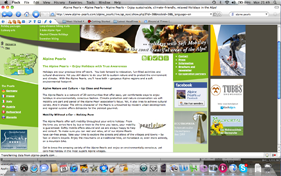
The network’s marketing focus is on soft mobility, which is communicated to guests through the association’s website www.alpine-pearls.com
The Alpine Pearls is a network of 21 communities that offer easy, yet comfortable ways to enjoy holidays in environmentally conscious fashion. Climate protection and nature conservation via soft mobility are part and parcel of the Alpine Pearl associations focus.
"The Alpine Pearls offer soft mobility throughout your entire holiday: From the time you arrive here by bus or train to the time you leave, your mobility is guaranteed. Softly mobile offers abound and we are always happy to help and consult. To make sure you can rest and relax, all of our Alpine Pearls have car-free areas. Take your time to explore the streets and alleys of the villages and towns – by foot or electric bicycle. Enjoy the mountains on a traditional hike, on horseback or, even more actively, on a mountain bike."
An interesting difference to communication strategies by other tour operators and organizations is that the Alpine Pearls make direct reference to environmental issues, possibly, because they cater more directly to tourists wishing to escape car-based lifestyles, enjoying quiet areas, and exploration of the local on foot, by bike or on horseback, as well as by means of e-mobility.
Communities wishing to join the Alpine Pearls consequently have to fulfil a list of criteria centred around sustain- able mobility, including (1) basic mobility, i.e. mobility offers connected to arrival and departure, mobility within the region and within the Alpine Pearls; (2) fun mobility, i.e. offers of e-mobility; and (3) service quality for mobility, i.e. informa- tion and service regarding mobility. Slow mobility is thus at the heart of the market- ing strategy, as also mirrored in the Alpine Pearls ‘quality promise’.
The focus on sustainable mobility by the Alpine Pearls appears to have been a success, even though no statistics on arrival numbers are collected . As outlined by Karmen Mentil, Project Director Alpine Pearls, safe, quiet, healthy alpine environments are an attraction in themselves, and the market for this type of holiday is growing. The marketing message that can be distributed through the network and under the Alpine Pearls brand is that there already exist options to engage in climate-sensitive holidays.
The success of the concept is also reflected in the growth of the network, with expectations for 4-5 new communities joining the Alpine Pearls by 2012. A total of 35 Pearls is possible, according to Karmen Mentil.
The Alpine Pearls have shown that it is possible to address mobility, and to make it attractive to arrive by public transport at the destination. This also includes perspectives on marketing and branding with, for instance, pristine alpine environ- ments being highly attractive for tourism, thus allowing for intercontextualization of pro-environmental behaviour.
The above was excerpted from ‘Carbon Management in Tourism’ by Professor Stefan Gossling due to be published by Routledge on 9 December
www.routledge.com/books/details/9780415566339/
Valere Tjolle
Valere Tjolle is editor of the Sustainable Tourism Report Suite: EXTRA SPECIAL OFFER at:
www.travelmole.com/stories/1145345.php


Valere




















Vegas’s Billion-Dollar Secrets – What They Don’t Want Tourists to Know

Visit Florida’s New CEO Bryan Griffin Shares His Vision for State Tourism with Graham

Chicago’s Tourism Renaissance: Graham Interviews Kristin Reynolds of Choose Chicago

Graham Talks with Cassandra McCauley of MMGY NextFactor About the Latest Industry Research

Destination International’s Andreas Weissenborn: Research, Advocacy, and Destination Impact

Graham and Don Welsh Discuss the Success of Destinations International’s Annual Conference

Graham and CEO Andre Kiwitz on Ventura Travel’s UK Move and Recruitment for the Role

Brett Laiken and Graham Discuss Florida’s Tourism Momentum and Global Appeal

Graham and Elliot Ferguson on Positioning DC as a Cultural and Inclusive Global Destination

Graham Talks to Fraser Last About His England-to-Ireland Trek for Mental Health Awareness

Kathy Nelson Tells Graham About the Honour of Hosting the World Cup and Kansas City’s Future

Graham McKenzie on Sir Richie Richardson’s Dual Passion for Golf and His Homeland, Antigua







 ADS PRO
Global tourism exceeds 1.5 billion travelers announces UN-Tourism
Qatar Airways offers reduced timetable to over 60 destinations
WTTC global tourism reached record economic impact of 11 trillion in 2025
Hands In, UATP join forces for airline multi-card payments
Overseas travelers to the United States declined by 2.5% in 2025