
COP15 Obama Climate Accord What it Means For Tourism
Sunday, 20 Dec, 2009
0
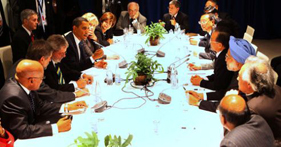
So, President Obama and the leaders of China, India and South Africa presented the rest of the 192 nations at the 15th Climate Change Conference in Copenhagen with an ‘Accord’ which has been duly noted. After two more years of negotiating, the world’s leaders have decided to defer any real decisions to COP16 in Mexico next year.
Of course climate change and the cost of mitigation and adaptation will affect the travel and tourism industry. What the ‘Accord’ provides is a little breathing space to come to terms with the measures that will need to be taken. However, climate change hasn’t stopped to have a breather too, so the later the measures are taken, the more draconian they will be. The principles in the ‘Accord’, which will affect the travel and tourism industry, are as follows:
2 Degree Global Temperature ‘Cap”
To limit “increase in global temperature below 2 degrees” in recognition of the scientific and “the ultimate objective of the Convention to stabilize greenhouse gas concentration in the atmosphere at a level that would prevent dangerous anthropogenic interference with the climate system”
To reduce global emissions by 50 per cent below 1990 levels by 2050 and “cooperate in achieving the peaking of global and national emissions as soon as possible, recognizing that the time frame for peaking will be longer in developing countries”.
Developing & Developed Countries Targets:
Annex 1 or developed countries “commit to reducing their emissions individually or jointly by at least 80 per cent by 2050”.
Developed countries are to implement individual or joint quantified targets for emissions reduction by 2020, to both 1990 and 2005 base years.
Developing nations are to publish their emissions curbing commitments by January which would be set out in an appendix to a new global agreement.
TRAVEL & TOURISM: Even at those rates of reduction, the IPCC warns, there remains a 50% chance that global temperature rise will be greater than 2°C. This puts island states and many seaside destinations immediately at risk and increases the volatility of mountain areas
MRV – Measurement Reporting Verification
Developing nations’ action on emissions will undergo only domestic measurement, reporting and verification but will be subject to internationally-agreed standards under the UN climate convention. They would then communicate progress to their commitments every two years.
TRAVEL & TOURISM: Each individual travel and tourism industry and company in it (including hotels, rail, airlines, coach, shipping etc) will eventually have emissions caps set and they will be monitored – how else could it work?
REDD – Reducing Emissions from Deforestation and Degradation
On deforestation, there should be the “immediate establishment of a mechanism including REDD-plus” to mobilise capital from developed countries for “reducing emissions from deforestation and forest degradation” and enhancing “removals of greenhouse gas emission by forests”. (REDD negotiators and observers were hopeful that a forests sector text was close to agreement at the talks.)
Financing
Developed countries are to “support a goal of mobilizing jointly 100 billion dollars a year by 2020 to address the needs of developing countries. This funding will come from a wide variety of sources, public and private, bilateral and multilateral, including alternative sources of finance.
There will also be 30 billion dollars made available over the three-year period 2010 to 2012 inclusive, balanced between climate change adaptation and emissions mitigation.
A new UNFCCC mechanism called the Copenhagen Climate Fund will be established to support funded “projects, programmes, policies” on mitigation, REDD-plus, adaptation, capacity building, technology development and transfer.
TRAVEL & TOURISM: You can be sure that a major proportion of that $100bn will come from markets – in other words organisations paying for their carbon emissions over and above a cap – such as the EU-ETS. When it happens this will represent a massive boost for the carbon markets and BIG financial opportunities for carbon efficiency.
Technology transfer
A new Technology Mechanism will also be established to further accelerate technology development and transfer under a country-by-country approach. (This is in contrast to the existing CDM which takes a project based approach.)
2016 review
A review of the Copenhagen Accord’s progress must be completed by 2016, and would also consider “strengthening the long-term goal to limit the increase in global average temperature to 1.5 degrees”.
Friends of the Earth said “Climate negotiations in Copenhagen have yielded a sham agreement with no real requirements for any countries. This is not a strong deal or a just one — it isn’t even a real one. It’s just repackaging old positions and pretending they’re new. The actions it suggests for the rich countries that caused the climate crisis are extraordinarily inadequate. This is a disastrous outcome for people around the world who face increasingly dire impacts from a destabilizing climate”
Valere Tjolle
Get a copy of the postCOP15 Tourism Carbon Guide, Sustainable Tourism Report and Marketing Guide. See: www.travelmole.com/stories/1139697.php
FURTHER INFORMATION:
Annex I Countries (industrialised):
Australia, Austria, Belarus, Belgium, Bulgaria, Canada, Croatia, Czech Republic, Denmark, Estonia, Finland, France, Germany, Greece, Hungary, Iceland, Ireland, Italy, Japan, Latvia, Liechtenstein, Lithuania, Luxembourg, Monaco, Netherlands, New Zealand, Norway, Poland, Portugal, Romania, Russian Federation, Slovakia, Slovenia, Spain, Sweden, Switzerland, Turkey, Ukraine, United Kingdom, United States of America and EU
Annex II Countries (who have to pay the bills):
Australia, Austria, Belgium, Canada, Denmark, Finland, France, Germany, Greece, Iceland, Ireland, Italy, Japan, Luxembourg, Netherlands, New Zealand, Norway, Portugal, Spain, Sweden, Switzerland, United Kingdom, United States of America (23 countries and separately the European Union; Turkey was removed from the annex II list in 2001 at its request to recognize its economy as a transition economy


Valere





















Vegas’s Billion-Dollar Secrets – What They Don’t Want Tourists to Know

Visit Florida’s New CEO Bryan Griffin Shares His Vision for State Tourism with Graham

Chicago’s Tourism Renaissance: Graham Interviews Kristin Reynolds of Choose Chicago

Graham Talks with Cassandra McCauley of MMGY NextFactor About the Latest Industry Research

Destination International’s Andreas Weissenborn: Research, Advocacy, and Destination Impact

Graham and Don Welsh Discuss the Success of Destinations International’s Annual Conference

Graham and CEO Andre Kiwitz on Ventura Travel’s UK Move and Recruitment for the Role

Brett Laiken and Graham Discuss Florida’s Tourism Momentum and Global Appeal

Graham and Elliot Ferguson on Positioning DC as a Cultural and Inclusive Global Destination

Graham Talks to Fraser Last About His England-to-Ireland Trek for Mental Health Awareness

Kathy Nelson Tells Graham About the Honour of Hosting the World Cup and Kansas City’s Future

Graham McKenzie on Sir Richie Richardson’s Dual Passion for Golf and His Homeland, Antigua







 ADS PRO
Clearing CSS/JS assets' cache... Please wait until this notice disappears...
Updating... Please wait...
Higher departure tax and visa cost, e-arrival card: Japan unleashes the fiscal weapon against tourists
Euromonitor International unveils world’s top 100 city destinations for 2025
U.S.A. and Israel attacks on Iran impact air movements in the Gulf (Update 1.00pm CET)
Global tourism exceeds 1.5 billion travelers announces UN-Tourism
WTTC global tourism reached record economic impact of 11 trillion in 2025