
Investors warn over UN climate fund
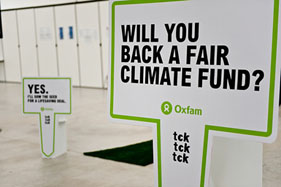
$10trillion investors warn that green economy fund could be strangled at birth
International investor bodies representing institutions with more than $10tn of assets say a flagship fund designed to channel billions of dollars to poor countries is at risk of being "strangled at birth" at this week’s annual UN climate talks. Reported the Financial Times
In a sign of the simmering antagonism overshadowing the negotiations in the Qatari capital of Doha, a group of 17 countries led by China and India have told the conference that the UN should be able to vet any investment made by the new green climate fund.
Such a move would be untenable for the private sector investors the fund is supposed to encourage, say the heads of two international investment groups focused on climate change.
"It would create too much uncertainty and stop people investing," said Stephanie Pfeifer of the Institutional Investors Group on Climate Change, which represents many of Europe’s biggest pension funds and asset managers.
"It would be like a government setting up an investment vehicle and having every investment it makes go back to the parliament," said Nathan Fabian of the Investor Group on Climate Change in Australia and New Zealand.
"If one of the objectives of the green climate fund is to attract private sector investment, this would achieve the opposite," he said. "It would mean the fund would be strangled at birth."
A formal submission to the conference from the group of 17 countries, which also includes Saudi Arabia, Iran and Iraq, says the fund’s board should develop ways of making sure "a particular funding decision may be reconsidered" at UN climate meetings.
Another proposal is also circulating that Mr Fabian said would create a more realistic framework for investors but it is unclear whether it is attracting much support.
The green climate fund was launched a year ago at the last UN climate talks, in Durban, South Africa.
But like almost every initiative to emerge from the global climate rules negotiating process, it has been dogged by squabbles over how and where it should be run, and by whom.
It now has a board and a home – Songdo, South Korea – but it is still empty. This year’s climate talks in Doha are supposed to finalise its rules and discuss where its money might come from.
The fund is expected to channel a significant portion of the $100bn a year wealthy countries agreed nearly three years ago that they would raise by 2020 to help poorer nations curb their greenhouse gas emissions and cope with the impacts of climate change.
Many developed countries, some of them struggling with weak economies, hope they can use the fund to galvanise private sector investment.
But poorer countries are often more wary of depending on privately funded climate aid because they say many of the problems they need to fix, such as poor seawall protection or vulnerable transport links, are unlikely to attract investment requiring a profitable return.
New offers on sustainable tourism information HERE


Valere
















Vegas’s Billion-Dollar Secrets – What They Don’t Want Tourists to Know

Visit Florida’s New CEO Bryan Griffin Shares His Vision for State Tourism with Graham

Chicago’s Tourism Renaissance: Graham Interviews Kristin Reynolds of Choose Chicago

Graham Talks with Cassandra McCauley of MMGY NextFactor About the Latest Industry Research

Destination International’s Andreas Weissenborn: Research, Advocacy, and Destination Impact

Graham and Don Welsh Discuss the Success of Destinations International’s Annual Conference

Graham and CEO Andre Kiwitz on Ventura Travel’s UK Move and Recruitment for the Role

Brett Laiken and Graham Discuss Florida’s Tourism Momentum and Global Appeal

Graham and Elliot Ferguson on Positioning DC as a Cultural and Inclusive Global Destination

Graham Talks to Fraser Last About His England-to-Ireland Trek for Mental Health Awareness

Kathy Nelson Tells Graham About the Honour of Hosting the World Cup and Kansas City’s Future

Graham McKenzie on Sir Richie Richardson’s Dual Passion for Golf and His Homeland, Antigua







 ADS PRO
Higher departure tax and visa cost, e-arrival card: Japan unleashes the fiscal weapon against tourists
Euromonitor International unveils world’s top 100 city destinations for 2025
U.S.A. and Israel attacks on Iran impact air movements in the Gulf (Update 1.00pm CET)
Global tourism exceeds 1.5 billion travelers announces UN-Tourism
WTTC global tourism reached record economic impact of 11 trillion in 2025