
New Caledonia is gradually trying to rebuild its tourism sector two years after violent political unrest in May 2024 brought parts of the French Pacific territory to a standstill and severely disrupted travel demand.
Images of roadblocks, fires and looting in Greater Noumea during the crisis triggered a sudden collapse in visitor numbers and broke the destination’s tourism momentum. While the immediate shock has eased, the recovery remains slow and uneven, with aviation and hospitality still operating well below normal capacity.
Tourism professionals say the territory is now focused on moving forward, even as political tensions remain unresolved. The message from industry leaders is consistent: safety has stabilized, infrastructure is operational, and the destination is open again to visitors.
Disappointing tourist numbers
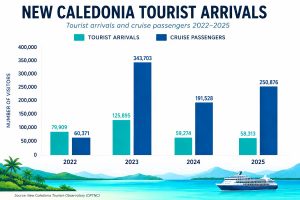
However, the numbers highlight the scale of the challenge. Overnight visitors’ arrivals have fallen from around 126,000 in 2023 to just 58,000 in 2025. And the majority of those current travelers are not traditional tourists but French visitors coming to see family members already living on the island.
Meanwhile, cruise visitors showed more resilience with total cruise passengers disembarking in New Caledonia reaching last year 250,876, an increase of 30.99% over 2024.
In 2025, top visitors are Metropolitan French (24,254 arrivals, market share of 41.58%). However, it represents only 60% of total arrivals prior to the crisis (over 42,000 in 2019).
France is followed by Australians (11,688 arrivals, market share of 20.04%), Wallis and Futuna territory (8,146 arrivals, 13.97%), New Zealand (2,305 arrivals, 3.95%) and French Polynesia (2,286 arrivals, 3.92%). Meanwhile, Japanese arrivals completely collapsed. Reaching 21,708 arrivals in 2019, being number 3, Japanese visitors generated only 370 arrivals last year, a market share of 0.63%.
Local tourism officials insist that conditions on the ground are now stable. They stress that tourists were never directly targeted during the 2024 unrest, describing the events as an internal political issue rather than a tourism security threat. They also say that visitors today can move freely across the territory without incident.
Rebuilding confidence
Efforts are now focused on rebuilding confidence and restoring the destination’s international image. Tourism representatives have stepped up marketing activity, hosting tour operators, media and influencers to showcase conditions on the ground.
Feedback from these familiarization visits has reportedly been positive, with many participants describing strong impressions of the destination.
Despite this, industry players acknowledge that reputational recovery will take time, particularly after extensive negative media coverage. Local operators say the sector has reorganized and professionalized in preparation for a rebound, but patience will be required.
Some early signs of recovery are emerging. Travel agencies are once again issuing quotations for New Caledonia itineraries, and service quality improvements are being noted. Select tour operators specializing in diving and experiential travel report encouraging client feedback and renewed interest.
Air connectivity has also improved with the introduction of a Paris–Noumea route via Bangkok by Aircalin in late 2024, which has helped support demand recovery, although internal air services remain under pressure.
On the ground, challenges persist. Domestic carrier Air Calédonie continues to struggle, while the hotel sector is operating at very low occupancy levels of around 15%. Hoteliers say they are fully prepared for a rebound but are currently waiting for demand to return.
New openings, including the Wadra Bay luxury resort on Lifou Island, have so far seen limited occupancy despite high expectations for island tourism growth.
Promoting authentic slow tourism experience
Local stakeholders argue that tourism now offers a more intimate and less crowded experience than before the crisis. With fewer visitors, they highlight uncrowded beaches, pristine diving sites and strong cultural encounters with local communities as key advantages for travelers seeking authenticity.
Industry voices say the destination is currently in a rare transition phase, offering what they positively describe as a “slow tourism” experience in one of the Pacific’s most diverse natural environments.