
Two-minute guide to elephant trekking
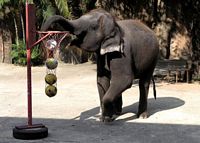
Have you ever ridden an elephant on your travels? Or watched elephants perform in a show? Perhaps you felt uncomfortable at the time, but were unable to put a finger on why. Well, you’re not alone. Elephant trekking is high up on the wish list of many travellers, particularly in Asia. Our new guide to Elephants in Tourism: Right or Wrong? is a world first. Compiling opinions and advice from NGOs, travel companies and local experts, it aims to give travel agents, and travellers, useful, accurate information to help tackle these ethical dilemmas.
Elephants have been a tourist attraction for some time and the abolishment of logging in Thailand in 1989 saw many animals and their handlers turn to tourism as a way of sustaining their livelihoods. Paid-for elephant back rides became a popular part of travel companies’ itineraries. Other elephants found themselves in tourist camps where they were trained to play football, perform in orchestras or paint pretty pictures – all for our entertainment.
Behind the scenes the picture has been less than pretty. There are no regulations or laws in Asia regulating elephant establishments. As a result the animals can be chained up all day with little freedom, water or shade from the midday sun; deprived from other elephant company; rocking and swaying with the psychological stress. Those used for rides may trek for hours, with several tourists packed aboard its back, and a chair or ‘howdah’ rubbing repeatedly on its skin causing sores that get easily infected. The handler or ‘mahout’ may overuse a bull hook, piercing and digging into the elephant’s skin to ‘control’ it. This is a life far from the freedom its wild counterparts enjoy.
Or so you’d think. What is currently happening with wild elephants is unfortunately as much a part of the problem. We are hearing how wild adult elephants are being gunned down so that illegal traffickers can capture the baby elephants. They are then subjected to a horrific ‘breaking in’ process which can involve days tied up in a cage; deprived of food, water and sleep; repeated beatings, burns and stabbings in an effort to get the elephant to submit to human control. A newly broken in calf can be worth US$30,000 or more when sold for tourism.
As long as elephant trekking and performances continue for tourists, then so will the insatiable demand for these wild elephants, thereby fuelling a deadly cycle that is so very threatening to this already endangered animal. It is this which has led to our decision to no longer promote elephant treks or performances on www.responsibletravel.com.
So what are the alternatives for tourists who want to see these majestic creatures? There are sanctuaries out there that are operating ethically. It is important to research thoroughly, avoiding those offering treks and performances and ask plenty of questions. Consider viewing elephants in the wild – there are some fantastic, responsible trips available and ultimately nothing compares to the experience of seeing these creatures in their natural habitats. It is by thoughtfully enquiring and voicing our concerns that we can bring about real change and help conserve this precious species for generations to come.
For more information on responsible tourism, see www.responsibletravel.com/elephants


Diane




















Vegas’s Billion-Dollar Secrets – What They Don’t Want Tourists to Know

Visit Florida’s New CEO Bryan Griffin Shares His Vision for State Tourism with Graham

Chicago’s Tourism Renaissance: Graham Interviews Kristin Reynolds of Choose Chicago

Graham Talks with Cassandra McCauley of MMGY NextFactor About the Latest Industry Research

Destination International’s Andreas Weissenborn: Research, Advocacy, and Destination Impact

Graham and Don Welsh Discuss the Success of Destinations International’s Annual Conference

Graham and CEO Andre Kiwitz on Ventura Travel’s UK Move and Recruitment for the Role

Brett Laiken and Graham Discuss Florida’s Tourism Momentum and Global Appeal

Graham and Elliot Ferguson on Positioning DC as a Cultural and Inclusive Global Destination

Graham Talks to Fraser Last About His England-to-Ireland Trek for Mental Health Awareness

Kathy Nelson Tells Graham About the Honour of Hosting the World Cup and Kansas City’s Future

Graham McKenzie on Sir Richie Richardson’s Dual Passion for Golf and His Homeland, Antigua







 ADS PRO
Higher departure tax and visa cost, e-arrival card: Japan unleashes the fiscal weapon against tourists
Singapore to forbid entry to undesirable travelers with new no-boarding directive
Euromonitor International unveils world’s top 100 city destinations for 2025
U.S.A. and Israel attacks on Iran impact air movements in the Gulf (Update 1.00pm CET)
Global tourism exceeds 1.5 billion travelers announces UN-Tourism