
Unexpected Abu Dhabi
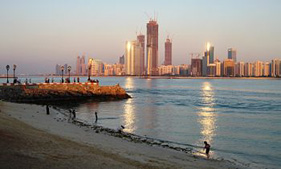
Dramatic developments: sustainability much more than the sum of its parts
Getting off an airplane at 6am and waiting in a slow moving queue for half an hour to be checked over by an immigration official is never a good introduction to a country on a first visit.
How do you get over the annoyance you feel when you can see dozens of harmless tourists kept waiting by officialdom? “I like your hat” said the smiling passport officer. Boom. That was the sound of a misconception exploding as I meandered towards the waiting smiles of my waiting driver and guide.
And there were many more misconceptions to go on this brief visit. In its 40years (to last week) the United Arab Emirates – Abu Dhabi, Ajman, Dubai, Fujairah, Ras al-Khaimah, Sharjah, and Umm al-Quwain – has made a practice of achieving the unexpected on many fronts and in very quick time too.
Consider, 40 years ago none of the emirates was thought of as a particularly popular tourism destination and now not only is one heading the charts with over 5 million tourists a year seeking sun, luxury and celebrity (Dubai) but another is set to hit the heights with massive investments in culture and sustainability (Abu Dhabi).
During the next few years, billion dollar investments by oil-rich Abu Dhabi are set to unveil an unparalleled trio of cultural tourism attractions.
If the schedule is achieved, by 2020 Abu Dhabi’s Saadiyat Island will see the creation of a Louvre Museum, a Guggenheim Museum, a NYU campus, a performing arts centre and Zayed National Museum amongst much else cultural. Not only this, but Masdar, a whole new city, is set to be Abu Dhabi’s contribution to the world of sustainability
Seeing is believing as they say.
To get some idea as to Abu Dhabi’s commitment to quality, just visit the exquisite Sheikh Zayed Grand Mosque which was started to be built less than 20 years ago.
Large enough to accommodate over 40,000 worshipers, the mosque’s design and construction 'unites the world', using artisans and materials from many countries including Italy, Germany, Austria, Morocco, India, Turkey, Malaysia, Iran, China, United Kingdom, New Zealand, Greece and United Arab Emirates. More than 3,000 workers and 38 renowned contracting companies took part in its construction.
The carpet in the main prayer hall is considered to be the world's largest carpet made by Iran's Carpet Company and designed by Iranian artist Ali Khaliqi. This carpet measures 5,627 m2 (60,570 sq ft), and was made by around 1,200-1,300 carpet knotters. There are seven imported chandeliers from Austria that incorporate millions of Swarovski crystals. The largest chandelier is the largest known chandelier inside a mosque and has a 10 m (33 ft) diameter and a 15 m (49 ft) height.
And these are just a few of the features – even the 96 columns in the main prayer hall are clad with marble and inlaid with mother of pearl.
You would imagine that such a place would be thronged with people and noisy activity. You’d be wrong – it’s as serene as a calm lake.
At Masdar City, the statistics continue unabated. But here the activity is directed towards the future – a low carbon future at that. Interesting concept in an oil economy!
Nonetheless, Masdar already has a massive solar panel test field, a beam down project to leverage solar power, a geothermal drilling rig, a material recycling centre, a personal rapid transport system, desalination plants amongst much else.
But Masdar even given its massive ambitions to be the zero-carbon city of the future, is much more than the sum of its parts.
From its knowledge centre to its linear parks, the city is being designed to be a vibrant holistic family home.
With all this massive activity, here again you would expect noise and rushing – you get little more than the contented swish of electric cars.
Maybe, though, the key to Abu Dhabi is the Corniche where crowds should gather to stroll, eat ice cream in the sun, shop in the markets, chat in the cafes, play with their kids.
Yes, they do all this happily, but nonetheless very serenely.
That is Abu Dhabi style perhaps – understated, unhurried elegance, where a Louvre and a Guggenheim can co-exist with a golf championship and a zero carbon city and bust all of your preconceptions – sustainably.
Valere Tjolle
Valere is editor of the Sustainable Tourism Report Suite 2011 Get your copy at a special offer price: HERE


Valere












Vegas’s Billion-Dollar Secrets – What They Don’t Want Tourists to Know

Visit Florida’s New CEO Bryan Griffin Shares His Vision for State Tourism with Graham

Chicago’s Tourism Renaissance: Graham Interviews Kristin Reynolds of Choose Chicago

Graham Talks with Cassandra McCauley of MMGY NextFactor About the Latest Industry Research

Destination International’s Andreas Weissenborn: Research, Advocacy, and Destination Impact

Graham and Don Welsh Discuss the Success of Destinations International’s Annual Conference

Graham and CEO Andre Kiwitz on Ventura Travel’s UK Move and Recruitment for the Role

Brett Laiken and Graham Discuss Florida’s Tourism Momentum and Global Appeal

Graham and Elliot Ferguson on Positioning DC as a Cultural and Inclusive Global Destination

Graham Talks to Fraser Last About His England-to-Ireland Trek for Mental Health Awareness

Kathy Nelson Tells Graham About the Honour of Hosting the World Cup and Kansas City’s Future

Graham McKenzie on Sir Richie Richardson’s Dual Passion for Golf and His Homeland, Antigua







 ADS PRO
Global tourism exceeds 1.5 billion travelers announces UN-Tourism
Qatar Airways offers reduced timetable to over 60 destinations
WTTC global tourism reached record economic impact of 11 trillion in 2025
Marginal increase for New York City tourism in 2025
Hands In, UATP join forces for airline multi-card payments