
Bisignani Says Copenhagen Unique Opportunity to Change Aviation’s Impact
Monday, 31 Aug, 2009
0
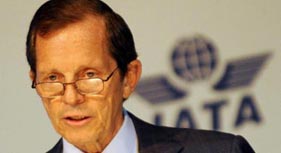
The Director General of IATA Giovanni Bisignani has united the aviation industry in a drive to achieve carbon neutral growth and eventually zero-carbon emission technology.
In an article which appeared on 21 August, Giovanni Bisignani called for governments to abandon punitive measures that do little for the environment and agree to adopt measures that help to reduce aviation emissions effectively.
He said:
"The Copenhagen process presents a unique opportunity for close co-operation between industry and government to address aviation’s climate change impact. While the positions on climate change negotiations in Copenhagen are unfolding, the airline industry is assuming its responsibility by making significant commitments to reduce its emissions based on concrete targets and a strong track record. At the same time, we are calling on governments to adopt a global and sectoral approach to aviation emissions."
"The industry has established a comprehensive and ambitious framework to lower its 2 per cent share of global man-made CO2 emissions. At the IATA AGM in 2007, I presented a bold vision for the industry to build a carbon-free aircraft within 50 years.To support this vision, IATA adopted a four-pillar strategy, which promotes and drives efforts in four key areas: improved technology, effective operations, efficient infrastructure and positive economic measures."
"Since its inception, efforts co-ordinated under the four-pillar strategy have delivered substantial reductions in emissions. Last year, IATA’s efforts saved 15 million tonnes of CO2. This year, we are forecasting a 6.5 per cent fall in emissions, from 666 million tonnes in 2008 to 623 million tones in 2009. About 5 per cent of this is from cuts in capacity due to the economic downturn, but the remaining 2 per cent is due to efficiencies achieved under the strategy."
"At the 2009 AGM, the IATA board of governors took a landmark decision to adopt a set of ambitious targets to mitigate greenhouse gas emissions from aviation:
- A cap on aviation CO2 emissions from 2020 (carbon-neutral growth);
- An average improvement in fuel efficiency of 1.5 per cent a year up to 2020; and
- A reduction in CO2 emissions of 50 per cent by 2050, relative to 2005 levels. Carbon-neutral growth, or CNG, is an important milestone on the route towards a zero-carbon future for aviation. It ensures that aviation’s net CO2 emissions stop growing, even when demand for air transport continues to grow. The achievement of CNG thus responsibly balances the contribution made by a sustainable, competitive and healthy aviation sector to the global economy with the urgent challenge of combating climate change.
Airlines are the first industry to make such a bold commitment at global level. To achieve it, a multi-faceted approach is required with a strong commitment from all aviation stakeholders: airlines, manufacturers, fuel suppliers, airports, air navigation service providers and governments.
We are calling on governments to adopt a global approach based on the following principles when they discuss the inclusion of aviation CO2 emissions in the broader Copenhagen framework:
- Aviation CO2 emissions should be addressed through a global sectoral approach, accounting for emissions at a global level, not at regional or national level.
- The aviation industry should be held accountable (and pay) for its emissions just once, whether from international or domestic activities.
- Aviation should have unrestricted access to carbon market instruments to meet its obligations, on a par with other sectors.
- We are looking to governments to make the necessary investments to modernise air traffic management and improve airport infrastructure. They must establish legal and fiscal frameworks to facilitate and increase investment in new aircraft fleets and low carbon sustainable alternative jet fuels.
- Economic measures to address greenhouse gas emissions from aviation must be cost-effective and non-discriminatory, implemented globally and on the basis of consensus; and must not create carbon leakage where emissions transfer between countries or carriers leads to market distortions. Revenues from economic measures should be earmarked for environmental purposes, such as the development and deployment of more fuel-efficient aircraft and low carbon jet fuels.
In conclusion, the next year will be critical for the aviation industry. Governments must abandon punitive measures that do little for the environment and agree to adopt measures that help to reduce aviation emissions effectively.
PROFILE:
Giovanni Bisignani joined the International Air Transport Association as Director General & CEO in June 2002. Since that time Mr. Bisignani has completely re-shaped and re-focused the organization to better serve its global membership of 230 airlines with a mission to represent, lead and serve the air transport industry.
While securely managing IATA’s US$315 billion settlement systems, Mr. Bisignani has driven an agenda of change focused on the air transport industry’s top priorities. The ground-breaking IATA Operational Safety Audit is the first global standard for airline safety management. By making it a condition for IATA membership from 2009, IATA membership now comes with an added mark of quality.
In 2004, under Mr. Bisignani’s leadership, IATA began Simplifying the Business – bringing convenience to travellers and cost reduction to airlines through effective use of technology. The programme’s headline e-ticketing initiative eliminated paper tickets globally on 1June 2008. And the cargo equivalent – IATA e-freight – is modernising the industry by removing cumbersome paper documentation.
Mr. Bisignani has engaged airports and air navigation service providers to build a new business partnership with a common goal of cost-efficiency. This has delivered billions of dollars in savings. Meanwhile, the Association’s calls for transparency and effective economic regulation of monopoly suppliers are positively impacting legislation around the globe.
Most recently Mr. Bisignani placed IATA in a leadership position in the debate on climate change and aviation. While air transport’s contribution to climate change is limited to 2% of global carbon emissions – Mr. Bisignani has united the industry in a drive to achieve carbon neutral growth and eventually zero-carbon emission technology.
Concurrent with his responsibilities at IATA, Mr. Bisignani is a Board member of NATS Holdings Limited, the air traffic services provider of the United Kingdom.
Mr. Bisignani’s career prior to joining IATA spans several industries. He launched the European travel portal Opodo and spent five years as CEO and Managing Director of Alitalia. During this time he also served on the IATA Board of Governors. He has been a Member of Pratt & Whitney Advisory Board and Chairman of Galileo International. Mr. Bisignani began his career with Citibank and then held several high-level positions at the energy company ENI and with the Italian industrial conglomerate IRI Group. He served as President of Tirrenia di Navigazione, the largest Italian ferry company and as CEO & Managing Director of SM Logistics, a group of logistics and freight forwarding companies partially owned by GE.
Mr. Bisignani studied both in Italy (Rome) and the United States (Harvard Business School). In June 2008, Mr. Bisignani received the honorary degree ‘Doctor of Science honoris causa’ by the School of Engineering at Cranfield University in the United Kingdom. Born in Rome in 1946, he speaks Italian, English and Spanish. He is married with one daughter and enjoys golf, tennis and riding.
Valere Tjolle
Sources: ABC Carbon Express; THe Australian; IATA


Valere




















Vegas’s Billion-Dollar Secrets – What They Don’t Want Tourists to Know

Visit Florida’s New CEO Bryan Griffin Shares His Vision for State Tourism with Graham

Chicago’s Tourism Renaissance: Graham Interviews Kristin Reynolds of Choose Chicago

Graham Talks with Cassandra McCauley of MMGY NextFactor About the Latest Industry Research

Destination International’s Andreas Weissenborn: Research, Advocacy, and Destination Impact

Graham and Don Welsh Discuss the Success of Destinations International’s Annual Conference

Graham and CEO Andre Kiwitz on Ventura Travel’s UK Move and Recruitment for the Role

Brett Laiken and Graham Discuss Florida’s Tourism Momentum and Global Appeal

Graham and Elliot Ferguson on Positioning DC as a Cultural and Inclusive Global Destination

Graham Talks to Fraser Last About His England-to-Ireland Trek for Mental Health Awareness

Kathy Nelson Tells Graham About the Honour of Hosting the World Cup and Kansas City’s Future

Graham McKenzie on Sir Richie Richardson’s Dual Passion for Golf and His Homeland, Antigua







 ADS PRO
Clearing CSS/JS assets' cache... Please wait until this notice disappears...
Updating... Please wait...
Global tourism exceeds 1.5 billion travelers announces UN-Tourism
Qatar Airways offers reduced timetable to over 60 destinations
WTTC global tourism reached record economic impact of 11 trillion in 2025
Marginal increase for New York City tourism in 2025
Hands In, UATP join forces for airline multi-card payments