
Costa Rica Tops Happy Nations List
Sunday, 19 Jul, 2009
0
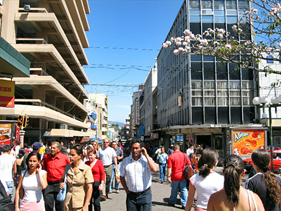
Costa Rica is the happiest place in the world, according to the UK’s New Economics Foundation. The country has a goal of building a new economy, "centered on people and the environment."
NEF ranks nations using the "Happy Planet Index," which seeks countries with the most content people. In addition to happiness, the index considers the ecological footprint and life expectancy of countries.
"Costa Ricans report the highest life satisfaction in the world and have the second-highest average life expectancy of the new world (second to Canada)," the organization said in a statement.
They "also have an ecological footprint that means that the country only narrowly fails to achieve the goal of … consuming its fair share of the Earth’s natural resources."
The Central American classical ecotourism destination, tucked between Nicaragua and Panama, offers lush rain forests and pristine beaches. Its president, Oscar Arias Sanchez, won the Nobel Peace Prize in 1987 for trying to help end civil wars in several Central American countries.
This year’s survey, which looked at 143 countries, featured Latin American nations in nine of the Top 10 spots.
The runner-up was the Dominican Republic, followed by Jamaica, Guatemala and Vietnam.
While Britain ranked 74th, the United States snagged the 114th spot, because of its massive consumption and massive ecological footprint. The United States was greener and happier 20 years ago than it is today, the report said.
Other populous nations, such as China and India, had a lower index brought on by their vigorous pursuit of growth-based models, the survey suggested.
"As the world faces the triple crunch of deep financial crisis, accelerating climate change and the looming peak in oil production, we desperately need a new compass to guide us," said Nic Marks, founder of the foundation’s center for well-being.
Marks urged nations to make a collective global change before "our high-consuming lifestyles plunge us into the chaos of irreversible climate change."
The report, which was first conducted in 2006, covers 99 percent of the world population, the statement said.
Valere Tjolle
Further information:
More information from the Happy Planet Index (HPI):
The highest HPI score is that of Costa Rica (76.1 out of 100). As well as reporting the highest life satisfaction in the world, Costa Ricans also have the second-highest average life expectancy of the New World (second only to Canada). All this with a footprint of 2.3 global hectares. Whilst this success is indeed impressive, Costa Rica narrowly fails to achieve the goal of ‘one-planet living’: consuming its fair share of natural resources (indicated by a footprint of 2.1 global hectares or less).
Of the following ten countries, all but one is in Latin America. The
highest ranking Group of 20 (G20) country in terms of HPI is Brazil, in 9th
place out of 143. Together, Latin American and Caribbean nations have the
highest mean HPI score for any region (59 out of 100).
The bottom ten HPI scores were all suffered by sub-Saharan African countries, with Zimbabwe bottom of the table with an HPI score of 16.6 out of 100.
Rich developed nations fall somewhere in the middle. The highest- placed Western nation is the Netherlands – 43rd out of 143. The UK still ranks midway down the table – 74th, behind Germany, Italy and France. It is just pipped by Georgia and Slovakia, but beats Japan and Ireland. The USA comes a long way back in 114th place.
It is interesting to note that many of the countries that do well are composed of small islands (including the Dominican Republic, Jamaica, Cuba and the Philippines).
No country successfully achieves the three goals of high life satisfaction, high life expectancy and one-planet living.
In summary, the countries that are meant to represent successful development are some of the worst-performing in terms of sustainable well-being. But perhaps, even if we are not there now, might we be moving in the right direction? HPI 2.0 tests this by looking at changes in HPI over time for countries where more data is available. The results are not promising:
Whilst most of the countries studied have increased their HPI scores marginally between 1990 and 2005, the three largest countries in the world (China, India and the USA) have all seen their HPI scores drop in that time.
Positive trajectories are seen in some countries; for example, in Germany (an increase of 23 per cent between 1990 and 2005), Russia (up 30 per cent) and Brazil (up 13 per cent).
Looking further back, focusing on OECD (Organisation of Economic Co-Operation and Development) nations, the picture is less positive. Most OECD nations saw a staggering drop in their HPI scores from the 1960s to the late 1970s. Whilst they have made some gains since then, scores were still higher in 1961 than in 2005. Life satisfaction and life expectancy combined have increased 15 per cent over the 45-year period from 1961 to 2005, but ecological footprints per head have increased by a worrying 72 per cent.
Clearly, business as usual will not help us achieve good lives that do not cost the Earth. However, looking at the components of the HPI provides some clues:
Different countries do well on different components. The highest average levels of life expectancy are those of Japan (82.3 years) and Hong Kong (81.9). The highest life satisfaction levels are those of Costa Rica (8.5 on a scale of 0–10), with Ireland, Norway and Denmark just behind. The countries which tread heaviest in terms of ecological footprint are Luxembourg, the United Arab Emirates and the USA – Luxembourg’s per capita footprint is equivalent to consuming natural resources as if we had almost five planets to rely on.
It is possible to live long, happy lives with a much smaller ecological footprint than found in the highest-consuming nations. For example, people in the Netherlands live on average over a year longer than people in the USA, and have similar levels of life satisfaction – and yet their per capita ecological footprint is less than half the size (4.4 global hectares compared with 9.4 global hectares). This means that the Netherlands is over twice as ecologically efficient at achieving good lives.
More dramatic is the difference between Costa Rica and the USA. Costa Ricans also live slightly longer than Americans, and report much higher levels of life satisfaction, and yet have a footprint which is less than a quarter the size.
Countries with the same ecological footprint support lives with differing levels of well-being and health. For example, Vietnam and Cameroon have identical ecological footprints (1.3 global hectares). However, whilst most people in Cameroon cannot expect to live more than 50 years, and reported life satisfaction is unsurprisingly low (3.9), the Vietnamese have a life expectancy higher than that found in many European countries (73.7 years) and a correspondingly higher level of life satisfaction (6.5).
Steps towards a happier planet can be found in many places. We focus on a few examples, several inspired by the first HPI report. One particularly promising model,
is the Living better, using less strategy emerging in Caerphilly, a local authority in South Wales. The strategy focuses on the three components of the HPI – health, a positive experience of life, and ecological footprint – and sets out some interventions aimed to improve performance on all three.


Valere





















Vegas’s Billion-Dollar Secrets – What They Don’t Want Tourists to Know

Visit Florida’s New CEO Bryan Griffin Shares His Vision for State Tourism with Graham

Chicago’s Tourism Renaissance: Graham Interviews Kristin Reynolds of Choose Chicago

Graham Talks with Cassandra McCauley of MMGY NextFactor About the Latest Industry Research

Destination International’s Andreas Weissenborn: Research, Advocacy, and Destination Impact

Graham and Don Welsh Discuss the Success of Destinations International’s Annual Conference

Graham and CEO Andre Kiwitz on Ventura Travel’s UK Move and Recruitment for the Role

Brett Laiken and Graham Discuss Florida’s Tourism Momentum and Global Appeal

Graham and Elliot Ferguson on Positioning DC as a Cultural and Inclusive Global Destination

Graham Talks to Fraser Last About His England-to-Ireland Trek for Mental Health Awareness

Kathy Nelson Tells Graham About the Honour of Hosting the World Cup and Kansas City’s Future

Graham McKenzie on Sir Richie Richardson’s Dual Passion for Golf and His Homeland, Antigua







 ADS PRO
Clearing CSS/JS assets' cache... Please wait until this notice disappears...
Updating... Please wait...
Global tourism exceeds 1.5 billion travelers announces UN-Tourism
Qatar Airways offers reduced timetable to over 60 destinations
WTTC global tourism reached record economic impact of 11 trillion in 2025
Hands In, UATP join forces for airline multi-card payments
Overseas travelers to the United States declined by 2.5% in 2025