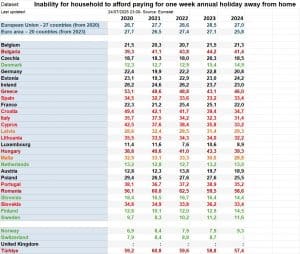
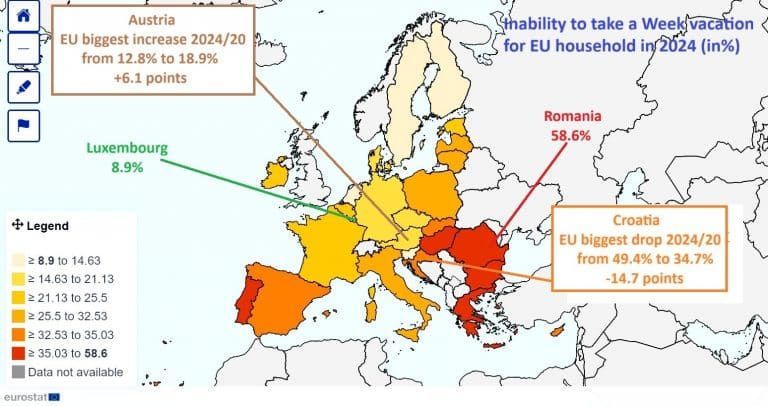
EU travel is still difficult for many EU citizens. One in four European Union citizens could not afford a one-week vacation in 2024, according to the most recent figures from Eurostat. The data highlights sharp contrasts across the bloc. Wealthier northern countries report far fewer households unable to pay for a trip. By contrast, much of southern and eastern Europe continues to struggle.
Overall, 27 % of EU residents said they lacked the means for even a short holiday. In the EU most populated countries such as France, Germany, the Netherlands or Poland, the share was however lower than the European average. Eurostat Data point out that in Italy and Spain, a large part of the population can’t still afford one week vacation.
At the other end of the spectrum, the problem was least pronounced in Luxembourg, where only 9% of people reported being unable to afford a holiday. All Scandinavian countries showed a percentage of less than 15% of their population unable to afford a vacation. Sweden had the most favorable rate at 11.6%.
Among well performing countries are the Netherlands at 13% and Slovenia at 14.4%, which overtook Austria in Central Europe. Surprisingly, the latter recorded the highest increase in households unable to afford a vacation compared to 2020. The percentage went up from 12.8% to 18.9%.
Southern Europe and Balkan trailing back
The situation looked very different in countries with weaker economies. In Romania, nearly six in ten people—59%—said they could not afford a week’s holiday. Greece (46%) and Bulgaria (41%) also reported some of the highest levels of deprivation within the union. Meanwhile, Cyprus experienced a large drop in the number of people unable to take one-week holiday outside home. Their number dropped from 42.5M in 2020 to 33.2% in 2024.
Despite economic wealth in the European Union, figures underscore the persistent divide in living standards with travel remaining out of reach for millions EU citizens.