
The Euromonitor International Top 100 City Destinations Index 2025, produced in collaboration with Lighthouse, assesses 100 cities using more than 50 metrics across six core pillars to deliver an overall city attractiveness score.
Covering economic and business activity, tourism performance, infrastructure, tourism policy and appeal, health and safety, and sustainability, the Index offers a holistic perspective on the factors driving urban success and resilience.
In 2025, cities are rethinking tourism strategies by prioritizing value over volume, acknowledging that unchecked growth puts pressure on infrastructure, ecosystems, and residents’ quality of life.
By focusing on visitors who stay longer, spend more, and engage more responsibly, urban destinations are easing over-tourism while building more sustainable and resilient economic returns. AI readiness has also emerged as a key differentiator in global competition. Cities at the forefront of AI adoption are optimizing transport and infrastructure, strengthening talent development, driving business innovation, and delivering more personalized visitor experiences.
Bangkok tops the world for international arrivals
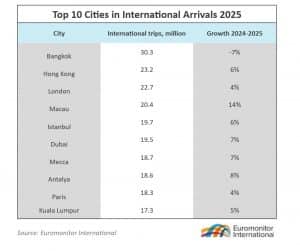
The Top 100 City Destinations Index 2025 shows that the world’s leading cities are expected to welcome 702 million inbound trips this year. It represents an 8% increase year over year. Together, these destinations account for 46% of global international tourism, continuing to outpace overall worldwide growth of 4%.
Bangkok retains its position as the world’s most visited city, with 30 million international arrivals, despite challenges including a stronger local currency, safety perceptions, and intensifying regional competition. Total arrivals dropped meanwhile by 7% compared to 2024.
Paris, however, leads in Overall City Attractiveness (Quality & Balance). The French capital recorded 18 million international visitors in 2025, up 4% year over year, reinforcing its status as the world’s most attractive and competitive tourism city overall—rather than the most crowded.
Hong Kong ranked second globally for international arrivals in 2025, posting 6% growth. The city benefited from the opening of Kai Tak Stadium, which hosted major international football events, as well as the reopening of the expanded Terminal 2 at Hong Kong International Airport, significantly enhancing connectivity.
Macau emerged as the most dynamic destination, with inbound trips rising 14% in 2025 and same-day visits increasing even faster. Nearly 90% of visitors originated from mainland China and Hong Kong. New initiatives, including Zhuhai residents’ “one trip per week” multi-entry scheme and Hengqin visitors’ multiple-entry policy, have further strengthened Macau’s regional appeal.
Tourism performance: Competition intensifies
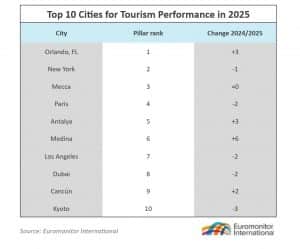
Orlando overtook New York to claim the top spot in the Tourism Performance pillar for 2025. Paris slipped two places but showed resilience, supported by continued travel linked to the Olympic Games legacy and major infrastructure upgrades. Only three cities—Orlando, Medina, and Los Angeles—ranked among the top 20 for both international and domestic tourism demand.
Orlando’s rise was driven largely by strong domestic travel, while Dubai continued to dominate international arrivals. Medina posted the largest gains, supported by higher hotel occupancy, increased airport traffic, and expanded airline connectivity. Orlando’s momentum was further fueled by the opening of Epic Universe in May 2025, upgrades at SeaWorld and Walt Disney World, and the city hosting six FIFA Club World Cup matches.
Dubai’s continued strength reflects aggressive promotion by the Department of Economy and Tourism, alongside sustained investments in connectivity and AI. Tourism remains central to the UAE Economic Agenda, which targets 40 million annual visitors by 2031.
The smart city imperative: AI takes center stage
By investing in AI innovation, smart city platforms, start-up incubators, and digital government services, leading cities are transforming tourism management and positioning themselves as global leaders.
Major destinations—including Abu Dhabi and Dubai, Singapore, Beijing, and Paris—are making significant investments in AI to reshape urban strategies. As adoption accelerates, the establishment of globally aligned regulatory frameworks will be critical to safeguard privacy, prevent bias, protect residents and visitors, and ensure responsible, sustainable urban innovation.