
AI : How HotelPlanner’s voice technology is redefining the booking experience
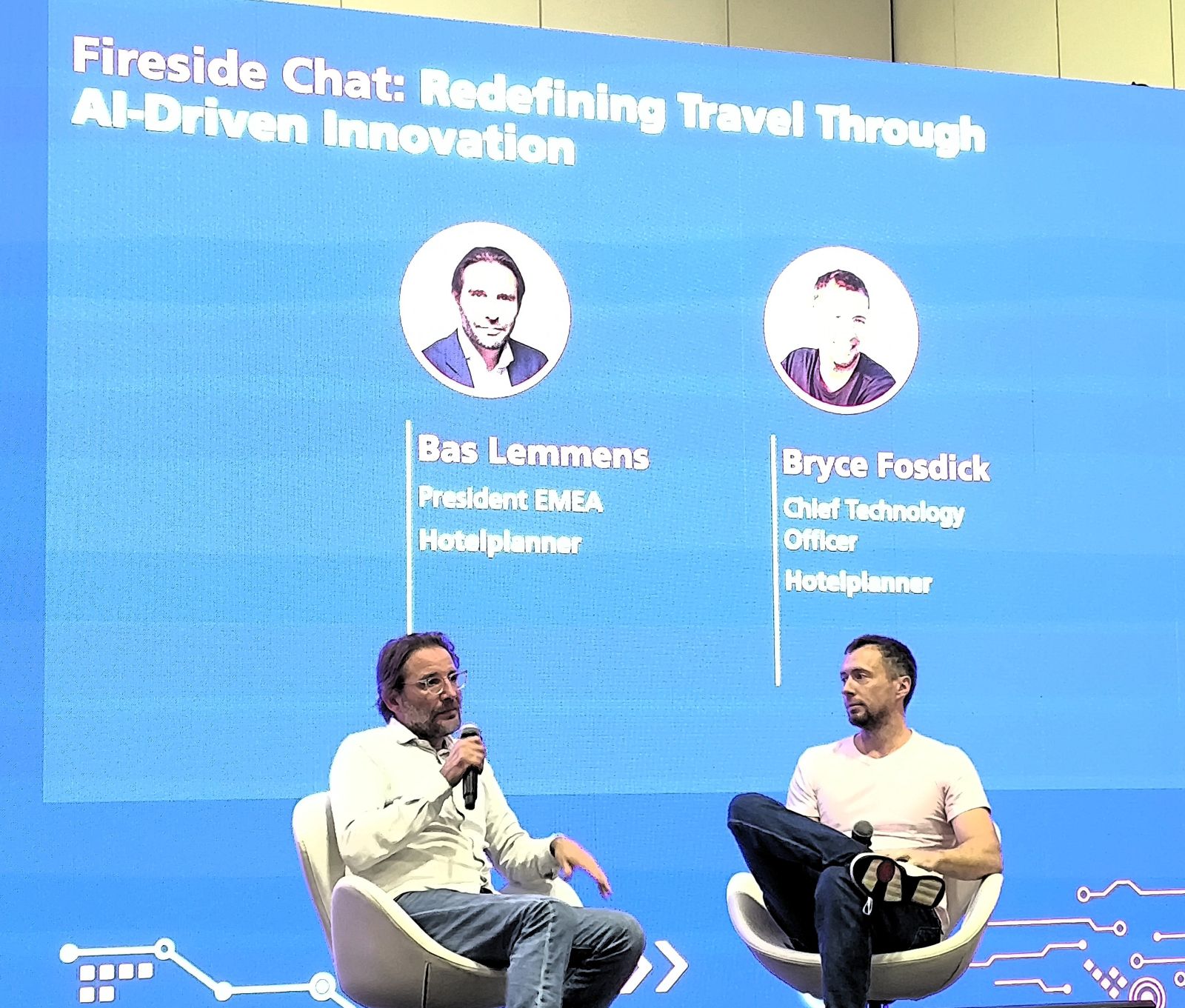
At a time when most companies are obsessed with digital clicks and online conversions, HotelPlanner and its partner platform Reservations.ai have taken a different route—by picking up the phone. The technology is blending human connection with artificial intelligence to redefine how travel bookings are made. This was highlighted during a conference session at ITB Asia with Bas Lemmens, President EMEA, HotelPlanner and Bryce Fosdick, CTO, HotelPlanner.
“When we first launched phone bookings, I didn’t believe in it,” admits Lemmens. “I’m an online guy. I thought people wanted everything digital.”
But the numbers told then a different story. Conversion rates on calls hit 30%, generating over $250 million in annual revenue. “Every five calls, we convert one,” he says. “And it keeps growing—today, we get around 80,000 calls a day.”
Unlike traditional call centers, which are paid hourly, HotelPlanner’s agents work on commission. “If you don’t make a booking, you don’t make money,” told Lemmens during his ITB Asia session. “But if you perform well, you can win the jackpot.“
But success brings scale—and with tens of thousands of daily calls, efficiency became the next challenge. That’s where Bryce Fosdick, the company’s head of AI innovation, stepped in. “With that call volume, even with revenue-sharing agents, we had to ask—how can we make this better?” he said. “So two years ago, we started looking into generative AI.”
Last year, the company finally launched its own AI-powered voice agents, moving beyond the limitations of chatbots. “I’m not a fan of chatbots,” Fosdick said bluntly. “They’ve been around for 10 or 15 years, and most people hate them. They work for simple customer service, but for transactions—real bookings—they fall short.”
AI booking agent to blend efficiency with a “human” touch
AI generated voice, however, is a sophisticated application which implies numerous challenges. “It needs to sound natural and respond fast,” Fosdick explained. “A delay of five or ten seconds is unacceptable when someone’s on the phone.”
After months of development, the company’s AI voice agents now handle up to 40,000 calls a day. They process complete bookings, including payments.
The key was data. Years of call recordings and transcriptions from the company’s “gig platform” provided a foundation. “We already had the data—how good sales sound, how to understand customer intent,” stressed Fosdick. “So we trained our AI to not just find hotels by name, but by memory. Like ‘the one with the pink flamingo in the lobby.The result is a truly end-to-end conversational booking experience.”
When the system launched last Christmas, the team even tested it with a playful “Call Santa Claus” campaign. “I told my mom to try it,” recalled Lemmens. “She’s 82, hates technology but she loved that she could just talk to her iPad and say, ‘Book me a hotel in Amsterdam for under $200.’ And the AI handled it. Actually it’s like going back to the travel agent days. More personal, however with instant answers.”
The AI agents also solved two long-standing issues: missed calls and limited hours. “Now we’re 24/7. There’s no waiting line,” added Fosdick. “And because AI is infinitely patient, it’s perfect for older users. It listens, suggests, and never rushes.”
But the company hasn’t gone fully robotic. “We don’t believe everything can be AI,” stated Bas Lemmens. “If a call is too complex, it still goes to a human. The human touch remains essential.”
Looking ahead, Bryce Fosdick sees the future of travel tech in multi-modal interaction. Something that he calls AGUI, or “AI-driven graphical user interface.”
“Right now, chatbots dominate,” he told. “We’re focused on voice, but the next step is seamless integration. Where you can talk, type, or tap. You can use the app natively, or just speak. Everyone interacts differently.”
Language barriers are already being addressed. “Some of our models can switch languages mid-call. You can start in Spanish, switch to English, and the system adapts,” described HotelPlanner CTO.
Asked what kind of people it takes to build such systems, Bryce joked: “Geniuses!”. But he adds that good data is the real secret. To handle the massive inflow from third-party suppliers, the company partners with specialized data-mapping firms to ensure accuracy in hotel descriptions and room types.
For now, HotelPlanner focus is on personalization. “Only 26% of people actually enjoy booking travel,” explained Fosdick. “We want to make it enjoyable again—friction-less, fast, and personal. The system should know if you’re traveling for business or with your family, remember your preferences, and take care of everything in seconds.”
For Bas Lemmens, the “connected trip” remains an unsolved challenge. “People still visit 30 websites before booking,” he stated. “It’s crazy. But now, with AI technologies, we’re finally close to making travel seamless.”
Related News Stories: Sabre: Conversational AI in travel a 'seismic shift' Smarter Reservations: AI, Customer Experience, and Dylan ... Alipay Voyager+ is the new AI revolutionary companion in travel Delta using AI for airfare pricing How AI-powered robots are keeping Frankfurt Airport clean Booking.com unveils its Global AI Sentiment Report AI use in holiday planning continues to rise Google AI to empower Canada tourism Agoda elevates hotel listings with AI image enhancement TravelTech Show 2026 | Europe's Travel Technology Event


TravelMole Editorial Team





















Vegas’s Billion-Dollar Secrets – What They Don’t Want Tourists to Know

Visit Florida’s New CEO Bryan Griffin Shares His Vision for State Tourism with Graham

Chicago’s Tourism Renaissance: Graham Interviews Kristin Reynolds of Choose Chicago

Graham Talks with Cassandra McCauley of MMGY NextFactor About the Latest Industry Research

Destination International’s Andreas Weissenborn: Research, Advocacy, and Destination Impact

Graham and Don Welsh Discuss the Success of Destinations International’s Annual Conference

Graham and CEO Andre Kiwitz on Ventura Travel’s UK Move and Recruitment for the Role

Brett Laiken and Graham Discuss Florida’s Tourism Momentum and Global Appeal

Graham and Elliot Ferguson on Positioning DC as a Cultural and Inclusive Global Destination

Graham Talks to Fraser Last About His England-to-Ireland Trek for Mental Health Awareness

Kathy Nelson Tells Graham About the Honour of Hosting the World Cup and Kansas City’s Future

Graham McKenzie on Sir Richie Richardson’s Dual Passion for Golf and His Homeland, Antigua







 ADS PRO
Global tourism exceeds 1.5 billion travelers announces UN-Tourism
Qatar Airways offers reduced timetable to over 60 destinations
WTTC global tourism reached record economic impact of 11 trillion in 2025
Hands In, UATP join forces for airline multi-card payments
Suspension of all regional trains in Catalonia following two new rail accidents in Spain