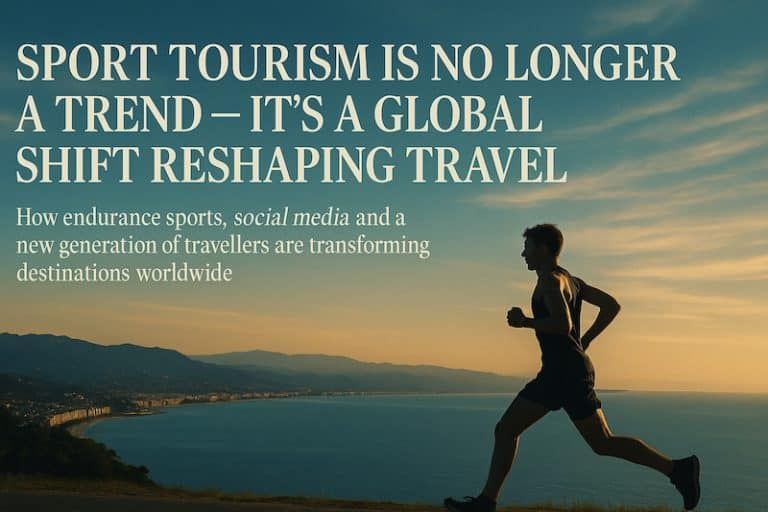
From the electric surge of the New York City Marathon to the Mediterranean blue of the Nice–Cannes race, endurance events are redefining the way the world travels. Great races in New York, Berlin, Chicago, London, Tokyo are cultural beacons. They gather runners from over a hundred countries and turn entire cities into temporary capitals of global aspiration. Even regional events, such as the Nice–Cannes course recently completed by Jean-François Pieri, shape booking patterns, social content, and a destination’s international aura. Few industry leaders experience this movement from as many angles as he does.
Being Chief Media Officer of Lexyl/HotelPlanner Group, Managing Director of TravelMole and the President of Cleverdis, Pieri is also an endurance athlete who trains across continents. In an exclusive interview, he talks about the importance of sport tourism -and particularly runs.
You recently ran the Nice–Cannes event. Beyond the personal challenge, what does this say about how sport is reshaping travel?
Running along the Mediterranean that morning, with the sea so close it seemed to breathe in rhythm with the runners, I realized how profoundly sport has changed the meaning of movement. People no longer travel for passive observation. They want to enter the landscape. They want the wind, the salt, the exhaustion, the triumph. All of this becomes part of the travel experience.
What strikes me most today is that every runner becomes a messenger. A marathon is no longer a local event; it is a global broadcast. Tens of thousands of people share their stories in real time, and through those stories, destinations acquire new layers of myth and meaning. Sport tourism isn’t a niche anymore. It is a cultural engine.
Social media is often described as the accelerator of this boom. How accurate is that?
Completely accurate, and perhaps still underestimated. Social media didn’t merely amplify endurance sports; it reinvented them. Long before Instagram or Strava, running and trail communities existed, but they were intimate, almost underground. Now, a race like the New York Marathon unfolds as a global drama, with millions following the journeys of thousands.
What makes sport magnetic online is its authenticity. No glossy marketing can compete with the emotion on a runner’s face at mile 23 in Brooklyn or at sunrise near Chamonix. The exhaustion is real. The beauty is real. The transformation is real. People feel that. Destinations have then discovered that their most powerful ambassadors are ordinary athletes sharing extraordinary moments.
“Travelers no longer go somewhere to ‘visit’ it. They go to inhabit it — physically, emotionally and narratively.”
Mountain destinations such as Chamonix, Zermatt, Verbier, Avoriaz have become international brands. How much of this rise is driven by sport?
Sport is the new narrative architecture of the mountains. For decades, skiing held the spotlight. But the emotional resonance today comes from trail running, ski touring, ultra-endurance events, high-altitude triathlons and gravel cycling. These sports bring travelers into intimate contact with terrain that tourism once barely touched.
Avoriaz is a perfect example. For many years it was primarily seen as a winter destination, even an architectural curiosity. Today, athletes come for altitude training, for summer trails, for clarity of air and the drama of cliffs. They return because the relationship becomes personal. They have sweated, struggled and grown there. Once you have had that kind of encounter with a landscape, you do not forget it. The mountains are no longer seasonal. They are year-round worlds.
You spend your life on planes, trains and across continents. How do you maintain serious training while managing a global leadership schedule?
Nomadic training is an art form. The difficult part isn’t the running itself; it is the fragmentation of time. Airports displace routine. Jet lag distorts sleep. Meetings compress days. So I treat training as an anchor, a structural element of the calendar. It’s not something I try to fit in; it’s something I build around.
Hotel choices become strategic. A property near a waterfront in Miami, a quiet park in Singapore, a safe loop in Berlin. These elements determine whether a week on the road becomes an opportunity or a setback. Running offers a sense of coherence in a life defined by movement. It sharpens thought, resets stress and restores rhythm.
Are hotels and travel companies truly aware of what sport travelers expect?
Only partially, and that gap represents one of the biggest opportunities in the travel industry. Sport travelers book earlier, spend more and return more frequently. They move with purpose. Their expectations are not extravagant, but they are precise: access to safe running routes, hydration options at dawn, breakfast before sunrise on race days, quick laundry, flexible checkout, knowledgeable staff.
The industry often assumes that a fitness room answers all needs. But sport travelers don’t want a machine — they want an environment that respects their physical routine. Hospitality has only begun to understand this shift.
“Sport travelers aren’t looking for gyms. They’re looking for ecosystems.”
Winter and mountain sports are undergoing major changes. How do you see the future of alpine destinations?
The mountains are reinventing themselves. Climate change, shifting demographics and the search for authenticity are forcing destinations to expand beyond the traditional ski model. The future of mountain tourism is multi-seasonal, multidisciplinary and deeply experiential.
Endurance sports have become catalysts in this transformation. The same slopes that welcome skiers in January host trail runners in July, cyclists in September and hikers year-round. This diversity gives mountains resilience and vitality. Chamonix, Zermatt, Verbier and Avoriaz have understood that the future lies not in a season but in a philosophy: the mountains as a continuous invitation.
Preparing for a race while managing multiple companies sounds daunting. What does that preparation look like?
It is a choreography of planning. For Nice–Cannes, I had a structured program weeks in advance. When you travel constantly, everything becomes part of the equation: sleep cycles, hydration, altitude, humidity, airport meals, long flights, the timing of long runs. Sleep becomes a strategic asset. Jet lag can sabotage weeks of training if you don’t take it seriously.
Running provides something that leadership often compromises: mental clarity. Some of the best decisions of my career have come in the middle of a long run when the noise of the world fades and strategy becomes visible.
If you had one piece of strategic advice for destinations wanting to attract sport travelers, what would it be?
Think in ecosystems, not in events. A marathon, a trail race, a triathlon — these are catalysts. But what creates loyalty is everything surrounding them: infrastructure, community, storytelling, training possibilities, gastronomy, wellness culture, the sense of belonging.
Sport travelers crave narratives. If a destination crafts a compelling one, they will return again and again, often with friends, family and an affinity that deepens over time.
As someone constantly traveling for business, how can sport be integrated without compromising performance?
By understanding that movement fuels performance rather than detracts from it. A run at sunrise before a day of meetings transforms mental clarity. Walking meetings bring creativity. Evening runs purge the residue of negotiations and presentations.
Physical activity is not a distraction. It is a competitive advantage. The most resilient professionals I know are those who have integrated sport into the architecture of their daily routine.
Now that Nice–Cannes is behind you, what’s next?
There is always a next. That is the strange and beautiful gravity of endurance sports. I am planning more mountain races, and I have already registered for a triathlon in M distance at the end of April 2026.
Sport provides the structure I need in a life shaped by movement, decisions and constant travel. It creates balance, ambition and forward motion — qualities that, I believe, will increasingly shape the future of global tourism.