
Outrage as cruise guard kills wild polar bear
Polar bear’s death raises questions about sustainable tourism in the Arctic
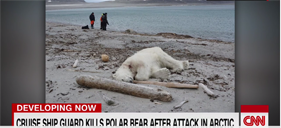
A wild polar bear was shot and killed after attacking a cruise ship guard, according to Hapag-Lloyd Cruises.
The cruise line is facing outrage after one of its employees shot and killed a wild polar bear in Norway after the animal attacked another of its employees.
Hapag-Lloyd Cruises said its ship was docked at Spitsbergen, the largest island on Norway’s Svalbard archipelago, on Saturday when the bear attacked a guard hired to go on shore before passengers to ensure there aren’t any polar bears in the area.
The guard suffered non-life-threatening head injuries and was airlifted out, Hapag-Lloyd Cruises said in a statement on Facebook.
"The incident occurred when the four-person polar bear guard team, who are always on board for these expedition cruises as required by law, prepared for a shore leave," the company said.
They failed to spot one bear, who attacked one of the guards, the cruise line said. The other guards shot the bear after trying unsuccessfully to evict the animal, the company said.
The Polar Bear is an endangered species . "When there’s only 25,000 polar bears left on the planet, every single one matters.
Online reaction to the episode has been highly critical. "’Let’s get too close to a polar bear in its natural environment and then kill it if it gets too close,’ Morons," British actor-comedian Ricky Gervais tweeted.
"Tourism… again proving itself to be harmful to wildlife," tweeted biologist Adam Hart.
"Maybe cruise sightseeing tours shouldn’t take place then polar bear guards wouldn’t be needed to protect gawking tourists & polar bears would be left in peace & not shot dead merely to satisfy a photo op?" suggested genealogist Jane Roberts on Twitter.
See Hapag Lloyd’s Facebook comments – HERE
The western settlement of Longyearbyen, with a population of roughly 2,000, is the area’s main tourism hub. Currently it’s high-season, which means thousands of international tourists hungering for a glimpse of the Arctic’s natural splendour cruise on both small and large ships, occasionally disembarking for land excursions on remote islands.
The number of cruise and expedition ship passengers has grown from approximately 35,000 people in 2006 to 48,000 in 2016, according to the most recent Svalbard government statistics. Some large cruise liners transport as many as 4,000 passengers, leading to overcrowding in the area.
But the polar bear’s untimely death renewed discussions about the sustainability of tourism growth near the North Pole.
There are roughly 3,000 polar bears living in the less-inhabited eastern part of the Svalbard archipelago. Driven nearly to extinction by overhunting in decades past, the population has been steadily increasing since the 1970s.
But their existence remains fragile and, as more ice melts, the bears are forced to travel longer distances to find food.
The incident sheds light on the challenges of tourism growth in the area.
Nature tourists come to the Svalbard archipelago to see the polar bears, as well as its 170 species of flora, various sea birds, foxes, voles and the unique Svalbard reindeer.
Another reason they come , is an increased interest in understanding global warming. Svalbad is "a canary in the cage" for the rest of the world when it comes to sensing global warming-related environmental changes. One of those changes is less ice. The lack of ice also means that Svalbard is also becoming more accessible and conventional ships can sail in this area.
To adapt to the changing tourism industry, the government has rolled out additional legislation in recent years to protect Svalbard, which already has some of the strictest environmental regulations in the world.
Valere Tjolle
Valere is publisher and editor of Sustainable Tourism 0.2 to be published in September


Valere





















Vegas’s Billion-Dollar Secrets – What They Don’t Want Tourists to Know

Visit Florida’s New CEO Bryan Griffin Shares His Vision for State Tourism with Graham

Chicago’s Tourism Renaissance: Graham Interviews Kristin Reynolds of Choose Chicago

Graham Talks with Cassandra McCauley of MMGY NextFactor About the Latest Industry Research

Destination International’s Andreas Weissenborn: Research, Advocacy, and Destination Impact

Graham and Don Welsh Discuss the Success of Destinations International’s Annual Conference

Graham and CEO Andre Kiwitz on Ventura Travel’s UK Move and Recruitment for the Role

Brett Laiken and Graham Discuss Florida’s Tourism Momentum and Global Appeal

Graham and Elliot Ferguson on Positioning DC as a Cultural and Inclusive Global Destination

Graham Talks to Fraser Last About His England-to-Ireland Trek for Mental Health Awareness

Kathy Nelson Tells Graham About the Honour of Hosting the World Cup and Kansas City’s Future

Graham McKenzie on Sir Richie Richardson’s Dual Passion for Golf and His Homeland, Antigua







 ADS PRO
Global tourism exceeds 1.5 billion travelers announces UN-Tourism
Qatar Airways offers reduced timetable to over 60 destinations
WTTC global tourism reached record economic impact of 11 trillion in 2025
Hands In, UATP join forces for airline multi-card payments
Overseas travelers to the United States declined by 2.5% in 2025