
Thailand to see another major infrastructure project on the brink of collapse
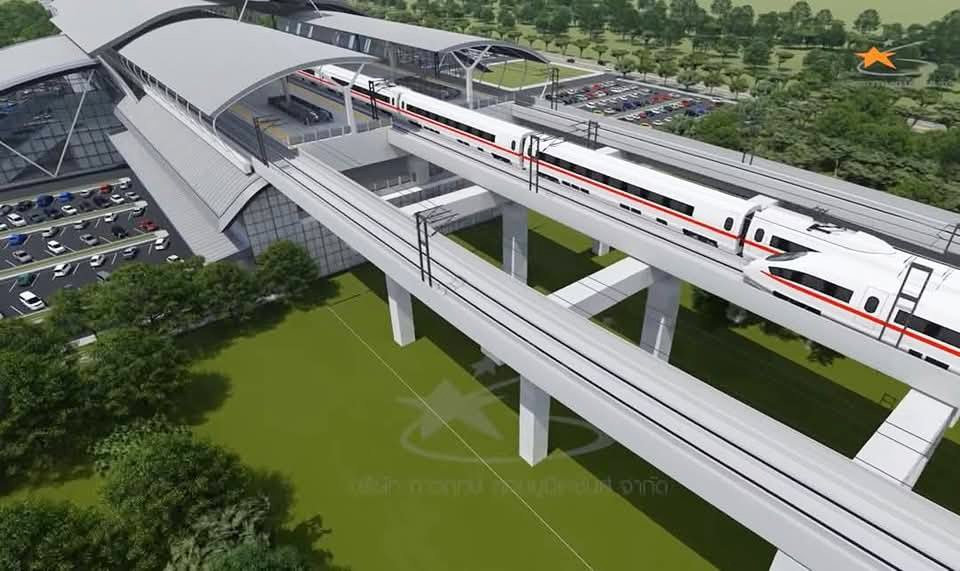
Another promising and ambitious infrastructure which could have changed the face of Thailand tourism is on the brink of collapse as reported by Thai newspaper Khaosod.
Six years after Thailand signed a public-private partnership (PPP) in October 2019, the country’s ambitious high-speed rail project connecting Don Mueang, Suvarnabhumi, and U-Tapao airports remains stalled. There is indeed little to show beyond paperwork and political discord. Once envisioned as the backbone of Thailand’s Eastern Economic Corridor (EEC), the 224.5-billion-baht (US$6.8 billion) project now stands perilously close to complete vanishing.
From Vision to Stalemate
Originally, the 220-kilometer line was meant to transform regional connectivity, cutting travel time between Bangkok’s Don Mueang and Suvarnabhumi airports to just 20 minutes and linking them to U-Tapao.
The latter, which has an international airport, is also the gateway to the EEC’s industrial and tourism hubs in Rayong, Chonburi, and Pattaya. The project was a flagship initiative of the Prayuth Chan-ocha military government. It was effectively designed to integrate air, rail, and economic infrastructure across eastern Thailand.
However, three years after Asia Era One Company—led by CP Group—won the bid, progress has ground to a halt. The private company still must fulfill the requirements needed to receive the State Railway of Thailand’s (SRT) Notice to Proceed (NTP). And finally launches a development frozen since the COVID-19 pandemic began.
A Changed Economic Landscape
What began as a high-growth, high-return project has been battered by shifting fundamentals. Passenger forecasts have fallen, investor enthusiasm for the EEC has waned, and borrowing costs have surged. During the pandemic, Asia Era One invoked force majeure, unable to pay the 10.67-billion-baht ($326 million) concession fee for the Airport Rail Link or secure sufficient financing. This pushed the entire scheme into limbo.
Faced with the impasse, officials saw three options: cancel the deal, renegotiate the terms, or allow SRT to take over the project itself.
In a bid to save the venture, the Eastern Economic Corridor Policy Committee (EECPC) approved five major contract revisions. These included allowing government co-investment to be paid in installments linked to construction milestones. The deal was to permit Asia Era One to provide 160 billion baht ($4.9 billion) in guarantees while paying the Airport Rail Link fee in seven installments.
Both SRT and Asia Era One agreed to the new framework. The Attorney General’s Office reviewed the amendments, and Cabinet approval appeared imminent. Construction was tentatively set to begin once the revised terms were ratified.
Then, Thai politics derailed -as usual- the deal. Under the new administration of Prime Minister Anutin Charnvirakul, the Ministry of Transport raised 18 legal objections to the revisions. Transport Minister Phiphat Ratchakitprakarn rejected the “build-and-pay” structure. It argued that government payments should occur only after project completion—per the original 2019 contract. He warned that the Cabinet would likely reject the amendments altogether.
His public opposition effectively scrapped the five-point compromise. Soon after, the SRT Governor resigned, leaving the project once again without leadership or direction.
U-Tapao ambitions as a new transportation hub are fading away
The potential collapse of the high-speed rail link has sent shockwaves through the Eastern Economic Corridor. The rail system was intended to be the spine connecting several EEC mega-projects, including the U-Tapao Airport expansion and the Eastern Aviation City.

U-Tapao’s ambitions as a new transport hub are rapidly fading. Already in September, things were turning sour when Bangkok Airways, a partner in the development of the new terminal, announced it would pull out and recoup its investment if there was no progress. Which was the case following the change of government.
Without the high-speed connection, the region’s integrated transport and logistics strategy could unravel, jeopardizing billions in public and private investment. It will particularly deprive one of Thailand’s largest tourism destination -Pattaya- from a convenient rail connection to the country’s premium air gateway – Suvarnabhumi. And also eradicate the possibility for locals and visitors to have a convenient transfer between Bangkok’s two main airports.
Thailand’s endless list of failed tourism and transport infrastructure projects
The expected stop to the project is only an additional element of a long series of failures in modernizing Thailand’s infrastructure. Among the collapsed -or at best long-delayed, projects are :
– The high-speed train from Bangkok to Nakhon Ratchasima and the border to Laos. Started in 2017, the project for the first phase is only completed to 35%. It is now expected to start operation by 2030.
– The Laem Chabang International Cruise Terminal project (30 minutes away from Pattaya and 90 minutes away from Bangkok) is currently in the feasibility study phase. First idea for a new cruise terminal emerged in the 2010s…
– Phuket light rail system which could help establishing a reliable mass transit system and avoid Phuket’s notorious taxi scams.
– Phuket International Convention and Exhibition Center project, approved for construction in 2010, then canceled under the following Prime Minister cabinet, then transformed in 2023 into a World Class Health Tourism Center. The latter has been canceled with a potential revival of the Phuket International Convention and Exhibition Center.

– South Terminal at Bangkok Suvarnabhumi, due to start in the mid 2020s with the estimated construction now expected by 2027;
– Bangkok-Don Mueang new air terminal, originally to be started in 2018 and now expected to start (eventually) in 2026;
– Chiang Mai new Lanna International Airport, stalled due to issues on land acquisition and probably to be cancelled next year;
– Bangkok Rama II highway facing several delays due to recurrent accident including a severe collapse in 2024. The highway highlights issues with construction in Thailand, reported Khaosod. Grim data point to 2,242 accidents on this highway between 2018 and January 2024, resulting in 132 deaths and 1,305 injuries. The last part of the highway is now due for completion in 2027.
And there are still more failed projects to be listed.
Meanwhile, the likely cancellation of Thailand’s three-airport high-speed rail is more than just another infrastructure project going to the drain. The once billed as a symbol of Thailand’s modernization, is now turning into a symbol of national failure due to shifting politics, disconnection to economic realities and a deny of the benefits being brought to Thai people.
Related News Stories: Thailand's flagship high-speed airport rail project on the brink of ... Can tourists visit Thailand and Cambodia as the conflict persists ? 200,000 free tickets to be given to tourists on domestic flights in ... Cambodia-Thailand cease fire does not reopen land borders to ... Etihad on board with TAT to promote Thailand tourism Taxes on tourists (1) : the case of Thailand Thailand unveils digital nomad travel campaign Amazing Thailand 'Grand Tourism and Sports Year 2025' Unveiled ... Centara Korat | Central Business District Hotel | Korat hotel Thailand with only 33 to 35 million tourists in 2025


TravelMole Editorial Team





















Vegas’s Billion-Dollar Secrets – What They Don’t Want Tourists to Know

Visit Florida’s New CEO Bryan Griffin Shares His Vision for State Tourism with Graham

Chicago’s Tourism Renaissance: Graham Interviews Kristin Reynolds of Choose Chicago

Graham Talks with Cassandra McCauley of MMGY NextFactor About the Latest Industry Research

Destination International’s Andreas Weissenborn: Research, Advocacy, and Destination Impact

Graham and Don Welsh Discuss the Success of Destinations International’s Annual Conference

Graham and CEO Andre Kiwitz on Ventura Travel’s UK Move and Recruitment for the Role

Brett Laiken and Graham Discuss Florida’s Tourism Momentum and Global Appeal

Graham and Elliot Ferguson on Positioning DC as a Cultural and Inclusive Global Destination

Graham Talks to Fraser Last About His England-to-Ireland Trek for Mental Health Awareness

Kathy Nelson Tells Graham About the Honour of Hosting the World Cup and Kansas City’s Future

Graham McKenzie on Sir Richie Richardson’s Dual Passion for Golf and His Homeland, Antigua







 ADS PRO
Global tourism exceeds 1.5 billion travelers announces UN-Tourism
Qatar Airways offers reduced timetable to over 60 destinations
WTTC global tourism reached record economic impact of 11 trillion in 2025
Hands In, UATP join forces for airline multi-card payments
Overseas travelers to the United States declined by 2.5% in 2025