
TOWARDS A GREEN ECONOMY – NTO CHALLENGES AND OPPORTUNITIES
Thursday, 20 Aug, 2009
0
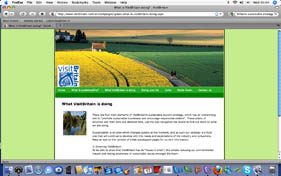
The scope and actions that an NTO can undertake in order to deal with climate change and sustainable tourism development
This article describes the scope and actions that an NTO can undertake in order to deal with climate change and sustainable tourism development. It will consider a model of NTO organization at the international, national and regional levels, which can be used to develop the NTO contribution to a green economy in response to policy lines. The Learning Area on Climate Change and Sustainable Tourism for NTOs will be highlighted in this section.
WHAT CAN NTOS DO? – SEVEN ACTION POINTS FOR SUSTAINABLE TOURISM
The following approach can be used by all NTOs to build their capacity to tackle this area of work, and can be built into the following good practice model of an NTO dealing with climate change and sustainable tourism:
- Respond to UN, EU and National Climate Change and Sustainable Development policy
- Join in or establish a network of organizations that can provide knowledge on the subject
- Formulate a vision and mission statement of how your NTO can contribute to the climate change and sustainable development processes
- Develop a programme of actions that are tailored to your stakeholders and your capacities, aimed to develop more sustainable tourism
- Choose certification as a practical tool to promote sustainable tourism, using the GSTC as guidance for the development of certification systems and sustainable tourism goods and services in your country’s tourism supply chain
- Assist in knowledge networking and sustainable tourism good practice dissemination, using leading global and European agencies to support your work
- Ensure you undertake an in-house operational sustainable development path that includes a carbon management programme.
Such a model enables all NTOs to assess where they stand at the moment, as well as providing guidance for NTOs to develop effective climate change and sustainable tourism strategies.
Not all NTOs have the same capacity to respond to the challenges and opportunities created in the climate change and sustainable tourism processes. The ETC questionnaire on Climate Change and Sustainable tourism (see Fig. 1 below) in 2008 showed that many NTOs already see the importance of the issue, and would like to work together to gain better knowledge of the issues without unnecessary costs or resource use. The fact remains that several NTOs have limited staff resources and budget, and have a strong marketing brief that is difficult to link to tourism development actions. However, a marketing organization can and needs to ensure that its product is moving towards sustainability, not only just to ensure long term viability but also to improve marketing potential. Some NTOs have taken a lead on this, and their experiences point to a model of how NTOs across Europe can coherently respond to policy initiatives in this field.
The table below shows the responses to the question ´Which are your organisation’s four most important activities concerning Tourism and Climate Change? `, Highlighting the most active areas of NTO action.
Question: Which are your organisation’s four most important activities concerning Tourism and Climate Change?
Number [of responses] % [of all respondents, n=20]
Implementation of certification systems 5 25
National strategy concerning tourism and CC 3 15
Encouraging responsible behaviour from visitors 2 10
Research and documentation 4 20
Communication and promotion of Green Tourism 3 15
Cooperation with governmental organizations 3 15
Encouraging sustainable business practices/networks 7 35
Ensuring own business practices are sustainable 4 20
Information/education (travel trade, regional TO, public) 6 30
Product development 2 10
Other 4 20
Not available 3 15
At the ETC`s San Marino Conference in October 2008, Fáilte Ireland and VisitBritain were chosen to highlight good practice experience in existing NTOs. Both examples showed how NTOs could use either their tourism marketing or environmental conservation orientation to actively support national government policies on climate change and sustainable development.
Promoting the use and development of certification systems and certified tourism goods and services as a practical means to achieve this was common to both, as was the mainstreaming of sustainability concepts through development of innovation and quality in their product supply chains. They also showed how networking is indispensable when it comes to finding out what is happening, who can be helpful, and what can be done using a partnership approach to sustainable tourism implementation in order to work on tight budgets.
Visit Britain has developed a sustainable tourism strategy through a partnership with other tourism sector stakeholders:
Visit Britain’s Action Plan for increasing sector sustainability – a partnership approach
Currently the Sustainable Tourism Action Group (STAG) manages a three-part model for sustainable tourism for the UK, made up of:
- Improving the relationship between sustainability and the UK’s quality assurance schemes
- Promotion of a range of tools for supporting businesses in taking action
- Development of a nationally consistent accreditation scheme that recognizes businesses taking action to care for the local area and environment.
South West Tourism in the Untied Kingdom offers a good example of how regional tourism board activity can be skilfully applied to bring local and regional initiatives into a coherent tourism sector knowledge network and market place. Networking sustainable development at this level needs to be encouraged by national organisations.
Stakeholders are informed of how climate change can affect them and what can be done about it.
In Ireland, Fáilte Ireland`s environmental background has enabled them to develop a seven-point action plan on joining in the fight against climate change.
Failte Ireland’s to do list to improve the environmental sustainability of tourism
7 Key Actions:
- Assess the impact of climate change on the tourism industry
- Assess the impact of tourismon any measures proposed to tackle climate change
- Contribute to the Governments Change campaign
- Measure and reduce the carbon footprint of the tourism industry
- Communicate the challenges to the industry and raise awareness
- Offer our visitors a low emissions choice
- Manage Failte Ireland’s own emissions
Sharon Comiskey is responsible for Tourism Ireland’s Research and Insights and will be addressing the Gothenburg meeting. She says that in Ireland the Green issue is important to consumers, and should be important for the tourism sector businesses and administrators as well. Tourism Ireland team up with Green Box, providers of green eco-tourism products and services nationally, who are given credibility by their EU flower certified business.
Ireland Green Box – showcasing eco-tourism to a global market
LINK: www.greenbox.ie/
When both the UK and Irish approaches are viewed together, it is clear to see that NTOs have to cover the wide range of sectoral and thematic issues involved by working with other stakeholders.
Also at the national level, Dimitrij Piciga, CEO Slovenian Tourist Board has this Symposium message for tourism stakeholders:
´Tourism creates 10% of world GDP and 5% of C02 emissions and we believe it can influence at least 50% of the population to act responsibly both in everyday life and through their decisions in work.
- NTOs should give the clear message to the tourism industry that GOING GREEN is not a short-term trend but should be the core philosophy for surviving in the business.
- The responsibilities of NTOs are research, development and promotion of GREEN TOURISM and its products. In this way it also influences green transportation, renewable energy, organic food, green buildings, green landscape planning, green tourist awareness, etc. A further responsibility of NTOs is to raise the awareness of the key stakeholders (tourists through the tourism industry, employees, supply chains, students, etc). As a result it comes to a green synergy based on tourism, which is required to achieve climate change goals.
- STB has created the brand architecture to communicate SLOVENIA as a green destination (meaning unspoilt nature, specialised green products and services and the responsibility to maintain this). We plan to address the key stakeholders to raise awareness of responsibilities and opportunities in going green with the Key message:
“GOING GREEN is not a short-term trend but should be the core philosophy for surviving in the business. We should reach the green synergy based on tourism, which is required to achieve climate change goals.”
Symposium presenters:
Moderator: Robert Franklin OBE, Executive Director,European Travel Commission
- Dimitrij Piciga, CEO, Slovenian Tourist Board, and Vice-President, ETC
Marketing Sustainable Tourism Products and Services in the Green Economy- Needs and Opportunities
- Jenny McGee, Head of England Strategy & Engagement, VisitEngland
The Contribution of NTOs to the Creation of a Green Economy
- Carla Aguirre, Head of Research, VisitSweden
Visit Sweden – Achieving a Climate Neutral Operations Programme
- Sharon Comiskey, Research & Insights Manager, Tourism Ireland
An NTO`s Contribution to National and Regional Sustainability Actions through Marketing


Valere















Vegas’s Billion-Dollar Secrets – What They Don’t Want Tourists to Know

Visit Florida’s New CEO Bryan Griffin Shares His Vision for State Tourism with Graham

Chicago’s Tourism Renaissance: Graham Interviews Kristin Reynolds of Choose Chicago

Graham Talks with Cassandra McCauley of MMGY NextFactor About the Latest Industry Research

Destination International’s Andreas Weissenborn: Research, Advocacy, and Destination Impact

Graham and Don Welsh Discuss the Success of Destinations International’s Annual Conference

Graham and CEO Andre Kiwitz on Ventura Travel’s UK Move and Recruitment for the Role

Brett Laiken and Graham Discuss Florida’s Tourism Momentum and Global Appeal

Graham and Elliot Ferguson on Positioning DC as a Cultural and Inclusive Global Destination

Graham Talks to Fraser Last About His England-to-Ireland Trek for Mental Health Awareness

Kathy Nelson Tells Graham About the Honour of Hosting the World Cup and Kansas City’s Future

Graham McKenzie on Sir Richie Richardson’s Dual Passion for Golf and His Homeland, Antigua







 ADS PRO
Clearing CSS/JS assets' cache... Please wait until this notice disappears...
Updating... Please wait...
Global tourism exceeds 1.5 billion travelers announces UN-Tourism
Qatar Airways offers reduced timetable to over 60 destinations
WTTC global tourism reached record economic impact of 11 trillion in 2025
Marginal increase for New York City tourism in 2025
Hands In, UATP join forces for airline multi-card payments