
The ICE (Immigration and Customs Enforcement) not only killed U.S. citizens during recent confrontations in Minnesota. They also damaged the reputation of the State as a tourism destination, especially during its winter season according to Explore Minnesota, the tourism marketing agency of the State. Exceptionally cold weather conditions did not help as well, tells a survey.
Explore Minnesota regularly surveys tourism, leisure and hospitality businesses, and destination marketing organizations to track industry sentiment and trends. Its latest survey, conducted between February 9 and 18, gathered 246 responses, offering a snapshot of the sector’s current outlook.
Minnesota tourism businesses report mixed winter season performance
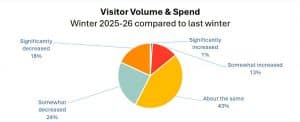
Overall, Minnesota winter tourism season has delivered mixed results. Compared with the previous winter, 14% of respondents reported increased business, 43% said performance was flat and 42% experienced declines in visitor volume and spending.
Regional differences were notable. Businesses in the Minneapolis–St. Paul metro area were most likely to report reduced activity, followed by those in northeastern Minnesota. Some operators continue to cite weather challenges as a factor, particularly for outdoor recreation. One outfitter said snowmobiling has struggled for three consecutive winters because of insufficient snowfall.
Despite these mixed business reports, several key tourism indicators show resilience. Hotel performance in December and January improved year-over-year. Occupancy rose to 43.8% in December and 46.1% in January, while revenue per available room (RevPAR) increased to $53.21 and $57.33 respectively. January was particularly strong in the metro region, where occupancy jumped 18.8% and RevPAR surged 26.4%.
Other indicators point to softer demand. Passenger traffic at Minneapolis–Saint Paul International Airport declined 9% in December and 4% in January compared with the same months in 2025. Canadian arrivals also fell sharply, dropping 14% year-over-year in both December and January.
The decline in Canadian travel is part of a broader international trend. Tourism Economics estimates international visitation to Minnesota fell 17.4% in 2025 to about 507,000 visitors, driven largely by fewer Canadians. After Canada, the state’s largest overseas markets include India, the United Kingdom and Germany.
Federal enforcement activity affecting tourism businesses
The survey also examined the impact of recent federal immigration enforcement activity in Minnesota. Nearly half of tourism businesses reported some level of impact: 18% said they were slightly affected, 16% somewhat affected and 11% significantly affected.
These effects have been concentrated in the Minneapolis–St. Paul metro area, which accounts for almost half of all businesses reporting impacts (49.47%). Other regions also reported disruptions, though at lower levels.
The most visible consequence has been cancellations or reduced bookings for events, meetings and reservations, affecting about 20% of respondents. Similar numbers reported declines in visitor traffic, while 12% saw reduced spending. Staffing challenges were also noted, particularly reduced employee morale and productivity.
Survey comments reflected a wide range of views about the causes and implications of these disruptions. Some respondents expressed concern that public attention and political tensions may discourage visitors, while others said winter is traditionally a slow period, making it difficult to isolate specific causes.
Comments about politics and the media:
o The federal presence is hurting Minnesotans
o State and local government and protesters’ responses to the federal presence
are problematic
o Greater Minnesota is different than the Minneapolis-St. Paul Metro region
o The media plays a big role and should stop being so negative
National research also suggests enforcement visibility could influence travel decisions. A January survey by Future Partners found that 46% of U.S. leisure travelers would consider avoiding destinations where law enforcement, military or immigration presence is highly visible.
Despite these pressures, industry sentiment for the year ahead remains cautiously positive. According to the Explore Minnesota survey, 46% of businesses are optimistic about leisure travel in 2026, while 26% are neutral and 28% pessimistic.