
A challenging year 2025 for Austrian rail ÖBB despite traffic growth
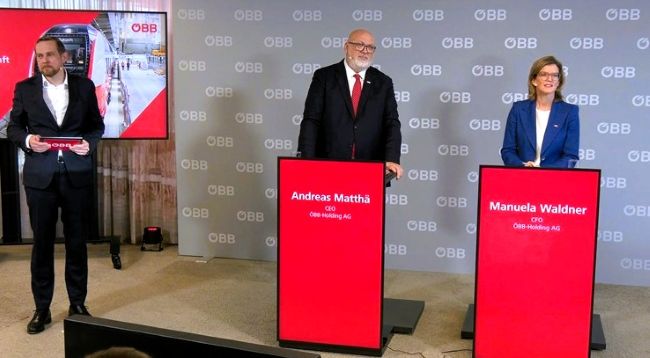
Presenting on April 17 the annual results of Austrian Federal Rail ÖBB, CEO Andreas Matthä and CFO Manuela Waldner highlighted the mounting economic pressure on business from a slowing economy and rising energy costs – particularly since the beginning of 2026. Even with record number of rail users.
Austria’s national rail operator delivered a mixed performance in 2025, combining record passenger volumes and major infrastructure milestones with mounting pressure from economic headwinds, rising energy costs, and a struggling freight division.
“The year 2025 was certainly a year of light and shadow. There was definitely light at the end of a tunnel, namely with the start of the new Koralm line, a 130 km long route that brings two regional capital cities together, but actually brings also Europe together. It is a defining moment, as people can in 41 minutes go to sip a cafe facing Graz famous Clock Tower or to sip a cafe in Klagenfurt at the Wörthersee Lake. Passenger demand for this line continues to grow, supported by convenient long-distance travel as this new infrastructure came online,” highlighted Andreas Matthä.
The milestone project underscored Austria’s ambition to position rail as the backbone of sustainable mobility. With faster, more seamless connections, the network is not just linking cities, but reshaping travel behavior.
Passenger growth hits new highs
ÖBB carried more passengers than ever before, surpassing the previous record set in 2024. Total volumes rose by 1.4% year-on-year, reaching 559 million passengers. “It was a new record, largely driven by long-distance services. We saw for this segment a growth of 1.5% to 47 million passengers,” added Matthä.
On regional and local transport, passenger numbers dipped slightly by 2.6% to 246 million, impacted by fewer working days and temporary service disruptions, particularly on Vienna’s regional trains’ network. Congestion remains a critical issue, especially on Vienna trunk lines.
International expansion also played a role, with the operator’s German subsidiary contributing to overall growth, highlighting the importance of cross-border operations in a competitive European rail market.
In the meantime, punctuality rose to 94.1%, placing Austria back among Europe’s top-performing rail systems. However, management made clear that this is not enough.
To address bottlenecks, ÖBB is investing in both infrastructure and digital upgrades, including the rollout of the European Train Control System (ETCS), enabling more frequent and efficient train operations.
Heavy investment continues
Group profit before tax came in at €68 million, down 40% compared to 2024. The decline reflects a challenging operating environment, including high energy costs and intensified competition, particularly in freight. Passenger transport remained the strongest performer, posting an operating result of €228 million.
ÖBB invested €5 billion in 2025, with the bulk allocated to infrastructure projects. Major developments include the completion of Southern Austria Koralmbahn, ongoing work on the Semmering Base Tunnel, set to open in 2030, and progress on the Brenner Base Tunnel, linking Austria to Italy. The Tunnel opening is now fixed in 2032, four years behind the original schedule.
Beyond megaprojects, the company is also upgrading existing lines, renovating rail stations, expanding electrification, and accelerating digitalization. New systems are replacing paper-based processes, improving efficiency and reducing costs.
Energy independence is another priority. In 2025 alone, ÖBB commissioned 25 new photovoltaic plants and plans to expand into energy storage in 2026.
To keep pace with rising passenger numbers, ÖBB is rolling out 84 new trains in 2026, including double-deck Cityjet units and next-generation Railjets. These will increase capacity, particularly on busy commuter routes in eastern Austria.
The introduction of ETCS-compatible trains will also allow for denser service patterns and improved reliability.
Outlook: growth with caution
Looking ahead, ÖBB expects continued growth in long-distance travel but warns that 2026 will remain challenging. High energy prices, geopolitical uncertainty, and economic softness—particularly in freight—are likely to weigh on performance.
Still, with sustained investment, expanding capacity, and a clear strategic focus, Austria’s rail operator is positioning itself to meet rising demand while navigating an increasingly complex operating environment.
Related News Stories: Costa Rica unveils tourism strategy after sluggish 2025 growth Innsbruck boosts global congress profile with 2026 fund - TravelMole TUI reaffirms 2025 outlook after strong quarter - TravelMole IGLTA expands global LGBTQ+ tourism amid rising polarization Global attractions industry suffering from climate change this year Slovenia cycling paradise inspired by champion Tadej Poga?ar's top ... ITB Berlin reaffirmed the critical value of global travel networking Jordan builds strong tourism momentum and eyes even bigger 2026 Winter in Glenwood Springs - TravelMole French hotel industry 2025 performance and 2026 outlook ...


newadmin
















Vegas’s Billion-Dollar Secrets – What They Don’t Want Tourists to Know

Visit Florida’s New CEO Bryan Griffin Shares His Vision for State Tourism with Graham

Chicago’s Tourism Renaissance: Graham Interviews Kristin Reynolds of Choose Chicago

Graham Talks with Cassandra McCauley of MMGY NextFactor About the Latest Industry Research

Destination International’s Andreas Weissenborn: Research, Advocacy, and Destination Impact

Graham and Don Welsh Discuss the Success of Destinations International’s Annual Conference

Graham and CEO Andre Kiwitz on Ventura Travel’s UK Move and Recruitment for the Role

Brett Laiken and Graham Discuss Florida’s Tourism Momentum and Global Appeal

Graham and Elliot Ferguson on Positioning DC as a Cultural and Inclusive Global Destination

Graham Talks to Fraser Last About His England-to-Ireland Trek for Mental Health Awareness

Kathy Nelson Tells Graham About the Honour of Hosting the World Cup and Kansas City’s Future

Graham McKenzie on Sir Richie Richardson’s Dual Passion for Golf and His Homeland, Antigua







 ADS PRO
Qatar Airways offers reduced timetable to over 60 destinations
Hands In, UATP join forces for airline multi-card payments
AirlineRatings reveals world's safest airline rankings for 2026
Vietnam warns airlines of possible flight reductions amid jet fuel shortages
Fliggy opens AI-powered travel bookings and developer tools