Bhutan is celebrated for its cliffside monasteries, pristine Himalayan scenery and a way of life which has little changed over centuries.
Tourism has been limited as the small Himalayan Kingdom refuses mass tourism. Bhutan is indeed recognized for its unique “high value, low impact” tourism model.
A USD40 tourist visa must be applied for before travel, usually via a licensed Bhutanese tour operator. Once in Bhutan, a daily levy called the Sustainable Development Fee (SDF) for all international tourists applies ant costs USD100 per day. The fee helps fund education, health care, environmental preservation, and community services.
Before the pandemic, the country welcomed 315,599 visitors in 2019. Arrivals dropped sharply to 103,066 in 2023, then rebounded to 145,065 in 2024, signaling a steady revival.
In 2024, Paro International Airport — the kingdom’s only international gateway — handled about 400,000 passengers. With its limited infrastructure, Paro has only a single 2,265 m long runway able to welcome aircraft as large as an Airbus A320. Most aircraft landing are ATR72. Because of the steep terrain and surrounding high peaks, all operations at Paro are restricted to daylight hours and visual meteorological condition
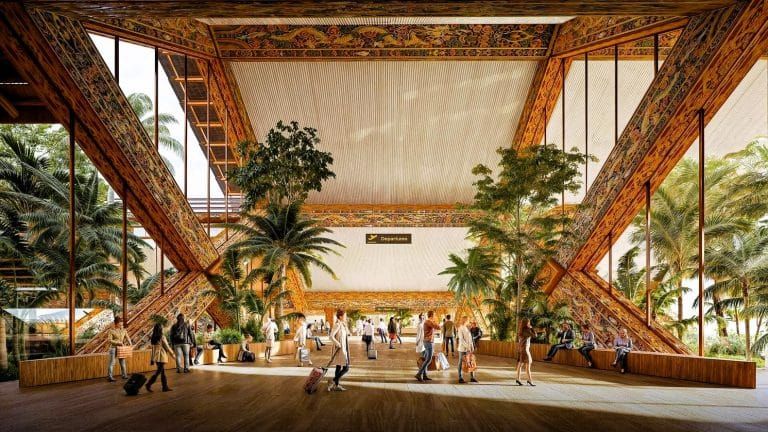
However, the country is now preparing for its most ambitious expansion yet. Though it won’t debut until 2029, Bhutan has unveiled a striking preview of Gelephu International Airport. The airport is likely to become a new object of visit for travelers with its incredible architecture. Designed by architecture cabinet BIG–Bjarke Ingels Group, the new hub is envisioned as Bhutan’s second international airport, initially supporting 123 daily flights.
According to BIG founder Bjarke Ingels, the project is shaped around Bhutan’s philosophy of “gross national happiness,” an ethos that prioritizes well-being as a measure of prosperity.
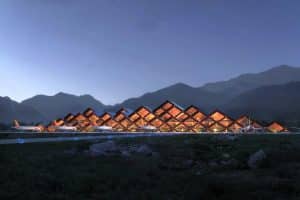
“An airport is the first and last impression you get of a place you visit,” Ingels said in a statement. He describes the architecture as a series of modular mass-timber frames that provide expansion flexibility while forming a stylized mountain range when viewed from afar. Every timber element is carved and colored using traditional Bhutanese craftsmanship and adorned with three types of dragons — symbols of the past, present, and future. “The result is traditional yet avant-garde, forward-reaching and rooted,” Ingels added.
The terminal design emphasizes natural light, local materials, and spaces that reinforce calm — including areas for meditation, yoga, and gong-bath sessions — but its architects stress that operational efficiency and a seamless passenger experience remain the top priorities. Once completed, the airport will span 731,946 square feet with capacity for 1.3 million annual passengers. Ultimately it aims for 5.5 million passengers by 2065.
Gelephu to open Bhutan to world aviation
While modest compared with heavyweights like Heathrow or JFK, this is a monumental leap for Bhutan. Gelephu is on flatter terrain, allowing longer runways capable of handling larger jets. The location near the Indian border — Bhutan’s primary diplomatic partner and trade lifeline — also positions the new airport as a key node for rail and road links.
It is a central pillar of King Jigme Khesar Namgyel Wangchuck’s broader Gelephu Mindfulness City vision, intended to anchor economic growth and strengthen national resilience. “This airport is essential for the success of the GMC as a business hub, and it is also a critical lifeline for Bhutan’s national security, especially for a landlocked country,” the king said.
Home to roughly 750,000 people, All foreign visitors pay a daily $100 Sustainable Development Fee, which — reflecting the same values now shaping the country’s next great gateway.