
Comment: What will your customers be wearing next?
Euromonitor travel and tourism analyst Angelo Rossini examines one of the most powerful trends in the travel and tourism industry, consumers using multiple devices such as PCs, smartphones, tablets and smart TVs simultaneously to get information and make bookings.
"The number of internet-enabled devices used by travellers is set to grow further in 2014, as it is expected to be a year of significant innovation, particularly in the field of wearable technology – like watches and glasses.
Keeping up with internet-connected devices is a challenge for travel companies. They need to build flexible systems so they can follow their customers moving from one device to another, making the most of these devices in terms of both bookings and customer service and therefore staying competitive.
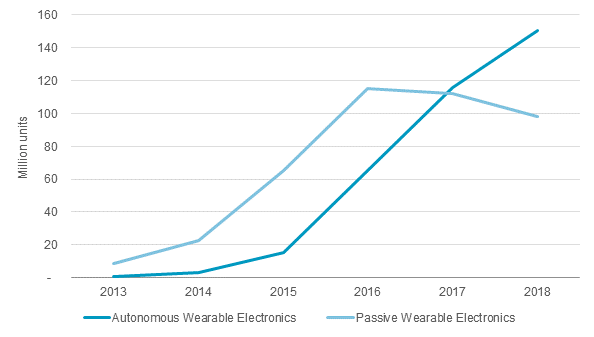
In 2013, wearable electronics on sale were mainly "passive" devices, designed to collect data and relay it to another device for processing such as with health and fitness information.
At the end of 2013, however, the focus turned to "autonomous" wearable electronics that can be used for a range of tasks, include a built-in processor and have the ability to install apps.
Examples of these "autonomous wearable electronics" include the Sony SmartWatch and Samsung Galaxy Gear, already on sale, and Google Glass, expected to be introduced to the general public in 2014. There are also rumours about the possible launch of an Apple iWatch in 2014.
According to Euromonitor International’s Consumer Electronics research, wearable electronics technology is expected to go mainstream in 2016, with a forecast 180 million units sold globally, and 250 million units sold in 2018.
Global Volume Sales of Wearable Electronics by Type: 2013-2018
Source: Euromonitor International
These have significant potential for the travel and tourism industry although mainly with customer service rather than bookings through customer alerts or showing them information on tourist destinations and travel services.
For example, Expedia is currently working on the development of software for Google Glass, even ahead of its release to the general public, focusing on notifications for customers, concerning eg. flight delays and gate numbers.
The TripIt app for the Samsung Galaxy Gear helps travellers conveniently manage their travel itineraries and reservations, as well as check maps and weather conditions.
The Qunar app for the Samsung Galaxy Gear, meanwhile, is mainly focused on customer service, giving travellers access to their flight and hotel bookings, flight statuses and weather conditions, but it does also have booking functionalities, in particular for last-minute hotel deals.
Travellers have been empowered by the rise of online travel over the last years, as it provided them with more information and choice. Wearable technology gives them even more power, offering them "enhanced awareness" of all the information they need to have about their destination and travel services, in real time."


Linsey McNeill
Editor Linsey McNeill has been writing about travel for more than three decades. Bylines include The Times, Telegraph, Observer, Guardian and Which? plus the South China Morning Post. She also shares insider tips on thetraveljournalist.co.uk





















Vegas’s Billion-Dollar Secrets – What They Don’t Want Tourists to Know

Visit Florida’s New CEO Bryan Griffin Shares His Vision for State Tourism with Graham

Chicago’s Tourism Renaissance: Graham Interviews Kristin Reynolds of Choose Chicago

Graham Talks with Cassandra McCauley of MMGY NextFactor About the Latest Industry Research

Destination International’s Andreas Weissenborn: Research, Advocacy, and Destination Impact

Graham and Don Welsh Discuss the Success of Destinations International’s Annual Conference

Graham and CEO Andre Kiwitz on Ventura Travel’s UK Move and Recruitment for the Role

Brett Laiken and Graham Discuss Florida’s Tourism Momentum and Global Appeal

Graham and Elliot Ferguson on Positioning DC as a Cultural and Inclusive Global Destination

Graham Talks to Fraser Last About His England-to-Ireland Trek for Mental Health Awareness

Kathy Nelson Tells Graham About the Honour of Hosting the World Cup and Kansas City’s Future

Graham McKenzie on Sir Richie Richardson’s Dual Passion for Golf and His Homeland, Antigua







 ADS PRO
Global tourism exceeds 1.5 billion travelers announces UN-Tourism
Qatar Airways offers reduced timetable to over 60 destinations
WTTC global tourism reached record economic impact of 11 trillion in 2025
Hands In, UATP join forces for airline multi-card payments
Overseas travelers to the United States declined by 2.5% in 2025