
Cu Chi Tunnels: A journey into Vietnam’s underground war
By Matt Lorenzo
The photographs never quite capture it—those stark black and white images of the Vietnam War that we’ve all seen in history books.
But standing at the entrance to the Cu Chi Tunnels, 90 minutes from Ho Chi Minh City, those grainy memories suddenly explode into vivid, uncomfortable reality.
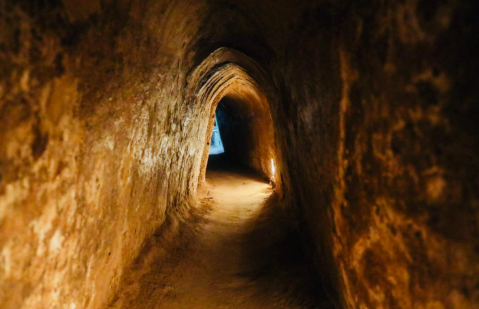
I found myself at the threshold of what can only be described as one of the most remarkable underground networks in military history. Stretching an incredible 255 kilometres beneath the Vietnamese jungle, these tunnels tell the story of how the Viet Cong turned simple hand tools and extraordinary determination into America’s most confounding adversary.
The tunnel system began humbly in the late 1940s as French colonialists pressed their occupation. But it was the arrival of American forces that transformed these modest hideouts into an underground city of stunning complexity.
Armed with nothing more than basic implements, Vietnamese fighters carved out room after room, ingeniously ventilating their subterranean world with bamboo pipes that the Americans mistook for grave markers.
What strikes you immediately is the lethal creativity on display. The infamous booby traps—some fitted with revolving spikes, others designed to catch soldiers at their most vulnerable points—were deliberately contaminated with animal waste to ensure infection. The psychological warfare was as calculated as it was brutal: wounded soldiers’ cries would draw their comrades, only for Vietnamese fighters to emerge ghost-like from concealed entrances and strike again.
Modern visitors can experience a sanitised version of this underground maze, though even that proves challenging enough. The oppressive heat hits you like a wall the moment you drop through one of those camouflaged trapdoors. Within minutes, sweat streams down your face as you crawl through passages barely wide enough for a human body.
I’ll admit it without embarrassment—I took the first exit opportunity available. The claustrophobic conditions are genuinely unsettling, and that’s in tunnels widened for tourist comfort. Imagining entire families spending days underground during heavy bombardments, breathing recycled air through bamboo straws, defies comprehension.
Perhaps most remarkable was the Vietnamese fighters’ psychological understanding of their enemy. They captured American soap and equipment, using familiar scents to confuse tracking dogs into believing they’d found friendly territory rather than enemy positions. They crafted sandals from discarded tires but wore them backwards to misdirect any pursuit.
In underground workshops lit by oil lamps, both men and women risked their lives dismantling unexploded American ordnance to create their own improvised explosives. The irony was brutal—American bombs became Vietnamese weapons in a deadly cycle of repurposing.
The numbers tell their own story. America spent billions on bombing campaigns and sophisticated weaponry yet had no effective answer to an enemy that could materialise from nowhere, strike without warning, and vanish back underground. It was a lethal version of whack-a-mole played across an entire region.
The tour concludes at an outdoor restaurant where visitors can rest and reflect. But peace proves elusive—the sharp crack of AK-47s from a nearby firing range shatters any sense of tranquility. Tourists are invited to purchase ammunition and test the weapons themselves, an opportunity that left me profoundly uncomfortable.
Standing there, listening to those gunshots echo through the same jungle where real battles raged barely five decades ago, the weight of what happened here becomes almost unbearable. This isn’t ancient history—many of the fighters who crawled through these tunnels are likely still alive today.
The Cu Chi Tunnels offer more than historical education; they provide a sobering reminder of human ingenuity born from desperation, and of how the most sophisticated military in the world can be confounded by determination, creativity, and intimate knowledge of home ground.
The black and white photographs suddenly seem inadequate—some experiences demand to be witnessed in full, uncomfortable colour.


TravelMole Editorial Team
Editor for TravelMole North America and Asia pacific regions. Ray is a highly experienced (15+ years) skilled journalist and editor predominantly in travel, hospitality and lifestyle working with a huge number of major market-leading brands. He has also cover in-depth news, interviews and features in general business, finance, tech and geopolitical issues for a select few major news outlets and publishers.




















Vegas’s Billion-Dollar Secrets – What They Don’t Want Tourists to Know

Visit Florida’s New CEO Bryan Griffin Shares His Vision for State Tourism with Graham

Chicago’s Tourism Renaissance: Graham Interviews Kristin Reynolds of Choose Chicago

Graham Talks with Cassandra McCauley of MMGY NextFactor About the Latest Industry Research

Destination International’s Andreas Weissenborn: Research, Advocacy, and Destination Impact

Graham and Don Welsh Discuss the Success of Destinations International’s Annual Conference

Graham and CEO Andre Kiwitz on Ventura Travel’s UK Move and Recruitment for the Role

Brett Laiken and Graham Discuss Florida’s Tourism Momentum and Global Appeal

Graham and Elliot Ferguson on Positioning DC as a Cultural and Inclusive Global Destination

Graham Talks to Fraser Last About His England-to-Ireland Trek for Mental Health Awareness

Kathy Nelson Tells Graham About the Honour of Hosting the World Cup and Kansas City’s Future

Graham McKenzie on Sir Richie Richardson’s Dual Passion for Golf and His Homeland, Antigua







 ADS PRO
Higher departure tax and visa cost, e-arrival card: Japan unleashes the fiscal weapon against tourists
Singapore to forbid entry to undesirable travelers with new no-boarding directive
Euromonitor International unveils world’s top 100 city destinations for 2025
U.S.A. and Israel attacks on Iran impact air movements in the Gulf (Update 1.00pm CET)
Global tourism exceeds 1.5 billion travelers announces UN-Tourism