
Germany’s air travel tax won’t be lowered in 2026 despite Government promises
More reasonable costs for airlines to fly to and from Germany as well as lower taxes to be paid by travelers. The new conservative government Merz had made the promise to act quickly to reduce the burden on air transport in Germany when it took the power last April.
Reducing the rate of the country’s air travel tax—also known as the aviation tax (“Luftverkehrsteuer”)—was seen as a move to ease financial pressure on travelers and the aviation industry. But that relief has now been postponed due to budget constraints.
Priority is given to rearming Germany rather than lowering air taxes
Disappointment about the failed commitment is big in both air transport circles and among German holidaymakers. It is however true that Chancellor Merz coalition agreement had made the tax rollback always subject to available funding.
As the cabinet prepares to finalize the 2026 federal budget, government insiders told the German Press Agency (dpa) explained that “there is no fiscal room for this in the federal budget at present.” Priority goes indeed to the defense budget and infrastructure.
A reversal of the 2024 tax hike would cost the federal government several hundred million euros per year. Officials are still evaluating whether the Ministries of Transport or Economy might be able to absorb those costs; But no concrete plans are on the horizon.
The tax, raised by 19% in May 2024 is one of the highest in Europe. It applies to all passengers departing from Germany. A passenger needs to pay €15.53 for short-haul flights (under 2,500 km); €38.72 for medium-haul flights (up to 6,000 km); and €70.83 for long-haul flights.

German airports and aviation industry groups have expressed sharp criticism, arguing that the high tax continues to put Germany at a competitive disadvantage in Europe. The German Airports Association (ADV) called the decision a missed opportunity to strengthen the country’s aviation hub status.
Aviation Sector Frustrated
“The aviation tax is a brake on growth and burdens passengers, airlines, and airports alike,” said ADV President Ralph Beisel. “Germany risks falling further behind as airlines shift capacity to more competitive locations abroad.”
According to ADV, air traffic in Germany has still not recovered to pre-pandemic levels, and the tax has worsened the recovery. The gap between Germany and neighboring countries is widening—especially compared to Italy, Austria, and Sweden, where governments have recently introduced subsidies, lower fees, or more aviation-friendly tax policies.
Several German airports—including Frankfurt, Munich, and Düsseldorf—have reported declining demand for short- and medium-haul connections as airlines reroute capacity to hubs with lower costs. Lufthansa Group has already shifted part of its growth strategy toward its subsidiaries in Austria (Austrian Airlines) and Switzerland (Swiss). In these countries, operating conditions are more favorable than in Germany.
Berlin is complaining to still not have the expected intercontinental air connections more than 35 years after being again Germany’s capital. Important airports such as Düsseldorf, Hamburg and Stuttgart saw their long-haul network declining over the years, despite being regional economic powerhouses.
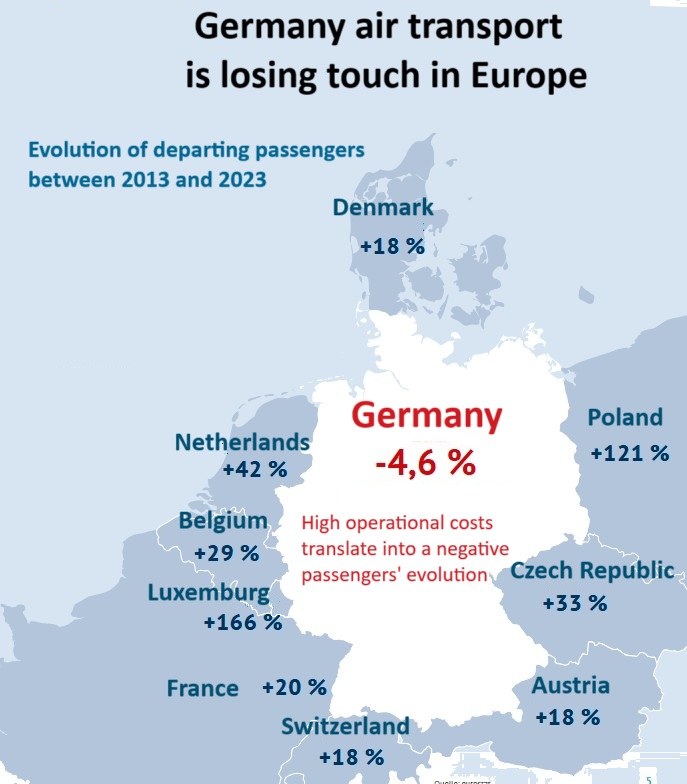
According to a study from the ADV, Germany air transport is lagging behind in its development compared to 2013. Germany is indeed losing its competitive edge and is being set back by a decade.
The continuous increase in regulatory and fiscal costs is increasingly burdening competitiveness and growth prospects. Private and business travelers do not find an offer that meets demand. In 2024, German airports welcomed 211.92 million passengers. It still represented a gap of 15.4% compared to 2019. And it was only 1.9% above 2014 numbers (207.93 million passengers).

Consequences for Regional Airports
Regional airports suffer particularly. With thinner margins and limited international connectivity, many are struggling to attract new routes or retain existing ones. ADV warned that smaller airports could face closure or further cuts to services if passenger volumes continue to decline due to high departure taxes.
For these airports, a reduction in the air travel tax would not only lower ticket prices but could have helped revive point-to-point traffic and attract new low-cost carriers.
The government insists that it is a postponement rather than a cancelling of the tax cut. However, the aviation industry says time is running out. “The longer the government delays, the more Germany loses its relevance as an international air hub,” declared ADV President Beisel.


TravelMole Editorial Team




















Vegas’s Billion-Dollar Secrets – What They Don’t Want Tourists to Know

Visit Florida’s New CEO Bryan Griffin Shares His Vision for State Tourism with Graham

Chicago’s Tourism Renaissance: Graham Interviews Kristin Reynolds of Choose Chicago

Graham Talks with Cassandra McCauley of MMGY NextFactor About the Latest Industry Research

Destination International’s Andreas Weissenborn: Research, Advocacy, and Destination Impact

Graham and Don Welsh Discuss the Success of Destinations International’s Annual Conference

Graham and CEO Andre Kiwitz on Ventura Travel’s UK Move and Recruitment for the Role

Brett Laiken and Graham Discuss Florida’s Tourism Momentum and Global Appeal

Graham and Elliot Ferguson on Positioning DC as a Cultural and Inclusive Global Destination

Graham Talks to Fraser Last About His England-to-Ireland Trek for Mental Health Awareness

Kathy Nelson Tells Graham About the Honour of Hosting the World Cup and Kansas City’s Future

Graham McKenzie on Sir Richie Richardson’s Dual Passion for Golf and His Homeland, Antigua







 ADS PRO
Global tourism exceeds 1.5 billion travelers announces UN-Tourism
Qatar Airways offers reduced timetable to over 60 destinations
WTTC global tourism reached record economic impact of 11 trillion in 2025
Hands In, UATP join forces for airline multi-card payments
Overseas travelers to the United States declined by 2.5% in 2025