
Social networking sites are no real threat to E-mails
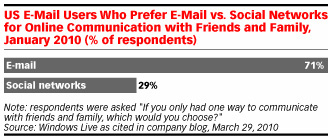
Most of the business houses had predicted that the social networking sites would pose some real challenge to the email usage in 2009 and by 2010 the networking sites would be ahead in terms of popularity as well as usage.
According to a survey report, web users have been found to be using e-mails more than the social networking sites. When it comes to communication, most of the people prefer e-mails to talk to their near and dear ones.
In March 2010, comparisons were drawn among the US users where it was found that almost 71% of the population prefers email in order to correspond with friends and family and only 21% prefers social networking sites to do the same.
 When compared to text messaging, the statistics were far stronger. 52% of the population preferred emails whereas 48% of the people preferred text massaging when communicating with their friends and family.
Although text messaging seems to put up some serious threats to the usage of e-mails, it did not get much attention as it deserves. At this point of time most of the limelight was on the socializing sites which earned adequate popularity but not enough user.
Surveys also suggest that the email have been reported to be given more time compared to the social networking sites. In case of written communication, almost 57% of the internet users use e-mail, another 24% is engaged with texting and just a share of 10% in case of socialization sites.


inertia2





















Vegas’s Billion-Dollar Secrets – What They Don’t Want Tourists to Know

Visit Florida’s New CEO Bryan Griffin Shares His Vision for State Tourism with Graham

Chicago’s Tourism Renaissance: Graham Interviews Kristin Reynolds of Choose Chicago

Graham Talks with Cassandra McCauley of MMGY NextFactor About the Latest Industry Research

Destination International’s Andreas Weissenborn: Research, Advocacy, and Destination Impact

Graham and Don Welsh Discuss the Success of Destinations International’s Annual Conference

Graham and CEO Andre Kiwitz on Ventura Travel’s UK Move and Recruitment for the Role

Brett Laiken and Graham Discuss Florida’s Tourism Momentum and Global Appeal

Graham and Elliot Ferguson on Positioning DC as a Cultural and Inclusive Global Destination

Graham Talks to Fraser Last About His England-to-Ireland Trek for Mental Health Awareness

Kathy Nelson Tells Graham About the Honour of Hosting the World Cup and Kansas City’s Future

Graham McKenzie on Sir Richie Richardson’s Dual Passion for Golf and His Homeland, Antigua







 ADS PRO
Global tourism exceeds 1.5 billion travelers announces UN-Tourism
Qatar Airways offers reduced timetable to over 60 destinations
WTTC global tourism reached record economic impact of 11 trillion in 2025
Hands In, UATP join forces for airline multi-card payments
Overseas travelers to the United States declined by 2.5% in 2025