
The Beltline Arboretum: Atlanta’s green urban oasis
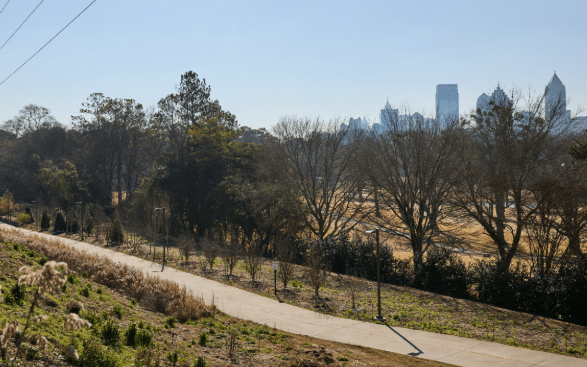
For visitors to Atlanta in need of a tranquil, green escape, the Atlanta Beltline Arboretum is the answer.
It stands as the world’s longest linear arboretum, spanning 12.44-miles of completed trail and connecting more than 45 neighborhoods adjacent to the Beltline.
It serves as a continuous educational and environmental resource enjoyed by millions of visitors each year. The arboretum continues to grow, reaching 16.7 miles of trail by summer 2026, and progresses toward completion of the full 22-mile loop by 2030. It maintains Level II accreditation from ArbNet, an international network of more than 900 arboreta.
This milestone adds to Atlanta’s growing list of distinctions, including the world’s busiest airport, the largest aquarium in the United States and now the world’s longest linear arboretum—a free, gateless public garden.
It further establishes the city as a global destination as it prepares to host FIFA World Cup 2026 matches. More than 16 miles of continuous mainline trail will be complete by the time Atlanta hosts FIFA World Cup 26 matches in Atlanta later this summer.
This new designation as the world’s longest arboretum recognizes two decades of partnership between Atlanta Beltline, Inc., and Trees Atlanta to plant the arboretum along each mile of the 22-mile rail-to-trail conversion from former rail lines.
The Beltline is still under construction and currently more than 13 miles of trail is completed with the 22-mile loop to be completed by 2030.
Along the way, hundreds of thousands of trees, grasses and shrubs have been planted along the trail to create a verdant corridor that highlights Atlanta’s iconic tree canopy.
“As we celebrate our 20th year and prepare to welcome FIFA World Cup 2026 visitors with even more miles of trail, the arboretum highlights how urban redevelopment can showcase biodiversity and ecosystem restoration,” said Clyde Higgs, President & CEO Atlanta Beltline, Inc.
“We’re proud that as we connect more than 45 neighborhoods, we’re doing it not just with trails but also with an ecological corridor of native Georgia plants, creating an urban oasis.”
The 60-acre arboretum links directly to more than 400 acres of parks, 13.6 miles of mainline trail, and 11 miles of connector trails creating a growing network of connected greenspaces often described as an “emerald necklace.”
This trail network expands access to nature and the benefits of trees in the heart of Atlanta for residents and trail users.
This connected network includes parks such as Historic Fourth Ward Park, Perkerson Park, Rose Circle Park, Shirley Clarke Franklin Park, Thomas Taylor Memorial Skatepark, Gordon White Park, D.H. Stanton Park, Boulevard Crossing Park, Enota Park, Piedmont Park, Arthur Langford, Jr. Park, and Adair Park.
Thanks to the partnership with Trees Atlanta, the Beltline Arboretum intentionally prioritizes sustainable landscape management practices focused on urban ecosystem restoration.
The arboretum showcases both native and non-native species to demonstrate trees, shrubs, and plants that can grow in Georgia, including special collections such as a pitcher plant bog, native azaleas, and over 15 cultivars of pawpaw.
A key component of a healthy ecosystem is diversity, and the Beltline Arboretum reflects this with more than 647 unique tree and woody shrub species.
Trees Atlanta has also planted over 700,000 native plants, including grasses and wildflowers, along the corridor.
Trees Atlanta’s engagement on the Beltline also includes regular community projects that allow volunteers to help install plants in the arboretum meadows.
“Trees are iconic to Atlanta’s identity, and Georgia is special in its incredible diversity of plants and trees. Before the Atlanta Beltline Arboretum was created, there was no other arboretum in the city of Atlanta,” said Greg Levine, executive director of Trees Atlanta.
The arboretum features several art collections of interest, including 33 Oaks which shows Georgia’s native oak species. Each of the species is planted on the Eastside Trail interspersed with a striking art installation of each tree’s leaf shape in large polished stainless steel by Atlanta artist David Landis.
This and four other art installations have been donated to the Beltline Arboretum by Trees Atlanta to inspire and support education.
The Beltline Arboretum first was accredited by ArbNet in 2016 and maintains a “Level II” status, which the organization uses to recognize institutions with significant plant collections and professional arboricultural capacity.
Guided, free walking tours of the Atlanta Beltline Arboretum are available through Trees Atlanta.
Trees Atlanta headquarters also is located on the Atlanta Beltline Southwest Trail.


TravelMole Editorial Team
Editor for TravelMole North America and Asia pacific regions. Ray is a highly experienced (15+ years) skilled journalist and editor predominantly in travel, hospitality and lifestyle working with a huge number of major market-leading brands. He has also cover in-depth news, interviews and features in general business, finance, tech and geopolitical issues for a select few major news outlets and publishers.





















Vegas’s Billion-Dollar Secrets – What They Don’t Want Tourists to Know

Visit Florida’s New CEO Bryan Griffin Shares His Vision for State Tourism with Graham

Chicago’s Tourism Renaissance: Graham Interviews Kristin Reynolds of Choose Chicago

Graham Talks with Cassandra McCauley of MMGY NextFactor About the Latest Industry Research

Destination International’s Andreas Weissenborn: Research, Advocacy, and Destination Impact

Graham and Don Welsh Discuss the Success of Destinations International’s Annual Conference

Graham and CEO Andre Kiwitz on Ventura Travel’s UK Move and Recruitment for the Role

Brett Laiken and Graham Discuss Florida’s Tourism Momentum and Global Appeal

Graham and Elliot Ferguson on Positioning DC as a Cultural and Inclusive Global Destination

Graham Talks to Fraser Last About His England-to-Ireland Trek for Mental Health Awareness

Kathy Nelson Tells Graham About the Honour of Hosting the World Cup and Kansas City’s Future

Graham McKenzie on Sir Richie Richardson’s Dual Passion for Golf and His Homeland, Antigua







 ADS PRO
Higher departure tax and visa cost, e-arrival card: Japan unleashes the fiscal weapon against tourists
Singapore to forbid entry to undesirable travelers with new no-boarding directive
Euromonitor International unveils world’s top 100 city destinations for 2025
U.S.A. and Israel attacks on Iran impact air movements in the Gulf (Update 1.00pm CET)
Global tourism exceeds 1.5 billion travelers announces UN-Tourism