
THE DESTINET PORTAL FOR SUSTAINABLE TOURISM
Thursday, 20 Aug, 2009
0
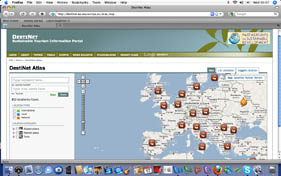
Managing a Climate Change and Sustainable Tourism Learning Area for NTOs
There is a clear need to relate policy on sustainable consumption and production to tourism sector development, and the best way to take on board such a complex process is to create national maps of sustainable consumption and production for the sector.
The DestiNet Portal is tailored specifically to do this job for the tourism sector.
The EEA and their partners have created a knowledge networking and communications system called the DestiNet Portal on Sustainable Tourism for every tourism stakeholder who wishes to get started on working more sustainably. Each region and country can have its own on-line folder in the DestiNet Portal and begin listing the stakeholders and processes that contribute to their green economic order. An existing example of this leading edge sustainable tourism development using ICT comes from the Austria which lists in the DestiNet market-place over 200 certified products and services available nationally.
Of course the trend is spreading all over Europe as countries start branding themselves as green economic champions and tourism sectors take the green marketing initiative. The more the merrier is what is now needed, with a means of quickly transferring what’s working in one country to other EU members.
Regional authorities should be doing the same, as the green economy tends towards the integrated and sustainable regional economic areas.
The DestiNet portal in this case is equally relevant for local and regional authorities to start knowledge networking forums and create their own regional green tourism market places. It is also directed to universities and other learning centres that wish to play a stronger role in regional human potential development and need to link with other administrative departments.
This of course suits the tourism sector perfectly, as tourism thrives on diverse and vibrant national and regional identities, cultures and environmental characteristics. The preservation of these in Europe cannot come a moment too soon.
Herbert Hamele, President of the Ecotrans Network on Sustainable Tourism Development has provided tremendous input in this Type II partnership that the Ecotrans Network on Sustainable Tourism Development has with the EEA, UNWTO and UNEP. Possibly the world’s leading expert on tourism sector certification,
Mr Hamele says:
“DestiNet is a Portal that provides a unifying knowledge networking system for European tourism stakeholders to administer and conduct green tourism business. On the one hand you need an independent public forum that offers quality assessment of the Portal information, and on the other you need to relate this to a Sustainable Tourism Sector Market Place to make the Green Tourism Economy visible to consumers, other businesses and administrators´.
Gordon Sillence as a DestiNet executive partner believes that the WSSD Sustainable Consumption and Production Framework of programmes should be one and the same as the Green economy, but much improved as a model by the merging and transfer of current programmes and good practice that has been occurring since 2002. He has been part of the DestiNet Portal development team and says that this is the current version of the Portal shows that it really is finally the tool to do this job:
´The large-scale socio-economic system of Agenda 21 requires highly developed IT architecture to truly enable the multi-stakeholder coherence that is needed to learn about, initiate and administer sustainable tourism development in a global market place. The application of cutting–edge ICT as used in the European Environment Agency’s Envirowindows programme and found in DestiNet`s new Atlas technology is the sort of breakthrough web development that, by taking a territorial, human know-how approach, now puts multi- stakeholder knowledge networking on a local to global basis in the hands and heads of all European tourism stakeholders.”
THE ETC NTO CLIMATE CHANGE & SUSTAINABLE TOURISM NETWORKING STRATEGY USING THE DESTINET PORTAL
NTO`s and other tourism stakeholders should ensure that they establish time to learn first of all the value system of what it means to be sustainable in their work practices. A change in personal value system will come out as a green dot when mapping sustainable consumption and production processes.
Based on the results of the San Marino process, the ETC networking strategy on climate change and sustainable tourism that will be launched at the UNWTO-ETC Symposium to be held in Gothenburg on September 14th -15th.
It has been divided into a 10 Step process that will act as guidance for each NTO to make use of expert and best practice knowledge being transferred at the global and European level.
DestiNet has become the home of the European Travel Commission’s Climate Change and Sustainable Tourism Learning Area for NTOs. National Tourism Organisations are being mapped on DestiNet and linked to visiteurope.com, this will enable NTOs to create easy to find showcases for their green products and services.
10 Step post-Gothenburg Networking Process for NTOs to link into the development of the Global Green Economy
1. Joining in the Global & European Information and Networking Processes
- UNWTO
- UNEP
- EEA
2. Forming/Joining a Global & European-level Partnership/network to Establish a Tourism and Climate Change Learning Area:
- Understanding Climate Change – Being Part of a Stakeholder Knowledge Network of Information
- Mapping the Green Economy with Tourism in Mind – a Journey Towards Sustainable Production and Consumption
3. Forming/Joining a National level Partnership/network to Establish a Tourism and Climate Change Learning Area at country level
- Contributing to the global picture with national maps
- Establishing/Joining in a National Networking Process
- Key stakeholders:
- Ministry of Environment
- Ministry of Tourism (Economy)
- Academic Body (ies)
- Tourism Businesses & Associations
- Consumer Groups
- NGOs
4. Establishing an information exchange system
- Mapping the Partnership with the DestiNet Sustainable Tourism Portal
- Establishing Information Exchange Protocols
- Establishing Supply Chain Information Distribution Channels
- Associations of:
- Accommodation & Restaurant Owners
- Tour Operators
- Travel Agents
- Transport operators
- Tourism Activities
- Other Tourism Supply Chain Product/Service Providers
5. Establishing Territorial (regional & local) Climate Change and Tourism Information Networks
- Working with Destinations to Establish Destination-level Networking of Information Through:
- Accommodation & Restaurant Owners
- Travel Agents
- Transport operators
- Tourism Activities
- Other Tourism Supply Chain Product/Service Providers
6. Definition of Structure and Content of Climate Change and Sustainable Tourism PortalTopics
· Stakeholders
· Projects
· Events
· News
· Publications
· Research
7. Induction Process for National Tourism Organisations
· How to use the information system
· Model plan of action at the national level
8.
Tiime-Tabling
Linking into other processes:
- Copenhagen Process
- WTO December Conference
- Aalburg Conference
- Brighton Conference
- European Environment Agency
- UNWTO Sustainable Tourism Development – Climate Change Information Network
- UNEP Climate Change and Tourism Green Passport Programme
- UN Sustainable Tourism Task Force – Global Observatory on Sustainable Tourism (GOST)
9. Resourcing the Strategy
· Linking in to SCP business and funding opportunities
A Handbook: Innovation in tourism: How to create a Tourism Learning Area is available from DG Enterprise, details the methodology of how to set up thematic knowledge networks that is being applied in the ETC.
LINK TO DOWNLOAD: ec.europa.eu/enterprise/services/tourism/studies_and_publications.htm


Valere













Vegas’s Billion-Dollar Secrets – What They Don’t Want Tourists to Know

Visit Florida’s New CEO Bryan Griffin Shares His Vision for State Tourism with Graham

Chicago’s Tourism Renaissance: Graham Interviews Kristin Reynolds of Choose Chicago

Graham Talks with Cassandra McCauley of MMGY NextFactor About the Latest Industry Research

Destination International’s Andreas Weissenborn: Research, Advocacy, and Destination Impact

Graham and Don Welsh Discuss the Success of Destinations International’s Annual Conference

Graham and CEO Andre Kiwitz on Ventura Travel’s UK Move and Recruitment for the Role

Brett Laiken and Graham Discuss Florida’s Tourism Momentum and Global Appeal

Graham and Elliot Ferguson on Positioning DC as a Cultural and Inclusive Global Destination

Graham Talks to Fraser Last About His England-to-Ireland Trek for Mental Health Awareness

Kathy Nelson Tells Graham About the Honour of Hosting the World Cup and Kansas City’s Future

Graham McKenzie on Sir Richie Richardson’s Dual Passion for Golf and His Homeland, Antigua







 ADS PRO
Clearing CSS/JS assets' cache... Please wait until this notice disappears...
Updating... Please wait...
Global tourism exceeds 1.5 billion travelers announces UN-Tourism
Qatar Airways offers reduced timetable to over 60 destinations
WTTC global tourism reached record economic impact of 11 trillion in 2025
Marginal increase for New York City tourism in 2025
Hands In, UATP join forces for airline multi-card payments