
Rail is on average 2.5 times more expensive than flying in France

Traveling by train in France can be significantly cheaper than flying—but only when a direct rail link is available. This is the conclusion of a new study published by French consumer advocacy group UFC-Que Choisir, which compared the lowest available prices on 48 of the country’s busiest domestic air routes.
According to the report, train fares are on average 40% cheaper than airfares when a direct rail connection is available.
However, when travelers must make one or more transfers, train prices actually rise—becoming 10% more expensive than flying. The lack of seamless rail options across French regions leads to a near doubling of average fares: €113 for non-direct routes, compared to €64 for direct ones.
One striking example is the rail route between Nantes and Marseille, where the cancellation of a direct rail service in 2020 coincided with an 11% increase in air traffic. The route now sees more than 400,000 air passengers annually, making it France’s leading domestic air corridor.
France-Europe rail fare on average 2.5 times more expensive than an air fare
The disparity is even more pronounced on international routes. A forthcoming report by Greenpeace, covering 21 popular France-Europe travel corridors, found that rail tickets are on average 2.5 times more expensive than air when weighted by passenger volumes. For example, on the Paris–Rome route, airfares average €70, while the equivalent rail fare can reach €210.
Greenpeace also found extreme pricing gaps on some days: a €15 flight from Marseille to London, while the cheapest train ticket was €188.
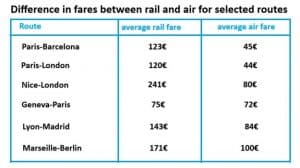
Environmental think tank Carbone 4 analyzed costs for the Paris–Barcelona route and attributed the imbalance to two main structural issues:
-
Tax breaks for airlines, including exemptions from kerosene tax and 0% VAT on international flights, which effectively subsidize air travel by €30–€40 per passenger.
-
High rail tolls, which account for over half of SNCF’s operating costs on certain cross-border lines.
The Climate Action Network is now calling for a rollback of aviation tax exemptions (excluding overseas territories) and a redirection of funds toward rail improvements. Their proposal would finance three key initiatives:
-
A subsidized annual round-trip train ticket at €29 per person, updating the 1936 “vacation ticket” introduced by France’s first socialist government called “Front Populaire”.
-
A revival of night train services, focusing on under-served regional and international routes (e.g. Marseille–Nantes, Paris–Barcelona).
-
Reduced rail tolls for TGV services, particularly on international and cross-regional lines.
As the climate crisis intensifies and public scrutiny of carbon-intensive travel grows, campaigners argue that pricing structures must better reflect environmental impacts—and that rail must be made both affordable and accessible across France and Europe.
Related News Stories: Great Rail Journeys acquired Take To The Tracks With Leger Holidays' Rail Holidays! - TravelMole Luxembourg almost without rail services over the summer Berlin–Hamburg rail upgrade to cause 9-month passenger disruptions China Railway to offer its largest timetable to date from July 1 DTH Travel offers exclusive Thailand train journey Trenitalia boots rail competition between Paris and Marseille Rail Archives - TravelMole Get Ready for New Orleans to Mobile Train - TravelMole SkyTeam Airline Alliance | Official Website


TravelMole Editorial Team




















Vegas’s Billion-Dollar Secrets – What They Don’t Want Tourists to Know

Visit Florida’s New CEO Bryan Griffin Shares His Vision for State Tourism with Graham

Chicago’s Tourism Renaissance: Graham Interviews Kristin Reynolds of Choose Chicago

Graham Talks with Cassandra McCauley of MMGY NextFactor About the Latest Industry Research

Destination International’s Andreas Weissenborn: Research, Advocacy, and Destination Impact

Graham and Don Welsh Discuss the Success of Destinations International’s Annual Conference

Graham and CEO Andre Kiwitz on Ventura Travel’s UK Move and Recruitment for the Role

Brett Laiken and Graham Discuss Florida’s Tourism Momentum and Global Appeal

Graham and Elliot Ferguson on Positioning DC as a Cultural and Inclusive Global Destination

Graham Talks to Fraser Last About His England-to-Ireland Trek for Mental Health Awareness

Kathy Nelson Tells Graham About the Honour of Hosting the World Cup and Kansas City’s Future

Graham McKenzie on Sir Richie Richardson’s Dual Passion for Golf and His Homeland, Antigua







 ADS PRO
Global tourism exceeds 1.5 billion travelers announces UN-Tourism
Qatar Airways offers reduced timetable to over 60 destinations
WTTC global tourism reached record economic impact of 11 trillion in 2025
Hands In, UATP join forces for airline multi-card payments
Overseas travelers to the United States declined by 2.5% in 2025